
Condition monitoring
Using machine data with eyes and ears
Condition monitoring of networked systems is challenging. The sensor and information fusion methods of inIT allow simple automatic monitoring of the health status of technical systems.
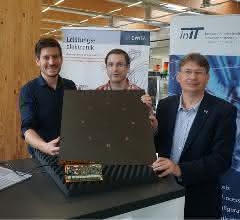
Several hundred electric drives and many thousands of sensors - condition monitoring of complex, spatially distributed and networked machines and systems is becoming increasingly challenging and has long since ceased to be satisfactorily accomplished using conventional methods. Scientists at the Institute for Industrial Information Technology (inIT) at OWL University of Applied Sciences are providing a remedy: Innovative sensor and information fusion methods allow automatic monitoring of the health status of technical systems of all kinds.
"Many cooks may spoil the broth, but this does not apply to the automatic condition monitoring of complex machines and systems," explains Professor Dr. Volker Lohweg, Institute Director at inIT and expert in the field of sensor and information fusion. "The inclusion of many different data sources, including not only sensors and actuators but also process data from the databases of the plant operators' ERP and MES systems, is essential in order to record the current status of modern technical systems."
In doing so, the researchers at inIT make targeted use of data that is actually superfluous - the so-called redundancies that arise due to the use of many different data sources. Redundancies are used profitably to determine and reduce conflicts in the statements of the individual data sources, for example in different machines along a production line. Conflicts are a sign that the statements of one or more data sources do not match the statements of the others. There are many reasons for this and can, for example, indicate incorrect parameterization or a defect in various sensors.
Research in the "ReWork" project
A current research project at inIT in the field of sensor and information fusion is the "ReWork" project. Focusing on the production of components for the aviation industry, the project is developing solutions to optimize production processes and, in particular, to reduce waste during repairs to aircraft wings and other components.
"The production of aircraft components is highly complex and requires maximum accuracy and precision in order to avoid material damage or breakage during flight and thus disasters," explains Lohweg. The quality control of industrially reworked components is essential, but cannot be effectively implemented with currently available techniques such as ultrasonic testing technology or X-ray inspection.
A new process for automated quality control has therefore been developed at inIT with partner Owita. Using an imaging process, sensors generate a kind of network of wave-shaped signals ("lamb waves") on the aircraft parts to be inspected and measure repair areas on the components. The measurement signals are evaluated automatically by computer-controlled algorithms that use the transmitted sensor information to assess and monitor the quality of the reworking and ultimately pass it on to the user.
"The sensor and information fusion ensures an increase in process reliability and holistically optimizes the individual steps along the process chain," says Lohweg, summarizing the benefits of the project. as


You might also be interested in
The AKIMI Research Project at WZL
Agent-Based AI Aims to Simplify Robotics for Small and Medium-Sized Businesses
The AKIMI research project is developing an agent-based AI designed to significantly simplify the setup, programming, and reconfiguration of robotic systems for small and medium-sized enterprises. The goal is to make robotics more flexible and...
 read more...
BS Rollen Strengthens Its Presence in North Rhine-Westphalia
With the groundbreaking ceremony, BS Rollen is launching the construction of a new company facility in Hückeswagen. The new building will house administrative offices, an assembly line, and a high-bay warehouse, and is intended to facilitate further...
read more...Intelligent brownfield networking
Many industrial companies are struggling with established plant structures and proprietary interfaces. Stefan Klaus' presentation will show in a practical way how brownfield environments can be efficiently networked with open technologies and made...
read more...Factory-X in practice
How can set-up processes in highly variant production be automated efficiently? Markus Benndorff from soffico shows how Factory-X, industrial data rooms and modular architectures create new possibilities for flexible production concepts.
read more...Mechanical engineering | Case study
Cordless in brush production
The machine manufacturer Wöhler Bohemia is integrating wireless HMI panels from Keba into its brush production systems. The background to this is the need for flexibility, robotics integration and new market strategies.
read more...International product approvals as a strategic competitive advantage in the global market
Which certificates are valid worldwide? Christian Latte, Head of Technical Compliance and Approval Officer at Hummel AG, explains this in an interview. He provides insights into product approvals and explains why early approval strategies shorten...
read more...Foundry modernizes plant park with continuous wire belt shot blasting system
The Spanish foundry Funosa is modernizing its equipment fleet with an RDGE 1250 wire belt continuous shot blasting machine from Rösler. Focus: sand removal from heavy iron castings, energy efficiency, ease of maintenance and ESG strategy.
read more...How bridging steps, stairs and catwalks are changing processes in production and logistics
At Logimat 2026, Munk Günzburger Steigtechnik will be showcasing modular bridging steps, stairs, platform and walkway systems for production, warehousing and logistics. With online configurators, distances can be efficiently shortened, processes...
read more...Drilling cycles optimized
A new replaceable head drill from Walter can reduce machining time in series production thanks to its patented interface and screwless design.
read more...