
Fraunhofer research
Using AI to combat compressed air waste
Most compressed air systems are inefficient. The air escapes from countless leaks; detecting them is difficult. Researchers at the Fraunhofer Institute for Manufacturing Engineering and Automation IPA want to use artificial intelligence to combat waste.
Around 60,000 compressed air systems are in operation in German companies. Together, they consume 16.6 terawatt hours every year, which corresponds to seven percent of the total electricity consumption of domestic industry. "The costs for this could be reduced by up to 30 percent," says Professor Sauer, Head of Resource Efficient Production at Fraunhofer IPA and Director of the Institute for Energy Efficiency in Production (EEP) at the University of Stuttgart.
For him, one of the greatest potential savings is the fact that the vast majority of compressed air systems have so far been inefficient. The reason: they are full of leaks. Holes and kinks in the hoses or leaking connectors: All this is difficult to detect. This is because often not all parts of a compressed air system are easily and safely accessible and the leaks are so tiny that they are very difficult or even impossible to see with the naked eye.
Until now, an ultrasonic measuring device has been used to detect the frequency ranges at which the air escapes, which are inaudible to humans. Most companies only make this effort once a year at most, or simply live with the leaks.
Holes, kinks and leaking connectors
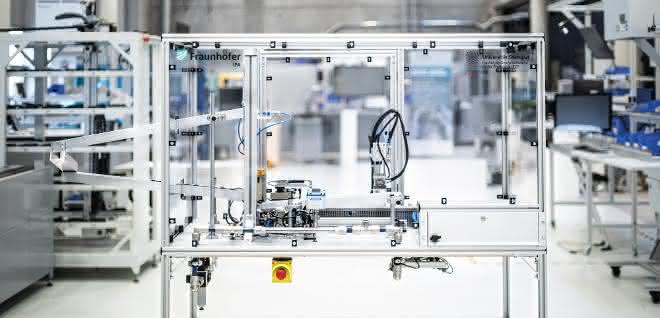
Christian Dierolf and his colleague Christian Schneider want to use artificial intelligence to identify leaks in compressed air systems and put an end to waste. As a first step, the two researchers have set up a demonstration system. In it, the compressed air flows either through intact hoses or through hoses with barely visible holes, kinks and leaking connectors - the most common leaks in compressed air systems in industry.
Whichever path the compressed air takes, it makes no difference to the naked eye: the actuators do their job. However, the demonstrator measures whether the air is flowing through the hoses with more or less pressure, determines the flow rate, the position of the actuators, the status of the valves and records ultrasonic signals.
Demonstrator as a database
All of this is stored synchronously in a cloud. "The demonstrator therefore creates the basis for our data-driven production research, for example by training self-learning algorithms," explain the researchers. These algorithms will later be transferred to industrial applications. There, they will not only detect and localize leaks, but in future will also display the name and order number of the affected component via an app. The person responsible for the compressed air system will then no longer have to search the catalog for a long time. Instead, they can procure a replacement with just a few clicks and thus keep downtimes to a minimum.
"In addition to classifying leaks, the focus of the research is on identifying the actuators present in the machine's compressed air network with minimal measurement effort," says Dierolf. However, like many of the researchers' other ideas, this is still a long way off. The seminar "Intelligent compressed air - identifying potential and increasing efficiency with Industry 4.0 methods" on November 6, 2019 at the Fraunhofer IPA in Stuttgart will show which measures, including with the help of Industry 4.0, can already be used to exploit existing efficiency potential and significantly reduce costs. as


You might also be interested in
ESTIA aims to strengthen Europe's cloud
New tech alliance for EU sovereignty
Twelve companies, including Dassault Systèmes, are founding the European Sovereign Tech Industry Alliance (ESTIA). The initiative aims to strengthen Europe's technological independence and define requirements for sovereign cloud services. The start...
 read more...
Deutsche Telekom and Nvidia launch one of Europe's largest AI factories
With the Industrial AI Cloud in Munich, Deutsche Telekom and NVIDIA are creating one of the largest AI factories in Europe. Companies can train AI models, carry out simulations and access 10,000 GPUs.
read more...Leveraging data potential with AI and streaming
Huge data treasures are still lying dormant in many manufacturing companies. And yet it is high time that these treasures were unlocked. There is often a lack of resources and capacity to make data usable in real time. Streaming production data can...
read more...More awareness of noise
Dematic offers solutions that are tailored to different cloud environments and reduce environmental impact through reduced material consumption and improved energy efficiency.
read more...Generative AI in the automation environment
The mechanical engineering and automation industry is undergoing profound change. This transformation is being driven by more volatile global trade, geopolitical crises and increasing market pressure, which demands greater agility, technological...
read more...Rigid data structures have had their day
The traditional data center is no longer the center of data. A hybrid cloud storage approach enables manufacturing companies to both meet the current requirements of data-intensive processes and future-proof their infrastructure.
read more...Software as a service in three stages
CIM Database Cloud is a new out-of-the-box solution from Contact for end-to-end digital product development.
read more...How production can benefit from AI
Together with AI technology, IIoT networking makes it possible to better control machine parameters and optimize quality with predictive quality. Downtimes and set-up times can also be further minimized. Cloud platforms also make these technologies...
read more...More expertise for digital engineering
Altair, a computational science and artificial intelligence (AI) company, has acquired OmniV, a technology from Michigan, USA-based software company XLDyn.
read more...