

Ultrasonic sensors from ifm
Measure distance safely in dusty environments
Ultrasonic sensors transmit and receive sound waves in a range that is almost imperceptible to the human ear.
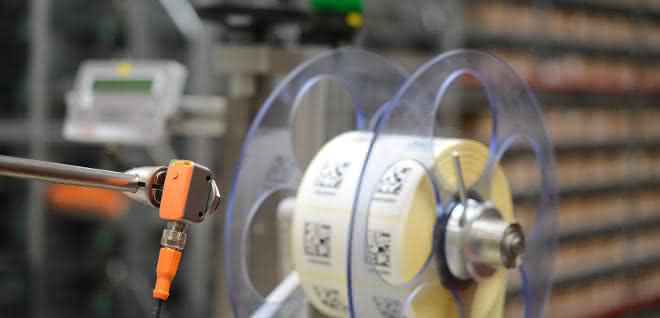
The object to be detected reflects the sound waves and the distance information is determined using time-of-flight measurement. Unlike optical sensors, the color, transparency or gloss level of the object are irrelevant.
Bats show how it's done - they emit ultrasonic waves and orient themselves using the echo reflected by objects in their environment. The underlying principle is time-of-flight measurement. The distance can be calculated from the time that elapses between sending the signal and receiving the echo, taking into account the speed of sound. Ultrasonic sensors have copied this principle from nature and are used for distance measurement in a wide variety of applications.
Functional principle of ultrasonic sensors
Ultrasound refers to sound waves that lie above the frequency spectrum audible to humans - i.e. from around 20 kHz. Frequencies of 40 to 300 kHz are generally used for ultrasonic sensors. The central component of an ultrasonic sensor is the transducer, which consists of a piezo crystal. Applying a voltage causes it to vibrate and emit a sound wave. To measure the distance to the object, a pulse timer switches off the voltage and sets the transducer to receive mode. The reflected sound in turn generates an oscillation in the transducer, which the piezo crystal converts into an electrical signal. The electronics measure the time that has elapsed since the signal was emitted and use this to determine the distance.
Due to the measuring principle, ultrasonic sensors have a blind zone - this means that they cannot detect very short distances. Ultrasonic sensors can work in two operating modes. With probes, the object to be detected reflects the sound waves directly back into the sensor. However, this only works if the object is aligned approximately straight to the sensor, otherwise the sound waves are deflected by the object. If the sound waves are deflected, barriers are used. For this purpose, a reflector is mounted at a suitable distance from the sensor, which reflects the sound waves. The sensor then detects when this reflection is interrupted by an object in the measuring range.
The sound waves generated in the transducer propagate evenly in the form of a sound beam. If the sound waves hit the side walls, this can lead to unwanted reflections and associated incorrect measurements. This can occur, for example, in a typical application - level measurement in a tank or silo. To avoid such incorrect measurements, ultrasonic sensors can be fitted with a so-called sound tube, which narrows the sound beam.
The right sensor for every application
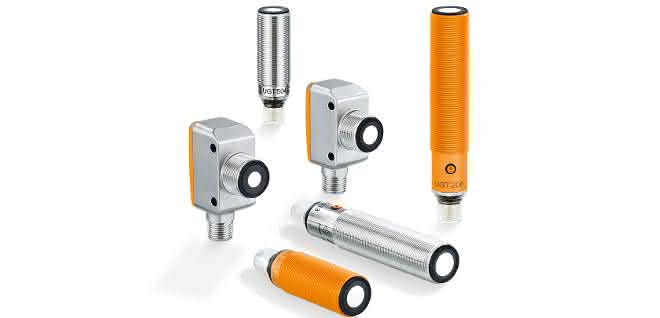
ifm offers an extensive portfolio of ultrasonic sensors in various designs. Round and cube designs are available in plastic or particularly robust V4A housings. The very compact M18 sensors have a small blind zone and scanning ranges of up to 2.2 m, which are otherwise only achieved by sensors in significantly larger designs. With the larger M30 ultrasonic sensors, ranges of up to 8 m are possible. The sensors are set either directly on the device using the teach button or by parameterization via the IO-Link interface.
With the M30 sensors, the sound beam can be changed very easily via parameterization. All ultrasonic sensors are equipped with an IO-Link interface as standard. One of the advantages of this is the digital signal transmission, which can output not only the presence but also the measured distance to an object. IO-Link also makes work easier when replacing a sensor: the parameterization of the old sensor can be transferred directly to the new sensor. This significantly reduces production downtime.
Also for difficult ambient conditions
One of the main advantages of distance measurement with ultrasonic sensors is that the measurement result is not affected by the material properties. Even shiny, colored or textured surfaces do not affect the measurement. Even transparent objects can be reliably detected, where optical sensors often reach their limits. Plastic parts such as blister packs, which are used for many products, are transported to the packaging machine in a packaging line with conveyor belts. These transparent parts can be detected very easily with ultrasonic sensors.
Ultrasonic sensors also master another challenge for optical sensors without any problems - a dusty environment. As a rule, dust does not adhere to the transducer as it is removed by the vibrations during operation. And dust on the surface of the object does not interfere with the sound reflection either. A typical application that generates a lot of dust is a machine in a sawmill that stacks wooden boards. Ultrasonic sensors are used here to detect the height of the stack, and their function is not impaired by the dust.
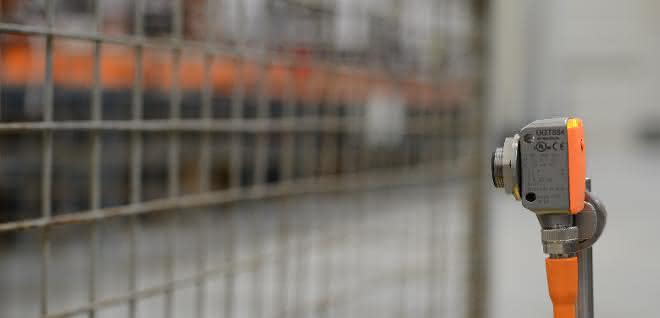
Ultrasonic sensors can do much more than just classic level measurement in tanks or silos. This functional principle really comes into its own in difficult environments with high dust levels or when detecting transparent objects. The IO-Link interface, which is standard on all new sensors from ifm, enables the ultrasonic sensors to be easily integrated into intelligent Industry 4.0 applications.
Stephan Heide


You might also be interested in
Housing and inserts for plenty of power
Lapp presented the expansion of its Epic Power series at SPS 2023: four new M23 circular connector inserts and three new M23 housings. The special feature: all housings can be combined with any of the four inserts.
 read more...
News and product updates from Smartgas
Portable gas analyzers for outdoor use
Smartgas is starting the second half of the year with a series of updates to existing products and a number of new products. Portable analyzers expand the range of applications, while new accessories such as protective housings and heating modules...
read more...Everything accurate in switch cabinet construction
To ensure smooth work processes, tools for processing enclosures and housings must function flawlessly and reliably. Häwa rounds off its punching range with the Multi-Press 500.
read more...Shafts and conversion parts
The Rodriguez range includes ball bushings including matching housings, shaft brackets, crossbars and supports.
read more...Cooling and temperature control units
Hygienic packaging sells safely
In few industries are the requirements for hygiene in the production process as strict as in the food sector - the health of consumers has top priority. This results in enormous challenges for all machines and components involved, especially in...
read more...Simple tool change in seconds
With the CMS, Schunk is launching a user-friendly, manual change system for quick component replacement. In addition to its simple and convenient operation, the CMS also stands out with its extensive range of optional modules and complementary end...
read more...Motion controller for small drives
Medium power range covered
Faulhaber has another housing-less and compact motion controller in its range, which is particularly suitable for integration in device construction and medical technology applications.
read more...Welding solutions in the name of resource efficiency
At the Welding & Cutting trade fair in Essen (September 11-15), Fronius will be focusing on the major drivers in welding technology. Quality requirements are increasing in all industries, but the required welding specialists are scarce. In...
read more...Safe solutions for cable installations
From thick power cables to thin sensor lines, cables and lines must be routed safely through systems and machines. A challenge that should not be underestimated, explains Jörg Sokat, Head of Product Management at Pflitsch.
read more...