

Torque sensors
Transmission-internal sensors
A new torque sensor system for cobots and lightweight robots is integrated into precision shaft gears and, according to the experience of the developers at Schaeffler, enables significantly shorter cycle times. This is easily verifiable and represents significant progress for the widespread use of robotics in industrial automation.
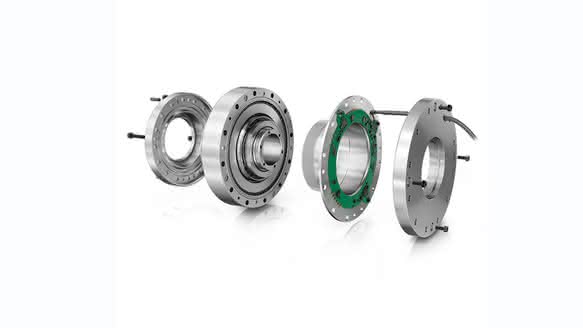
If cobots are to carry out processes sensitively and force-controlled and teaching is to be smooth, it is almost impossible to do without a sensor system to determine the external forces. Sensor modules, i.e. sensors that are developed and offered as stand-alone components for cobots, are mainly used on the cobot market to measure external forces and torques. These require additional installation space and must be structurally integrated into the cobot.
External torque sensor concept
With these sensors, the forces and torques are recorded with the help of an elastic structure to which the actual sensor technology (strain gauge) is usually glued. The design of these sensors is a compromise between high resolution and low deformation. For applications in which the end effector must precisely maintain a path curve or position under load, the position deviation caused by the sensor is a major disadvantage. Specific designs are known as 6-axis force-torque sensors on the end effector or sensor modules flanged to the joint axes.
The Schaeffler developers' approach is not to use an additional elastic element to measure the torques, but an existing component of the drivetrain in the joint. This means that no additional elasticity is introduced into the cobot structure and the rigidity of the cobots is fully maintained even with sensors. What are the advantages of this internal concept?
Stiffness and influence on positioning time
Cobots are at a significant disadvantage compared to industrial robots due to their slim design and consequently their higher elasticity. At higher accelerations, the slim cobot structure vibrates noticeably - especially when positioning with maximum deceleration. What is gained in terms of short cycle times through high speeds and accelerations is lost again through a longer settling time during positioning.
The following factors have a major influence on the natural frequency of cobots:
- the tilting rigidity of the spherical plain bearings or the main gearbox bearings
- the torsional rigidity of the gearbox and
- the torsional rigidity of the torque sensors.
External versus internal torque sensor concept
With external torque sensors, the additional elasticity introduced can reduce the torsional stiffness of a joint to between 25 % and 60 % of the original value. With the concept developed by Schaeffler, the torsional stiffness of the joint remains 100%. The influence of the torsional stiffness of torque sensors on the dynamic behavior of cobots is illustrated by comparing these two concepts in a worst-case scenario. The RT1 precision shaft gearbox from Schaeffler serves as the basis for comparison, once with integrated sensors and once with an external sensor module. In each case, the motor accelerates a mass moment of inertia of 7.6 kgm2 from zero and brakes the drive back to a standstill.
The drive with external sensor module (diagram 1) clearly shows unstable behavior with very large acceleration peaks. In order to improve the dynamic behavior, the control parameters were adjusted in a second simulation. This made it possible to reduce the acceleration peaks, but at the expense of the positioning time. This increases to 1.2979 s (diagram 2). Diagram 3 shows the dynamic behavior of the RT1-T gearbox with integrated torque sensor. The positioning time is only 0.99241 s and is therefore 0.3 s shorter. Even without adjustment of the control parameters, the oscillations subside quickly here.
This simulation was carried out for the axis of rotation of a single joint. Of course, the conditions for six joints with their variable spatial positions of a cobot are much more complex and the effects are much greater. However, the simplified example illustrates the positive influence of torque sensors on the positioning time if they do not reduce the torsional stiffness of the joint.
Properties of the internal torque sensors
Schaeffler has many years of experience in the development, application and series production of integrated torque sensors. The sensor technology known as Sensotect is used successfully in the wind energy and automotive industries, for example. The functionality is realized by a sub-micrometer-thin, strain-sensitive PVD metal coating, which is structured by micromachining. The component itself becomes the sensor and the sensor becomes the component. The flexspline of the precision shaft drive was used for the application in robotics, as it is located directly in the force flow. No additional installation space is required. Adhesives and transfer polymers are not required. Another outstanding feature is the very low hysteresis and linearity deviation, also due to the absence of interference factors. The smallest changes in force and torque are also reliably detected, which significantly simplifies the smooth direct teach-in, operation and self-optimization of cobots.
The sensor element offers an accuracy of <0.5% (full scale), which is an excellent value compared to sensor modules on the cobot market. As the sensor technology is permanently integrated in the RT1 precision shaft gearbox, further influences such as mechanical hysteresis and temperature are added, which ultimately lead to a "sensor+gearbox" system accuracy of <1.5 % (full scale of the repeatable peak torque of the precision shaft gearbox). This distinction must be taken into account when comparing with external torque sensors on the market, which are functional as a unit.
Short positioning times or short cycle times require a particularly rigid cobot structure. The torque sensors integrated by Schaeffler into the precision shaft gearboxes do not affect the mechanical structure of cobots - the torsional rigidity of the rotary axes is fully maintained in comparison to external sensors.
As a further component of the overall solution, Schaeffler developed the double-row angular contact needle roller bearing XZU for the RT precision shaft drive series. It increases the rigidity of the cobot structure transverse to the rotary axes. If XZU bearings are provided in each joint of a cobot instead of the usual crossed roller bearings, a reduction in positioning time of up to 50% can be achieved. With RT1-T precision shaft drives, the speed and acceleration level of cobots can be increased without having to accept long settling times and large amplitudes. Schaeffler is thus opening up a way for the industry to use cobots economically and autonomously in dynamic applications.
Nicolai Hämmerle, Head of Strategic Business Field Robotics, Schaeffler


You might also be interested in
Hamburg Regional Court issues preliminary injunction against Elite Robots Germany
In the copyright dispute between Teradyne Robotics and Elite Robots Germany, the Hamburg Regional Court has issued an interim injunction. The distribution of the software and products concerned is prohibited, and there is also a comprehensive...
 read more...
Schunk founds tech spin-off for humanoid robot hands
Schunk is bundling its activities in humanoid robotics by founding its own spin-off at the beginning of January. The aim of the new company is to develop modular humanoid robot hands for industrial applications.
read more...Partnership for humanoid robotics
Schaeffler and Neura Robotics jointly develop humanoids
Schaeffler and Neura Robotics will work together in the future to develop and supply key components for humanoid robots. The systems will also be integrated into Schaeffler's global production network.
read more...Yaskawa at the Automatica 2025
AI meets robotics
At this year's Automatica, everything at Yaskawa revolves around AI-based robotics solutions for the smart factory and beyond. As a trade fair highlight, the manufacturer is presenting its new Motoman Next product concept.
read more...Kassow Robots at the Automatica
7-axle vehicle in action
At Automatica, Kassow Robots will be presenting a wide range of industrial applications for production and logistics tasks that provide new impetus for efficiency and flexibility in industrial automation.
read more...Robotics and automation in six exhibition halls
From June 24 to 27, 2025, Automatica, the trade fair for intelligent automation and robotics, will bring industry and research together in six exhibition halls. Preparations are in full swing.
read more...Interview with Jörg Rommelfanger
Robotics in 25 years
The annual IFR report shows that the number of industrial robots is steadily increasing worldwide. They have already played an important role in ABB's portfolio for decades. In an interview with INDUSTRIAL Production, Jörg Rommelfanger, Head of...
read more...Reliable end effector for cobots
Collaborative robots are now widely used for a wide range of handling tasks. SMC offers three versions of the RMH pneumatic gripper for this purpose; it is compatible with cobots from a total of twelve companies.
read more...7-axis cobots with controller in robot base
With the Edge Edition, Kassow Robots has launched the world's first 7-axis cobots with a controller integrated into the robot base.
read more...