

Bipolar plates of fuel cells
Three leak tests at once
Systems for leak testing modern components for electromobility and hydrogen fuel cells are a key focus of Worthmann Maschinenbau and its subsidiary Maceas.
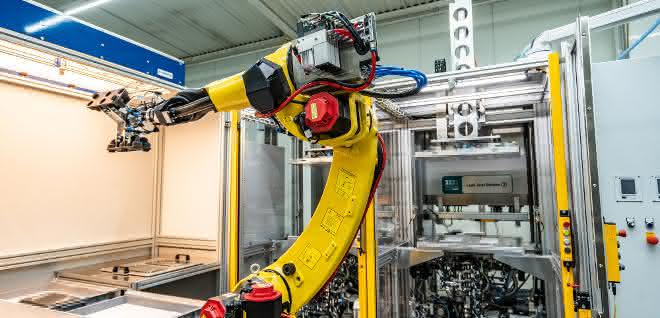
The engineers have now developed and built a new system for the complex testing tasks in the area of fuel cell bipolar plates, which performs the tests on the three circuits directly one after the other. Maceas has solved the challenge of getting to grips with the helium background during testing using the vacuum method by implementing numerous design measures. Another important factor was the new, intelligent I∙Zero software function, which Inficon used to dynamically calculate the background from the measurement data of its LDS3000 helium testing device for the first time.
The importance of bipolar plates in a fuel cell
While battery electric vehicles (BEVs) store the electricity they need in large traction batteries, fuel cell electric vehicles (FCEVs) generate the electricity they use to power their electric motors themselves. This is because FCEVs carry hydrogen in a tank, from which they generate electricity in a galvanic cell - the fuel cell. The controlled reaction of hydrogen and atmospheric oxygen produces only unproblematic water vapor as exhaust gas.
Fuel cell stacks are the heart of fuel cell vehicles. In these fuel cell stacks, hundreds of bipolar plates are often stacked between two end plates, each separated by membrane electrode units. These electrically conductive bipolar plates connect the anode of one cell to the cathode of the other cell. Each bipolar plate is designed with two cavities for the process gases hydrogen and atmospheric oxygen. It also contains an internal high-temperature cooling loop to ensure an optimum process temperature. Hydrogen and atmospheric oxygen are conducted from the cavities of the process gas flow to the membrane of the membrane electrode unit over a large area via a flow field.
Consequences of leakage problems
It is essential for the functional safety of a bipolar plate that the two process gas lines and the coolant circuit are reliably sealed. This is because hydrogen leakage - whether through crossover leaks between the anode and cathode or through overboard leaks on seals - could lead to an uncontrolled reaction with oxygen. If hydrogen enters the cooling circuit, there is a risk of corrosion. The efficiency of the cooling system suffers due to gas bubbles, and there is also a risk of damage to the pump. If, on the other hand, coolant escapes from the cooling circuit, this reduces the efficiency of a fuel cell stack and can damage the fuel cell. To prevent all these failure scenarios, leak tests are required on each individual bipolar plate. All three channels - for hydrogen, atmospheric oxygen and coolant - must be reliably sealed both from each other and from the outside.
Worthmann and Maceas
Since its foundation in 1995, Worthmann Maschinenbau GmbH has been a specialist for
leak testing and automation. The company is based in Barßel-Harkebrügge in Lower Saxony, not far from Oldenburg. Its core competencies lie in helium leak testing and ultrasonic gas bubble detection in water baths. The corresponding business unit operates under the name Maceas GmbH, a wholly owned subsidiary of Worthmann. The specialists at Worthmann and Maceas ensure smooth quality assurance processes in industrial series production with customer-specific automation solutions. The company places a particular focus on the development of sustainable e-mobility - on leak testing tasks in connection with hydrogen and battery technology.
The vacuum method as a starting point
The engineers at Worthmann and Maceas were already working on the technical aspects of bipolar plate leak testing in 2019. At the end of 2020, Maceas then received its first customer order to develop and build a leak testing system for the bipolar plates of fuel cells. The Maceas engineers chose the LDS3000 leak tester from Inficon as the basis for this. Inficon GmbH from Cologne is a global manufacturer of instruments and devices for leak testing. "Tracer gas methods are playing an increasingly important role for us today," explains Daniel Schönbohm, Sales Manager at Worthmann and Maceas. "Our experience with Inficon has been consistently positive.
For many years, we have been using the LDS3000, which is designed for installation in industrial testing systems, for integral leak tests using the helium-vacuum principle. A major advantage of vacuum testing with the LDS3000 is the short cycle times. We use another Inficon device, the XL3000flex, for sniffer leak detection when we need to precisely locate leaks."
The new leak testing system is expandable
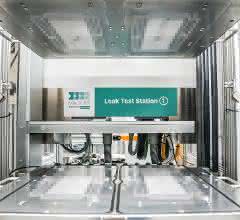
Maceas has designed the new helium leak tester for bipolar plates on a modular basis. A system consists of at least one main module, which also includes a control cabinet and the operating elements. Two bipolar plates are typically inserted into the actual test chamber. With a simple main module, which is mostly intended for small series or prototypes, this is usually still done manually. The test starts at the push of a button and the upper part of the vacuum chamber moves down and seals the two plates. The inlets and outlets of the plates are also sealed so that all relevant volumes can first be evacuated by a vacuum pump and then pressurized with tracer gas as required.
Maceas does not work with pure helium gas here, if only for cost reasons and to keep the helium background to a minimum. The system itself produces a test gas mixture with a helium concentration of only 10 percent. However, in order to be able to test with such a diluted tracer gas, the system must also be ten times more sensitive than when testing with pure helium. The smallest limit leakage rate against which the system can test the tightness of the bipolar plates today is at a helium volume flow of 1 ∙ 10-5 mbar∙l/s with a helium content of 10 percent.
An unexpected helium peak
The natural occurrence of helium in the air already poses a certain problem if you want to use it as a test gas. Helium has a concentration of 5 ppm in the atmosphere. In addition to this natural background, tracer gas may also collect in and around the leak testing system. Evacuating the vacuum chamber and the three test circuits reduces the helium background before the actual measurement. Inficon has also been offering a so-called zero function for some time to automatically eliminate the background from the measurement result. Nevertheless, the developers at Maceas encountered unexpected problems when it came to the helium background. "We didn't have a continuously falling and then stable helium background, but surprising peaks," reports Daniel Schönbohm.
The helium gas was hiding in the system. "These helium sources that were affecting our test were in the dead spaces of the test chamber and also in the tools. To eliminate all these helium sources, we designed new guides, changed the valve technology and also installed larger turbomolecular pumps." In addition to the structural measures on the system, Maceas also benefited from the fact that Inficon was currently working on a new, improved "I∙Zero" software function for the LDS3000.
Dynamically determining the helium background
"This software extension for the dynamic determination of the helium subsurface was currently in the development pipeline at Inficon," reports Schönbohm. "We have a very good working relationship with the application engineers at Inficon. When they heard about our problem, they immediately offered us the opportunity to use the new I∙Zero prototype," Schönbohm continues. "That was also an important element in our fight against the helium underground." The effect of practically all zero functions available on the market has so far been quite limited.
One reason is that conventional solutions simply select a point on the falling curve that describes the helium concentration due to evacuation. This point then serves as the zero point of the measurement. As a result, it is only possible to take meaningful measurements after a comparatively long evacuation phase, particularly in the case of smaller limit leak rates or vacuum chambers with a larger volume - because any leak rate below the defined zero point would otherwise go undetected.
I∙Zero functionaccelerates the test cycle
The major difference of the new I∙Zero function, for which Inficon has already applied for a patent, is that it does not define a fixed helium value as the zero point. Instead, it continuously analyzes the curve at which the helium background falls during evacuation and testing. The algorithm uses the past two seconds to extrapolate the further behavior of the helium background. This makes it possible for the first time to measure leak rates that would otherwise simply disappear in the underground. In other words, process-reliable leak tests are now possible after a significantly shorter evacuation phase.
Throughput and speed increase noticeably. Depending on the test part and the limit leakage rate against which it has to be tested, I∙Zero also makes it possible in principle to design the system for vacuum testing in a slightly less complex way. "However, we had to go to a lot more design effort to test the complex bipolar plates," says Schönbohm. "After all, our system has to test three channels in a row - for their tightness to each other and their tightness to the outside."
Three test procedures in one
Once the two bipolar plates have been inserted into the system, a tool closes around the two plates. This tool itself forms the vacuum chamber for the leak test to the outside. At the same time, its seals and valves allow the relevant channels of the plate to be successively turned into vacuum chambers for the test. After the first evacuation, the cooling channel - the largest area in the plate - is first filled with 10 percent helium in a helium-air mixture at test pressure. The cooling channel is then tested to see whether it is sealed against the air channel, against the water channel and to the outside of the chamber.
The following test of the air duct is about the tightness to the hydrogen duct and to the outside. And in the final test of the hydrogen duct, only its tightness to the outside needs to be tested. This is because any leak rates in metallic components are always identical in both leak directions - so a test in one direction will reveal any leaks in both directions. Before each of the three test procedures, the helium background concentration is always determined using the I∙Zero function in order to keep the cycle times as short as possible.
Cycle times down to 12 seconds
The entire test cycle, consisting of loading the system, the three evacuations and the three test processes, now takes just 48 seconds. "This means that our system effectively tests a bipolar plate in one station every 24 seconds," says Schönbohm. "Each main module can be extended by a secondary module, which doubles the throughput again. We then have an effective cycle time of 12 seconds, i.e. 300 bipolar plates per hour." The modular system can not only be expanded as required, but robot-supported, fully automatic loading is also possible.
Maceas then uses vacuum grippers and a vision system to ensure the correct orientation of the plates. The first customer for the new Maceas helium leak test for the fuel cell bipolar plates was a manufacturer in Sweden, the second was a company in the USA, and the third customer was a German supplier. This third installation involves fuel cells for trucks - and therefore no longer metal bipolar plates, but graphite ones. Their advantage is their longer service life: while metal plates are expected to last up to 10,000 operating hours, graphite plates have a service life of 20,000 to 30,000 hours.
Funded: Testing of tanks with liquid hydrogen
In addition to testing bipolar plates and fuel cells, Maceas is currently also dedicated to testing cryogenic hydrogen tanks. These allow hydrogen to be carried in liquid form at a temperature of minus 253 degrees Celsius. The design principle of such tanks is similar to that of a thermos flask: a multi-walled structure with an insulating vacuum layer prevents the transfer of heat. The project to test these tanks for leaks is being funded by the state of Lower Saxony. Maceas is currently building a test facility in collaboration with a Tier 1 supplier. In order to permanently maintain the deep vacuum in the wall of the tank, tests against limit leakage rates of 10-6 to 10-7 mbar∙l/s are required.
Maceas is once again using an LDS3000 helium leak detector. The new I∙Zero function from Inficon could also prove very useful in this scenario. For Sales Manager Daniel Schönbohm, one thing is certain: "Being able to test faster with I∙Zero is always an advantage from a cycle time perspective." The future belongs to alternative drives. Modern leak testing systems such as those from Maceas enable quality assurance, which is essential for the industrial series production of new drive components.


You might also be interested in
Soft grippers for delicate foods
Irregularly shaped, fragile, and varying in size and weight: products such as potatoes, baked goods, and dairy products push mechanical grippers to their limits.
 read more...
Development Collaboration for Humanoid Robotic Hands Launched
Schunk is entering into a new development partnership with Robert Bosch Robotics. Their shared goal is to develop an industrial-grade robotic hand that can be integrated into various humanoid robot systems.
read more...Robot-controlled packaging of rolls
Koch Robotersysteme, a company specializing in the integration of robotic systems, has developed a complete, automated packaging line for packaging rolls based on Tentoma’s RoRo StretchPack packaging machine.
read more...Robotics and autonomous order picking
Locus Robotics acquires Nexera Robotics and expands autonomous warehouse logistics
Locus Robotics takes over Nexera Robotics and may have taken a decisive step towards truly universal warehouse automation. A new gripping technology should now make possible what was previously considered difficult to automate.
read more...Gentle wheel handling
The newly founded Eisenmann Robotics division develops new robotics concepts to increase the level of automation in modern production facilities.
read more...Gripping systems and vacuum generators
Schmalz is presenting new gripping systems and vacuum generators at Automatica. Exoskeletons, which allow employees to move heavy workpieces effortlessly, will also be on display.
read more...Smart universal gripper for power electronics
The power electronics manufacturer Semikron Danfoss uses the EGU 50 mechatronic parallel gripper from Schunk in a robotic cell. It handles different components and feeds them to a measuring line. With its functionalities, it meets all requirements...
read more...Schmalz takes over finger gripper from Soft Robotics
The vacuum specialist Schmalz is expanding its gripper portfolio and acquiring the mGrip product family from the US company Soft Robotics (SRI), including all finger gripper configurations, patents and the associated know-how.
read more...Soldering with special gripper
In order to make the mini wave soldering of large panels stable and reproducible, Eutect developed a special gripper that prevents the panel from bending, among other things.
read more...