

Additive manufacturing
Test procedure in the test
In comparison, neutrons detect most defects in additively manufactured components.
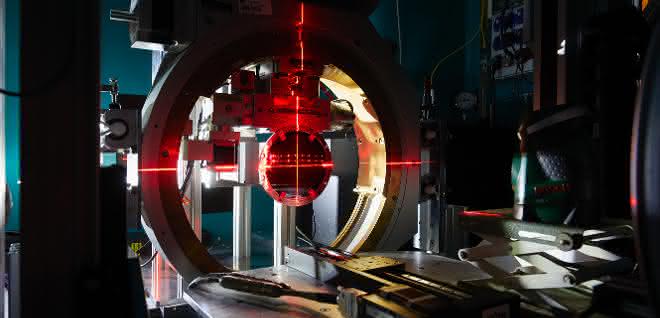
Conventional processes often reach their limits in the manufacture of turbines. Complex components with delicate structures and curved shapes are therefore increasingly being produced using additive manufacturing. Various test methods are used to find defects inside the component. A research team from the Technical University of Munich (TUM) has now tested several methods. The best defect detection was achieved with neutrons from the Heinz Maier-Leibnitz Research Neutron Source (FRM II).
Laser beam melting is a common additive manufacturing process for turbine blades with internal cooling channels. In this process, a laser melts a thin layer of metal powder at certain points. Layer by layer, the component is created in a bed of powder. Like an archaeological excavation, the component is then uncovered and the remaining powder can be reused for the next component.
However, process instabilities can lead to defects in the component and thus reduce the strength of the component. Typical defects are pores and cracks. Individual layers can even become partially or completely detached from one another.
In the case of safety-relevant components such as turbine blades, such defects can have serious consequences. "We therefore have to inspect critical components after the manufacturing process - non-destructively, of course," explains Cara Kolb from the Institute for Machine Tools and Industrial Management at TUM.
A look inside
For their experiments, the researchers produced test specimens with defects of different sizes and depths and attempted to detect them using non-destructive testing methods. They used active infrared thermography (aIRT), ultrasonic testing (UT), X-ray computed tomography (CT) and neutron grating interferometry (nGI).
PhD student Tobias Neuwirth carried out the tests on the ANTARES instrument at the research neutron source. "We test components with neutron grating interferometry. We observe the scattering and absorption of neutrons with spatial resolution. If this changes, it provides information about the type and size of the defects," he explains.
Deeper penetration and better resolution with neutrons
Each of the methods tested has its potential and challenges. Although neutron grating interferometry is complex and more expensive than the other test methods examined, it detects the most and smallest defects of all the methods.
"Neutrons can penetrate deep into the material and enable a high resolution of the inner component structure. They are particularly suitable for nickel-based alloys, which are extremely important for the additive manufacturing of aerospace structural components," concludes Cara Kolb.
Research into test methods that ensure the quality of additively manufactured components in a non-destructive manner is very important. Such test procedures indicate how likely a component is to fail during operation. And with the increasing use of additive manufacturing in aircraft or cars, for example, the test procedures are also becoming more important.


You might also be interested in
Plagiarius 2024 negative prize
On January 26, 2024, the Plagiarius campaign awarded its dreaded "Plagiarius" negative prize for the 48th time to manufacturers and retailers of particularly brazen counterfeits and fakes.
 read more...
Ivalua honors winners of the Generative AI...
AI-supported "add-ons" for buyers within 48 hours
Ivalua, provider of cloud-based spend management solutions, announced the winners and innovations of the first Generative AI Innovation Cup. The competition took place in December 2023. It was open to all Ivalua partners and employees - more than...
read more...Efaflex celebrates 50 years of high-speed...
The emphasis is on "fast"
Since day one, Efaflex has wanted to use new technologies as early as possible and drive progress in the industry. This year, the family business is celebrating its 50th anniversary under the motto "Fast Forward".
read more...Security of supply even during power outages
In the winter of 2022, Germany was worried about energy shortages. The drugstore retailer dm did not paint any horror scenarios, but nevertheless saw the possibility of controlled, temporary, regional power cuts (brownouts).
read more...Safety technology in mechanical engineering
Modules with new functions
Euchner's product highlights at EMO 2023 include the communication-capable solenoid interlocks.
read more...Transforming the paper industry towards climate neutrality
Together with partners from industry and research, Voith is developing a project for the optimization of energy and material flows in paper production. The aim of the research project is to develop a digital framework that enables effective process...
read more...Up to 95 percent less flue gas thanks to direct extraction
The requirements for occupational safety measures and safety technology are also constantly increasing in welding technology. The Technical Rules for Hazardous Substances (TRGS) stipulate that welding fumes and harmful substances must be extracted...
read more...Competitive advantages with large machines
Whether 3D-printed components for machines and systems, prototypes or aids for design: additive manufacturing is almost indispensable for modern companies in mechanical and plant engineering and automation if they want to play in the premier league.
read more...Transport technology from the modular system
Many transport tasks can be realized with the help of linear technology. Pre-configured solutions are available to simplify the interaction between the linear unit, motor, gearbox and controller. This minimizes the effort required for research and...
read more...