
Surface inspection
Flawless paint surfaces
Fully automatic in-line paint inspection. When it comes to surface inspection in the automotive sector, sufficient quality assurance can only be achieved with automatic optical in-line inspection.
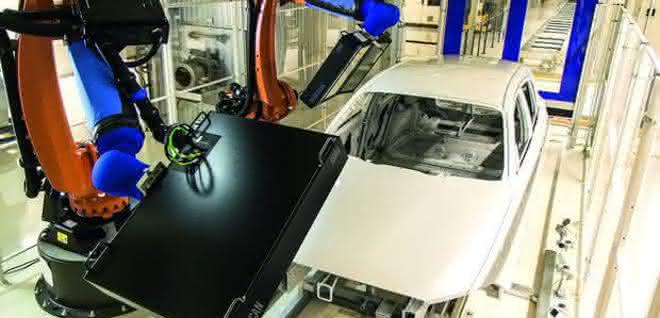
The goal of shorter cycle times in difficult production environments requires efficient and robust testing of paint surfaces. Vehicle production is a role model for many industries and drives the use of new technologies like no other - including in the area of quality assurance. Intelligent robot-guided production and inspection, for example, makes high-end automation technology for paint inspection possible. Complete systems available today - such as Car Paint Vision (CPV) from Isra Vision - combine robotics and surface inspection. Thanks to quick and easy integration of new vehicle types and automatic offline robot path generation, they can be used flexibly. Whether on-the-fly, with continuous conveyance of the vehicle, or in a cycle-based stop-and-go process, the entire relevant surface is inspected inline. CPV ensures an objective and consistent evaluation of the paint surface quality. Isra Vision uses the Paintscan hybrid sensor for this solution, which combines two surface inspection methods. This means that all topographical and non-topographical paint defects are detected. Integrated evaluation units ensure fast surface inspection times and reduce maintenance costs. Data processing takes place in the process cycle; defect information is available immediately. The optional final marking of defects makes reworking simple and time-saving.
The oversampling method ensures seamless paint inspection: a high scanning frequency and overlapping images in the direction of travel capture every point on the body multiple times. Redundant data with up to ten images ensures reliable inspection results with a detection rate of more than 95 percent. All relevant defects - such as inclusions, craters, pigment defects, scratches, dents and dings - are detected and classified. The classification software is already pre-trained. Algorithms enable self-learning defect detection and can recognize line-specific defects. Thanks to its flexible application options, the system is particularly suitable for multi-model lines, as a collision-free robot inspection path is automatically planned on the basis of CAD models. The executing robots do not require an additional linear axis to be moved in line tracking mode.
The inspection data obtained enables sustainable and continuous production optimization. In conjunction with the Enterprise Production Management Intelligence solution ("Promi"), the statistical data obtained is evaluated according to individual information requirements and displayed on dashboards. Thanks to easy-to-use user software, configuration is quick and intuitive. Retrofitting into existing systems is also easy to implement. pb


You might also be interested in
Fraunhofer IOSB Opens Humanoid Robots Lab
The Fraunhofer IOSB is opening a Humanoid Robots Experience Lab in Karlsruhe, Lemgo, and Ilmenau. Companies and organizations can use these facilities to test potential applications for humanoid robots and develop pilot projects.
 read more...
Artificial Intelligence in Manufacturing
Trumpf and IPAI Are Expanding a European AI Network for Industry
The high-tech company Trumpf is an official partner of the IPAI AI network in Heilbronn. Together, the partners aim to exchange experiences, develop new AI applications for industrial use, and advance the development of artificial intelligence in...
read more...Case Study: Networked Manufacturing Platform for Toolmaking
Using a networked manufacturing platform, Escha GmbH & Co. KG, a manufacturer of industrial fastening technology, has comprehensively modernized its toolmaking operations.
read more...Barcelona Declaration on Robotics and...
Robotics Associations Adopt Global Automation Strategy
The global robotics industry is stepping up its collaboration. The associations AER Automation, A3, IFR, and VDMA Robotics + Automation have formed a long-term alliance by signing the “Barcelona Declaration on Robotics and Automation 2026.” The...
read more...Jane Heffner is the new president of the International Federation of Robotics
Jane Heffner is the new president of the International Federation of Robotics. Adrien Brouillard has been appointed vice president of the global federation.
read more...Greater Transparency in the Robotics Market
RoboFinder Launches as an Independent Comparison Platform
Launch at Gitex Europe: 'RoboFinder' aims to bring more transparency to the professional service robotics market. In this interview, founder and CEO Brian Engels discusses market potential, challenges, and the goals of the new platform.
read more...Artificial Intelligence for the Physical Space
Alibaba Expands Qwen Model Family with a Robotics Suite for Physical AI
Alibaba is expanding its Qwen model family with a robotics suite for Physical AI. The three models—for manipulation, navigation, and simulation—are designed to assist autonomous robots with complex tasks in real-world environments.
read more...International Federation of Robotics
U.S. Robotics Industry Sees Double-Digit Growth
In the U.S., sales of industrial robots rose by 11% compared to the previous year: 38,000 units were newly installed in 2025. This significant recovery is driven by robust growth in the food industry and other non-manufacturing sectors. However, the...
read more...Development Collaboration for Humanoid Robotic Hands Launched
Schunk is entering into a new development partnership with Robert Bosch Robotics. Their shared goal is to develop an industrial-grade robotic hand that can be integrated into various humanoid robot systems.
read more...