
Sensor duo
Faster together
The enhanced version of a proven sensor and a new four-camera sensor solution with top speeds in scanning and data processing now take the fully automatic "reach into the box" to the next level of performance.
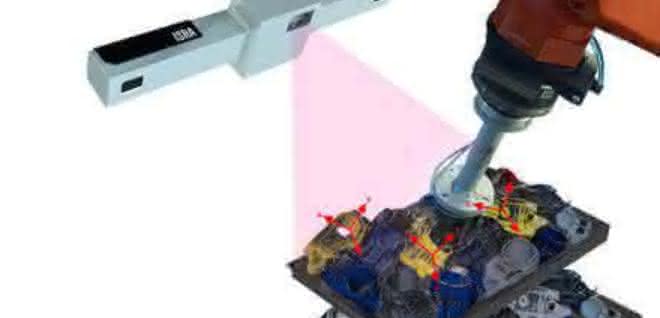
The two sensors for the fully automatic "reach into the box" extend the successful Intellipick 3D products from Isra Vision. Particularly robust and with high speed, the two sensors meet even difficult production requirements such as harsh environments and the shortest cycle times. Equipped with embedded technology, WLAN and the OPC/UA communication protocol, they are also optimally equipped for networked production. With the embedded PC, the design of both sensors eliminates the need for extensive cabling between the camera and PC, allowing data transmission to achieve maximum speed.
The newly equipped Intellipick-3D-Pro is suitable for difficult lighting conditions with its multi-line laser illumination and optional software extensions. It has been specially designed for the most demanding challenges on production lines. The laser illumination enables detailed image capture with a high depth of field, even at large distances from the container, in incident ambient light and under harsh conditions. Parts as small as 15 millimetres are reliably detected and gripped, even in complex positions. The system detects dirty surfaces as well as shiny or matt components. Collision avoidance automatically plans the optimum gripping path and enables trouble-free operation. Thanks to a software extension, the system tolerates different container positions and types.
With quad-camera technology, the Powerpick-3D achieves new top speeds for scanning times in the millisecond range. For this multi-stereo process, four integrated cameras capture the components to be gripped in the container. Powerpick-3D automatically creates an optimized gripping sequence and calculates the corresponding robot paths. As various camera angles are available thanks to the quad-camera equipment, the sensor's multi-view images remain reliable even if there are shadows in the sensor's field of vision or light reflections on the component surfaces.
All bin-picking solutions are based on point cloud technology, which enables them to fully capture the objects inside a container. The various sensors extract the components to be picked from this - initially unstructured - information using a CAD template. As the system learns new part geometries quickly and efficiently using a CAD data set, the number of components that can be detected is virtually unlimited. pb


You might also be interested in
Basler acquires 76% of Indian image processor
Basler, supplier of image processing components for computer vision solutions, has acquired 76% of the Indian sales partner Alpha TechSys Automation.
 read more...
Process monitoring and fault detection
Cameras ensure quality during laser melting
Powder bed-based laser melting (PBF-LB/M) opens up new possibilities in additive manufacturing. Modern camera systems provide crucial process data to further increase quality and efficiency.
read more...Vision Sensor is three times faster than its predecessor
The 'CS-62' vision sensor from di-soric is around three times faster than its predecessor, the 'CS-60'. In combination with the 'nVision-i 25.1' software, it enables image processing solutions that were previously reserved for smart cameras.
read more...Thermal imaging cameras for quality control
Automated thermal imaging cameras are often suitable for quality control applications where temperature plays a role. However, while there are various solutions on the market for slow processes, it is challenging to select a camera that reliably...
read more...Easy entry into industrial VGA thermography
Reliable temperature measurement is a prerequisite for the success of many industrial processes. Berlin-based manufacturer Optris presents the Xi 640 infrared camera, a new member of its Compact Line, which enables non-contact temperature...
read more...Powder bed-based laser melting optimized
Aconity3D has set itself the goal of optimizing the stability of the manufacturing method of powder bed-based laser melting and thereby promoting its use in a wide range of industries. By using high-speed industrial cameras from SVS-Vistek, the...
read more...INDUSTRIAL Production Products of the year...
2nd place, category handling, assembly and production logistics: SICK
safeVisionary2 is the first 3D time-of-flight camera with Performance Level c safety certification. It enables safe three-dimensional environmental detection and won 2nd place in the competition for Product of the Year 2024 in the handling, assembly...
read more...Nomination Products of the Year 2024
SICK: Camera systems safeVisionary2
safeVisionary2 is the first 3D time-of-flight camera with Performance Level c safety certification. It enables safe three-dimensional environmental detection and has been nominated in the 2024 Product of the Year competition in the handling,...
read more...AI vision brings additional opportunities
The seamless integration of AI into the consumer sector has helped to improve our quality of life and make interactions with technology more efficient. In industry, AI vision with machine learning opens up new possibilities that are not covered by...
read more...