

Industrial image processing
Seamless all-round view
The imaging of rotationally symmetrical objects for quality control in industry was previously prone to errors. A new system with four cameras ensures significantly higher process reliability in image processing.
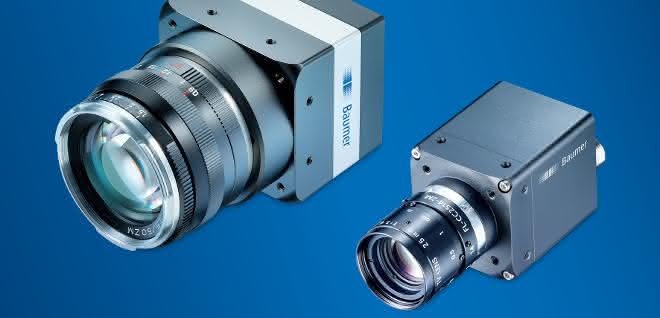
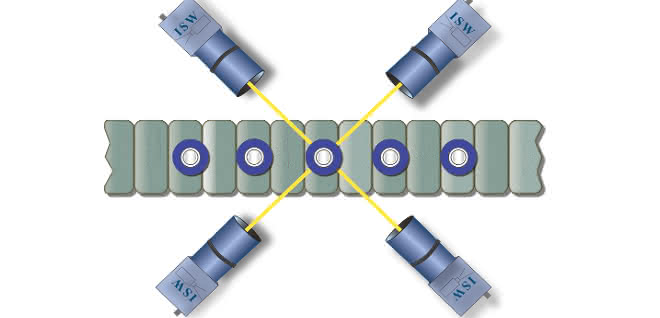
In the pharmaceutical, food and beverage industries, products must be inspected precisely in order to meet the high requirements. For the inspection of rotationally symmetrical objects, Industrielle Sensorsysteme Wichmann (ISW) has developed a new solution with four industrial cameras from Baumer's CX series, whose simultaneously captured images provide a complete picture of a product.
Rotationally symmetrical objects - this term covers many everyday products. For example, spray cans, ampoules or cans, i.e. objects that can be completely imaged if they are rotated around their own axis. They are often found in cylinder form in the pharmaceutical sector and in the packaging industry for food and beverages. Sensitive industries in which it is important to closely monitor the quality and safety-related issues, some of which are prescribed by law, in order to reliably detect possible damage to screw connections, deformation of the packaging, missing spray nozzles or missing labels or even incorrect contents.
New solution for an old problem
Current approaches to checking rotationally symmetrical products concentrate on rotating them once around their own axis on a defined path at a constant speed and with an exact exposure time in front of a camera. The image is then checked using image processing. "The seam areas between the individual images are often unclean, so that in some cases only serial defects, i.e. defects across several products in one stream, can be detected," explains Stefan Tukac, authorized signatory at ISW. However, the engineers at ISW wanted a 100 percent inspection that would also reliably detect one-off product defects while remaining in the production cycle. Six months later, the new inspection system called "4ninety" was ready. The system covers 90° of the circumference of a round body with four cameras. "Exactly the 360°, which also includes unwinding," says Tukac. The four individual images are combined and evaluated by the software without overlapping to form an overall image.
ISW's approach is simple and can be integrated into existing production processes with little effort. The inspection cell can be positioned above any conveyor belt. With the help of various axes, cameras and lighting can be adapted to different conveyor belts and products. Once positioned, aligned and set up on the software side, the system takes on a wide range of inspection tasks. The shapes of products can be checked, for example for integrity, dimensional compliance or lid placement. However, the presence and position of features such as the correct placement of labels and the inspection of applied 1D and 2D codes or texts (OCR/OCV) are also possible. "Our standard library consists of several thousand fonts. This allows us to assign clear customer fonts to our standard fonts for reliable readability," explains Tukac. By simply defining fixed threshold values, faulty products can be sorted out based on the measured deviations in millimetres or degrees. For label detection, ISW relies on a grayscale and contour algorithm that compares the recorded labels with a master. If there are any differences, the product is ejected.
The heart of image processing
The heart of the inspection system lies in the software-based image processing. The basis for this is the acquisition of very good quality images. "We rely on Baumer cameras from the CX series, with which we have very good experience in terms of reliability and compatibility with our software routines," says Tukac. Four 5-megapixel CX.I cameras with Sony Pregius IMX264 sensors are used. Polarization filters suppress reflections on the products caused by the lighting. The modular tube system patented by Baumer additionally protects the camera and lens against dust, for example. At the same time, protection class IP 65/IP 67 is achieved. Combined with the hard-anodized surface, the cameras are thus equipped to withstand the cleaning often required in food environments. "In addition to the standard-compliant GigE Vision interface, the cameras are also bright, deliver low-noise images and impressed us with their fast, reliable image transmission," adds Tukac.
With their high image quality, they are suitable for detecting small deviations and correct seam formation between the individual images. Know-how also lies in the computing power. "Back-calculating the four individual images, each with a resolution of 5 megapixels, into one plane and calculating the seams is very processor-intensive," says Tukac. ISW solved this with a powerful computer, multithreading, a very good graphics card for outsourcing computationally intensive operations and clever programming. For products with multiple labels and strong light-dark contrasts, the system can also be operated with four LXG models with a resolution of 4 megapixels and HDR function.
"We have been offering our system on the market since 2019. Our existing customers from the pharmaceutical and packaging industries are completely satisfied," says Tukac. However, the potential is even greater due to its broad applicability. Because not only cylindrical objects, but also other geometric shapes can be checked with 4ninety. "An adjustment in the software is sufficient here so that we can compensate for possible imaging errors due to the object geometry," says Tukac, giving an outlook.
Nicole Marofsky, Marketing Communication, Baumer / am


You might also be interested in
Further simplify assembly processes
In addition to the proven racks with a length of one meter, Wittenstein alpha now offers optional two-meter racks for linear systems. They are particularly suitable for use in short axes, for example, in order to simplify assembly even further.
 read more...
Hiwin manufactures its own shaft gearboxes
Have you ever waited several months for an urgently needed corrugated gearbox? Hiwin has too. That's why the Offenburg-based drive specialist has decided to produce its own space and weight-saving reduction talent.
read more...Human-robot interaction at the trade fair
Sumitomo Drive Technologies is presenting its drive solutions for automation and robotics at Automatica 2023 together with the Lafert Group. The company will be showcasing two different applications of the Tuaka drive system for robot applications...
read more...Partial automation with robots
At Automatica, Promess will be showcasing its modular individual workstations and how these can be partially automated with robot support. The servo press manufacturer will also be providing information about the latest features of its Revolution X...
read more...A new benchmark for collaborative robots
At this year's Automatica, Denso Robotics will be showcasing its innovations in the field of robotics. The collaborative Cobotta Pro product family will be the focus of the presentations. Visitors to the trade fair can see all variants in various...
read more...Clamping system for a new milling machine
Investments in machinery often lead to further purchases - as is the case at Joma-Maschinenbau, whose modern production facility has recently been supplemented by a 5-axis milling machine.
read more...Schunk wants to simplify processes in automated production
The declared aim of automation specialist Schunk is to make its customers' processes comprehensible, simple and efficient. Data transparency plays an important role in this. It enables reliable processes and provides the basis for resource-saving...
read more...Festo and Hahn Automation develop battery tester for greater safety
The success and reputation of electric vehicle manufacturers depend on the safe and flawless functioning of batteries. Hahn Automation has therefore developed a battery tester that performs a fully automated 100% test of mobile energy storage...
read more...SPN Schwaben Präzision presents gearbox solutions for automation and industrial robotics
Short cycle times, robust technology, wear-free surfaces and compact designs have always been relevant for automation and robotics solutions. This year's Automatica trend topics include "Sustainable production" and "Digitalization and AI". SPN aims...
read more...