

Precision measurement technology
Safe adherence to tolerances during machining
With the NetGage3D product family, Isra Vision provides precise white light interferometers with which machining production can be reliably controlled.
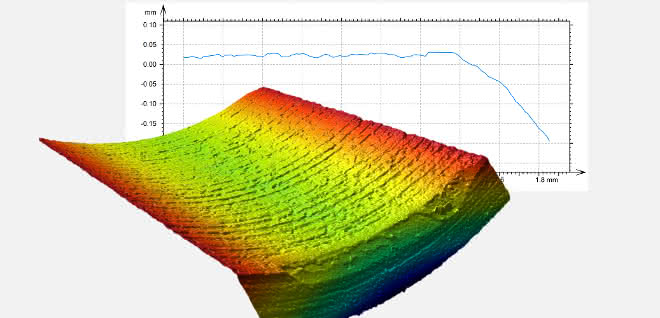
In machining production, expensive tools are used that must be optimally utilized with the aim of achieving high efficiency without endangering the workpiece. When machining workpieces made of gray cast iron or high-temperature cast steel, increased tool wear must also be taken into account. The reliable and non-destructive inspection of workpieces and components allows tight tolerances to be maintained while maintaining a high level of efficiency without jeopardizing process reliability.
High quality requirements are placed on vehicle powertrain components, such as the crankcase as the central component of the combustion engine. It not only houses the cylinders, but also serves as the "skeleton" of the combustion engine, to which many other components are attached. The piston movement exerts high forces on the component at hot temperatures. In order for the crankcase to withstand these loads, a high level of precision is required in production. To achieve this, the component and tool wear must be continuously monitored.
Permissible tolerance limits are defined for this wear, which must be monitored. Wear monitoring in machining production on the component to be machined or on the tool itself requires precise, fast and non-destructive testing methods. Only optical measuring methods that enable short test times and full-surface detection are suitable.
White light interferometry as a flexible and robust measurement method
White light interferometry has established itself as a particularly flexible and robust optical measurement method. The key to the three-dimensional imaging of the object lies in the superimposition of light beams. They are created when the measurement object and a reference mirror are evenly illuminated by polychromatic light, which is split in two by a semi-transparent mirror. The reference mirror and measurement object reflect the rays back into the camera. Depending on the height structure and object surface, different path lengths are created for the reference and sample light. These superimposition patterns can be evaluated by the software, whereby a distance is calculated for each object point. This results in an exact topographical image of the surface in the form of a height map. The white light interferometers in Isra Vision's NetGage3D product line are particularly reliable and compact. They measure surfaces precisely, quickly and reliably, whether as a stand-alone system or integrated directly into the line.
White light interferometry not only ensures wear control within the machining industry, but also inspects rough or smooth components in the electronics and semiconductor industries, in glass production and in medical technology.
Measure surfaces precisely, quickly and reliably
Topological surface parameters such as flatness, roughness or step heights are recorded with just one measurement down to the nanometer range. Even structures with the smallest dimensions can be reliably measured with white light interferometry.
Different cameras are used depending on the application: The detection of roughness is realized via a particularly high lateral resolution. Sensors with a very large measuring field of up to 110 x 110 mm² are used to check flatness. Information on dimensional accuracy and completeness is also identified. The entire surface topography within the measuring range and the geometric shape of an object can also be checked.
During the measuring process, the compact measuring head is moved in the z-direction and the object is scanned. This produces a "depth image" of the object with an extremely low measurement uncertainty. This means that even low-lying areas, such as drill holes, trenches or etched structures, can be measured without shadowing. At the same time, large working distances are maintained. Depending on the surface, very high measuring speeds can be achieved.
Quick configuration of the measuring task is guaranteed by the simple and intuitively designed user interface. This is very important, as small batches are increasingly being produced in the machining industry. During the initial setup, the entire process is stored as an automated recipe and is therefore available for further measurements. The clear reporting ensures control of the respective machining and wear status at all times.
Safety for efficiency, quality and cost-effectiveness
Thanks to their universal design and various modifications, the sensors can cover a wide range of applications and are used wherever stability and long-term accuracy are required. Users in machining production benefit from the fact that tolerances are reliably maintained with optical inspection. Tool life is optimized in a targeted manner and workpiece rejects are avoided. Archiving precise machine settings also ensures optimum results in the long term and conserves resources. In this way, the NetGAGEG3D product line ensures efficiency, quality and cost-effectiveness and ensures greater competitiveness.


You might also be interested in
Basler acquires 76% of Indian image processor
Basler, supplier of image processing components for computer vision solutions, has acquired 76% of the Indian sales partner Alpha TechSys Automation.
 read more...
Process monitoring and fault detection
Cameras ensure quality during laser melting
Powder bed-based laser melting (PBF-LB/M) opens up new possibilities in additive manufacturing. Modern camera systems provide crucial process data to further increase quality and efficiency.
read more...Vision Sensor is three times faster than its predecessor
The 'CS-62' vision sensor from di-soric is around three times faster than its predecessor, the 'CS-60'. In combination with the 'nVision-i 25.1' software, it enables image processing solutions that were previously reserved for smart cameras.
read more...Thermal imaging cameras for quality control
Automated thermal imaging cameras are often suitable for quality control applications where temperature plays a role. However, while there are various solutions on the market for slow processes, it is challenging to select a camera that reliably...
read more...Easy entry into industrial VGA thermography
Reliable temperature measurement is a prerequisite for the success of many industrial processes. Berlin-based manufacturer Optris presents the Xi 640 infrared camera, a new member of its Compact Line, which enables non-contact temperature...
read more...Powder bed-based laser melting optimized
Aconity3D has set itself the goal of optimizing the stability of the manufacturing method of powder bed-based laser melting and thereby promoting its use in a wide range of industries. By using high-speed industrial cameras from SVS-Vistek, the...
read more...INDUSTRIAL Production Products of the year...
2nd place, category handling, assembly and production logistics: SICK
safeVisionary2 is the first 3D time-of-flight camera with Performance Level c safety certification. It enables safe three-dimensional environmental detection and won 2nd place in the competition for Product of the Year 2024 in the handling, assembly...
read more...Nomination Products of the Year 2024
SICK: Camera systems safeVisionary2
safeVisionary2 is the first 3D time-of-flight camera with Performance Level c safety certification. It enables safe three-dimensional environmental detection and has been nominated in the 2024 Product of the Year competition in the handling,...
read more...AI vision brings additional opportunities
The seamless integration of AI into the consumer sector has helped to improve our quality of life and make interactions with technology more efficient. In industry, AI vision with machine learning opens up new possibilities that are not covered by...
read more...