

Rapid corrosion test
The color brings it to light
Stainless steel system components are protected against corrosion by a passive layer on the surface. If this is damaged or incompletely formed, the protection is lost. This can result in production downtime and high investments for repairs. The KorroPad method is a quick test for quality control of the passive layer. It only takes 15 minutes. By Helga Leonhard and Jens Lehmann
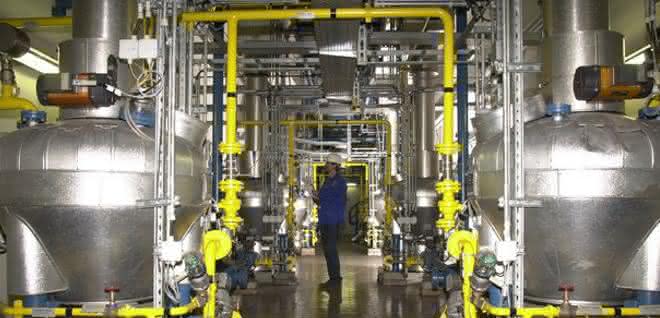
Harsh conditions prevail in many production plants. Components made of stainless steel have to withstand a lot on a daily basis. In the process industry, for example, the material surfaces of the pipes and containers, which are usually made of chrome-nickel-molybdenum steel, come into direct contact with acids, corrosive gases or other aggressive media.
The protective passive layer consisting of chromium oxide on the steel surfaces has a decisive influence on the economic and safe operation of the system. However, due to faulty or unfavorable conditions during production, processing, transport or storage, the surface protection on the components may be damaged or not continuous. If the passive layer is defective, there is a risk of localized corrosion, including pitting corrosion. This can result in material leaks, hazards for people and the environment, unplanned plant shutdowns and costly repairs.
Damage to the passive layer is not visible to the naked eye. Conventional methods for checking the protective layer, such as salt spray tests or electrochemical measurements, represent a considerable financial hurdle for small and medium-sized companies. This is because they require time, special equipment and expert knowledge. What was missing until now was an easy-to-use test method that did not require any special prior knowledge to use. The so-called KorroPad rapid test closes this gap.
TÜV Süd Chemie Service routinely uses electrochemical measurement methods to check the condition of passive layers. For example, current density-potential curves are recorded in laboratory measuring cells or locally on components. From this, pitting corrosion potentials can be determined and thus possible corrosion risks can be detected. It was therefore of particular interest to compare methods: The experts wanted to compare the results of electrochemical investigations and the tests using the KorroPad method. The aim was to evaluate the rapid test developed by the Federal Institute for Materials Research and Testing (BAM) and test it in practice.
Iron ions reveal weak points
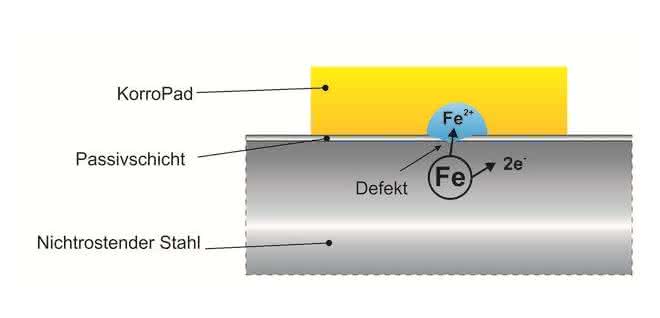
The KorroPad method works in a surprisingly simple way: if the protective chromium oxide layer on the steel surface is missing, iron ions escape from the material. This is where the test procedure comes in. The gel-like KorroPads consist of water with small amounts of sodium chloride and an indicator for iron ions.
The indicator potassium hexacyanoferrate(III), which is yellowish-transparent in aqueous solution, changes color to "Berlin blue" on contact with the iron ions. Clearly visible blue dots appear as indicators on the pale yellow pads. At these points, the protective passive layer on the stainless steel surface is not present or could not form.
The KorroPads are about the size of a five-cent coin. Each test requires three pads, which are placed on the previously cleaned steel surface and pressed down. A test time of 15 minutes is sufficient. The tester then removes the pads with a plastic spatula and places them on a carrier film.
The test result can be scanned or photographed for evaluation and documentation. The Korro-Pad method is a non-destructive test. Pipes, containers and other components can be tested for corrosion risk before they are installed in a production facility for quality control purposes. If the test reveals a risk of corrosion, the materials experts work with the plant operator to advise on the next steps.
Successfully tested in practice
The KorroPad process is suitable for use on all relevant stainless steel grades. Extensive practical tests at TÜV Süd Chemie Service confirmed this. The test objects were austenitic chromium-nickel-molybdenum steels. All tests on annealing colors after welding also resulted in indications in the KorroPad. In addition, the testers found that electrochemical cleaning or polishing with suitable devices or mechanical processing such as brushing the weld seams sometimes still resulted in indications. Obviously, the tarnish had not been sufficiently removed beforehand, which prevented the complete reformation of the passive layer.
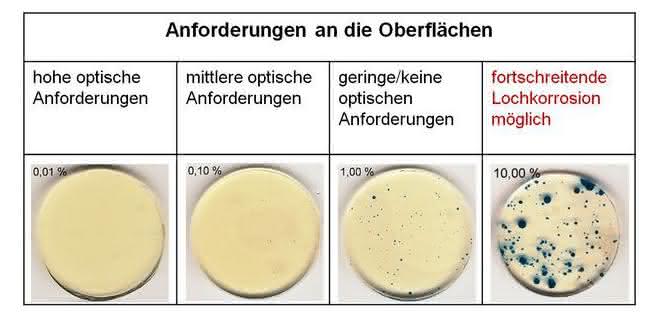
The practical tests were accompanied by local electrochemical measurements for comparison purposes. The results showed that where KorroPad tests led to indications, a lower pitting corrosion potential could be determined. The risk of corrosion is therefore increased at these points.
Clarity right from the start
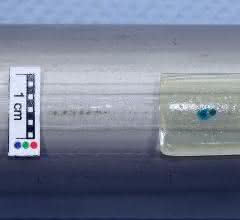
The corrosion resistance of the steels can be tested both on delivery and after processing. This ensures clarity regarding surface protection at all times. This also benefits, for example, trade businesses, which can protect themselves from costly warranty claims. The KorroPad method can also be used to characterize many process-related influencing factors on the surface quality and the material. Due to the quick application and simple evaluation of the test results, both positive and negative changes in terms of passive layer stability can be recognized immediately. Users are thus able to react quickly, eliminate critical influences and optimize in-house processes.
Dr. Helga Leonhard, Test Engineer Materials Eng. & Testing at TÜV Süd Chemie Service GmbH, and Dipl.-Ing. (FH) Jens Lehmann, research associate at the Federal Institute for Materials Research and Testing (BAM) / am


You might also be interested in
E-scooter with customizable damping
The startup Scuddy has significantly improved the flexibility, performance, customizability and ergonomics of its second-generation foldable e-scooter of the same name - thanks in part to damping technology from ACE.
 read more...
Hurdles on the road to success
Welding is one of the most complicated processes in the manufacturing process, and it is becoming increasingly difficult to find suitable personnel. Can this problem be solved by automating processes? Can or should the robot colleague replace the...
read more...New plug-and-play solutions for the warehouse
Exotec announces a new Skypath conveyor system, the optimized Skypicker picking robot and Deepsky, another proprietary storage software. All three products can be seamlessly integrated into the manufacturer's Skypod system.
read more...Production automation
At Motek, Weiss will be presenting solutions for the linear and rotary movement of workpieces that can be easily integrated into the overall system of hardware and software.
read more...Solutions for surface hardening
Many industrially used components require a combination of a tough core and a hard surface layer so that they can better withstand the stresses of use. Hardening is achieved by rapidly heating the surface and then cooling it quickly.
read more...Wheel bearings and wheel bearing sets
Low-friction rolling behavior
Hecht Kugellager offers a wide range of bearing technology for use in the automotive industry, commercial vehicles and mobile machinery.
read more...Simulation in product development
The Munich-based start-up Spyra significantly shortens the development time of its production by using Solidworks simulation solutions.
read more...Doubling production capacity by 2026
Nabtesco is investing in a third production site, doubling its production capacity to two million precision gearboxes per year by 2026.
read more...Counterbalance trucks with lithium-ion technology
Clark has relaunched the GEX and GTX series.
read more...