
Quad-camera technology
Bin picking for small components
A manufacturer of plastic building blocks from Denmark uses a compact Isra vision sensor for the highly complex separation of very small parts, as the subsequent step in the process requires precise positioning.
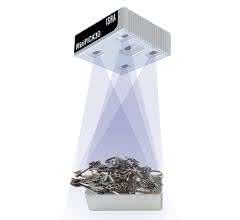
During the production of the popular plastic building blocks, the parts fall out of the injection molding machine into a box. The subsequent separation for assembly is very complex due to the high-gloss surface. Around 20 different types with sizes of around 60 by 200 millimetres are processed at this stage of production. Another challenge is the subsequent process step, which requires maximum gripping accuracy.
High-precision object detection is therefore required. MiniPick3D meets this requirement and implements short cycle times. The sensor can detect and automatically grip components with an edge length of just a few millimetres - such as connectors, injection-moulded elements, electronic parts or precision mechanical components. Its quad-camera equipment ensures a complete overview of each container as well as the necessary precision and speed.
Small components are not only a challenge due to their small size: Robot systems can move them very quickly due to their low weight, and usually only over short transport distances. Fast scanning times and precise object recognition are therefore essential in order to achieve an optimum cycle time.
Quad-camera technology for high data quality
The MiniPick3D's quad-camera technology uses four integrated cameras to fully capture the volume of each container. MiniPick3D is designed in particular for crates with a volume of up to 300 x 200 x 150 millimetres. The different viewing angles of the four integrated cameras enable several perspectives on the same object. These multi-view images ensure that a component is reliably detected and gripped even if there are shadows or light reflections on the surface.
Using special embedded processor technology, the sensor achieves scanning times of just a few hundred milliseconds, regardless of the surface structure or the components to be detected. Its powerful high-performance LED illumination provides all the necessary reference points in a fraction of a second to reliably detect the components to be gripped at high speed. In addition, several parts can be gripped after just one scan, which offers further time advantages. In combination with collaborative robots in particular, this opens up new applications for "reaching into the box", for example in the areas of assembly and logistics.
Industry 4.0-ready
Using CAD data, MiniPick3D receives the information it needs to recognize the parts to be gripped in the generated point cloud. The sensor automatically calculates the optimum collision-free robot path to pick the parts. An integrated plausibility check ensures uninterrupted operation. The sensor also learns new component shapes using a CAD data set - thanks to the easy teach-in with CAD teach-in, almost any possible component shape can be quickly set up and detected.
MiniPick3D is suitable for all common robot types and can be permanently mounted or used on a mobile robot. With WLAN and the OPC/UA protocol, the sensor is also prepared for networked production and Industry 4.0. as


You might also be interested in
Basler acquires 76% of Indian image processor
Basler, supplier of image processing components for computer vision solutions, has acquired 76% of the Indian sales partner Alpha TechSys Automation.
 read more...
Process monitoring and fault detection
Cameras ensure quality during laser melting
Powder bed-based laser melting (PBF-LB/M) opens up new possibilities in additive manufacturing. Modern camera systems provide crucial process data to further increase quality and efficiency.
read more...Vision Sensor is three times faster than its predecessor
The 'CS-62' vision sensor from di-soric is around three times faster than its predecessor, the 'CS-60'. In combination with the 'nVision-i 25.1' software, it enables image processing solutions that were previously reserved for smart cameras.
read more...Thermal imaging cameras for quality control
Automated thermal imaging cameras are often suitable for quality control applications where temperature plays a role. However, while there are various solutions on the market for slow processes, it is challenging to select a camera that reliably...
read more...Easy entry into industrial VGA thermography
Reliable temperature measurement is a prerequisite for the success of many industrial processes. Berlin-based manufacturer Optris presents the Xi 640 infrared camera, a new member of its Compact Line, which enables non-contact temperature...
read more...Powder bed-based laser melting optimized
Aconity3D has set itself the goal of optimizing the stability of the manufacturing method of powder bed-based laser melting and thereby promoting its use in a wide range of industries. By using high-speed industrial cameras from SVS-Vistek, the...
read more...INDUSTRIAL Production Products of the year...
2nd place, category handling, assembly and production logistics: SICK
safeVisionary2 is the first 3D time-of-flight camera with Performance Level c safety certification. It enables safe three-dimensional environmental detection and won 2nd place in the competition for Product of the Year 2024 in the handling, assembly...
read more...Nomination Products of the Year 2024
SICK: Camera systems safeVisionary2
safeVisionary2 is the first 3D time-of-flight camera with Performance Level c safety certification. It enables safe three-dimensional environmental detection and has been nominated in the 2024 Product of the Year competition in the handling,...
read more...AI vision brings additional opportunities
The seamless integration of AI into the consumer sector has helped to improve our quality of life and make interactions with technology more efficient. In industry, AI vision with machine learning opens up new possibilities that are not covered by...
read more...