
Camera interface
Program camera functions yourself with the Vision standard
When users want to run functions they have created themselves on intelligent cameras, they encounter two challenges: On the one hand, they often only have access to proprietary interfaces, which makes it more difficult to process the data in third-party applications, and on the other hand, only a few models offer a high-speed data interface such as GigE Vision.
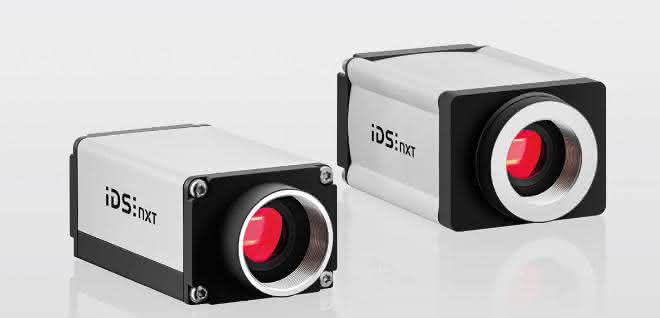
However, industrial applications often require both. IDS therefore combines standard vision industrial cameras with the vision app-based IDS NXT concept. Thanks to the "Smart GenICam App", data generated by customer-specific programming can be used in exactly the same way as if it were part of the manufacturer-independent standard functional scope of the industrial camera.
As a camera interface, GenICam enables standardized camera functions on the one hand, while on the other, camera manufacturers can integrate special functions using the feature node map (the camera API, so to speak). IDS is currently developing a "Smart GenICam" vision app with which customers can also integrate and use their own camera features in a vision-compliant manner. The function should be available from the second quarter of 2019.
Users load the new camera function onto their IDS NXT camera packaged as a vision app. The camera firmware then integrates the application code into the range of functions. The configuration, control and results of the Vision App can be easily processed in any GenICam-compliant third-party application, such as Halcon, via the camera's XML description file - while simultaneously utilizing the full GigE bandwidth.
The use of vision-compliant applications on the IDS NXT platform offers a further advantage, as application processes can be scaled between the camera and host PC. As powerful embedded systems, models such as IDS NXT rio and rome offer the possibility of shifting decision-making processes from the host PC partially or completely to the camera ("on the edge"). Advantages include a lower network load, hardware-accelerated processing, lower energy consumption and lower system costs. as


You might also be interested in
Basler acquires 76% of Indian image processor
Basler, supplier of image processing components for computer vision solutions, has acquired 76% of the Indian sales partner Alpha TechSys Automation.
 read more...
Process monitoring and fault detection
Cameras ensure quality during laser melting
Powder bed-based laser melting (PBF-LB/M) opens up new possibilities in additive manufacturing. Modern camera systems provide crucial process data to further increase quality and efficiency.
read more...Vision Sensor is three times faster than its predecessor
The 'CS-62' vision sensor from di-soric is around three times faster than its predecessor, the 'CS-60'. In combination with the 'nVision-i 25.1' software, it enables image processing solutions that were previously reserved for smart cameras.
read more...Thermal imaging cameras for quality control
Automated thermal imaging cameras are often suitable for quality control applications where temperature plays a role. However, while there are various solutions on the market for slow processes, it is challenging to select a camera that reliably...
read more...Easy entry into industrial VGA thermography
Reliable temperature measurement is a prerequisite for the success of many industrial processes. Berlin-based manufacturer Optris presents the Xi 640 infrared camera, a new member of its Compact Line, which enables non-contact temperature...
read more...Powder bed-based laser melting optimized
Aconity3D has set itself the goal of optimizing the stability of the manufacturing method of powder bed-based laser melting and thereby promoting its use in a wide range of industries. By using high-speed industrial cameras from SVS-Vistek, the...
read more...INDUSTRIAL Production Products of the year...
2nd place, category handling, assembly and production logistics: SICK
safeVisionary2 is the first 3D time-of-flight camera with Performance Level c safety certification. It enables safe three-dimensional environmental detection and won 2nd place in the competition for Product of the Year 2024 in the handling, assembly...
read more...Nomination Products of the Year 2024
SICK: Camera systems safeVisionary2
safeVisionary2 is the first 3D time-of-flight camera with Performance Level c safety certification. It enables safe three-dimensional environmental detection and has been nominated in the 2024 Product of the Year competition in the handling,...
read more...AI vision brings additional opportunities
The seamless integration of AI into the consumer sector has helped to improve our quality of life and make interactions with technology more efficient. In industry, AI vision with machine learning opens up new possibilities that are not covered by...
read more...