

Condition monitoring
Wait in good time instead of repairing later
The manufacturer Nord Drivesystems offers a system solution to regularly or permanently record drive and status data and to optimize the operational reliability and efficiency of machines and systems. This information can be used to develop concepts for predictive maintenance.
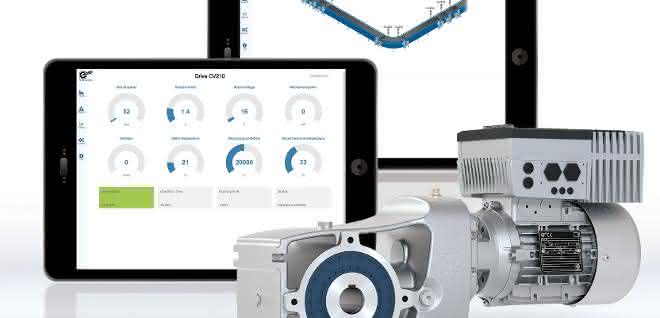
The basis is the fast, efficient and comprehensive evaluation of analog and digital data (measured values, signals and operating parameters) by the intelligent PLC in the drive electronics.
Predictive maintenance
The aim of predictive maintenance is to proactively maintain machines and systems and detect changes, reduce downtimes and increase overall system effectiveness. Condition-based maintenance replaces traditional time-based maintenance.
Nord Drivesystems pursues a drive-based approach in which information from condition monitoring is transferred to predictive maintenance using intelligent algorithms and virtual sensors. This includes, for example, sensorless determination of the optimum oil change time based on the oil temperature. This makes use of the fact that oil ageing in gearboxes is particularly dependent on the oil temperature. This information, in combination with known transmission parameters and specific, operational parameters, enables the oil change time to be specified more precisely. A physical temperature sensor is not required for this.
The drive data is pre-processed using intelligent algorithms in the integrated PLC of the frequency inverter, which is used as the evaluation unit. The data obtained can be made available to the customer via all common interfaces.
The right PLC software architecture
The drive's equipment can be optionally extended and can be adapted to the respective automation task at any time. The customer can choose which tasks (drive monitoring, drive control, process control) they want to transfer directly to the drive. This scalability gives them the opportunity to gain initial experience in a smaller production area, for example, before converting their entire system.
Three expansion stages are available. In the small version, the drive PLC only monitors the drive. The drive parameters are pre-processed in the PLC and forwarded to the higher-level system controller, which is then responsible for drive and process control.
Scalability
In the medium version, the PLC also integrates the drive control and thus also executes drive-related functions.
In the largest expansion stage, the inverter PLC completely replaces the higher-level system control. In addition to communication with a control system, a local data management system without an internet connection can also take over the data if required. dsc


You might also be interested in
Plagiarius 2024 negative prize
On January 26, 2024, the Plagiarius campaign awarded its dreaded "Plagiarius" negative prize for the 48th time to manufacturers and retailers of particularly brazen counterfeits and fakes.
 read more...
Ivalua honors winners of the Generative AI...
AI-supported "add-ons" for buyers within 48 hours
Ivalua, provider of cloud-based spend management solutions, announced the winners and innovations of the first Generative AI Innovation Cup. The competition took place in December 2023. It was open to all Ivalua partners and employees - more than...
read more...Efaflex celebrates 50 years of high-speed...
The emphasis is on "fast"
Since day one, Efaflex has wanted to use new technologies as early as possible and drive progress in the industry. This year, the family business is celebrating its 50th anniversary under the motto "Fast Forward".
read more...Security of supply even during power outages
In the winter of 2022, Germany was worried about energy shortages. The drugstore retailer dm did not paint any horror scenarios, but nevertheless saw the possibility of controlled, temporary, regional power cuts (brownouts).
read more...Safety technology in mechanical engineering
Modules with new functions
Euchner's product highlights at EMO 2023 include the communication-capable solenoid interlocks.
read more...Transforming the paper industry towards climate neutrality
Together with partners from industry and research, Voith is developing a project for the optimization of energy and material flows in paper production. The aim of the research project is to develop a digital framework that enables effective process...
read more...Up to 95 percent less flue gas thanks to direct extraction
The requirements for occupational safety measures and safety technology are also constantly increasing in welding technology. The Technical Rules for Hazardous Substances (TRGS) stipulate that welding fumes and harmful substances must be extracted...
read more...Competitive advantages with large machines
Whether 3D-printed components for machines and systems, prototypes or aids for design: additive manufacturing is almost indispensable for modern companies in mechanical and plant engineering and automation if they want to play in the premier league.
read more...Transport technology from the modular system
Many transport tasks can be realized with the help of linear technology. Pre-configured solutions are available to simplify the interaction between the linear unit, motor, gearbox and controller. This minimizes the effort required for research and...
read more...