

Measuring systems
Six times in view
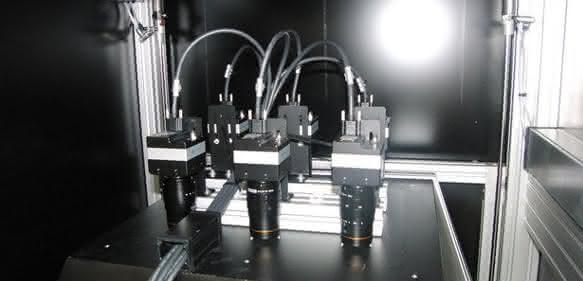
Image-based, fully automated inspection. To ensure that only cavity-free die-cast aluminum parts are delivered, Gruber & Kaja uses a multi-camera system developed by Autoforce Vision Systems to detect cavities. The image processing specialists used six industrial cameras from Baumer's LX series to solve a task that was previously considered impossible to automate.
For Gruber & Kaja, a supplier of engine-related aluminum die-cast parts to the automotive industry, the delivery of void-free components is a key success factor. This is particularly crucial for flat CNC-machined sealing surfaces in order to ensure that the sealing lip is fully seated. As part of the automation expansion of the production processes, the company invested in the previously manual visual blowhole inspection. The task: to reliably detect blowholes as small as 0.4 millimetres in a component size of 350 by 400 millimetres. Autoforce Vision Systems was the only supplier able to meet the requirements.
"Neither we nor Gruber & Kaja were aware of any system on the market that could automatically detect or evaluate such small blowholes for the given component size," explains Stefan Perg, one of the managing directors at Autoforce Vision Systems. In addition, the minimum roughness of the components in the specified active and passive sealing areas was a complex requirement. The machining marks on the surfaces, such as milling grooves, also had to be taken into account for the image acquisition. The solution from Autoforce Vision Systems: a multi-camera system with a specially designed dome-shaped illumination area. "By splitting the image across several cameras, we minimized distortion and increased the optical resolution. And thanks to the illumination dome, we achieved optimum illumination in order to filter out the milling grooves caused by the machining process and thus literally make them invisible," says Perg, explaining the central system structure. There is a slight overpressure in the lighting dome to prevent the ingress of dirt.
Autoforce Vision Systems uses six GigE cameras from Baumer's LX series with a resolution of eight megapixels to capture images. Image evaluation is carried out via Halcon thanks to the cameras' third-party compatibility. For this purpose, Autoforce Vision Systems programmed an application with which the individual images captured are merged with pixel accuracy to form an overall image and then overlaid with the original CAD data of the component currently being inspected to define the inspection regions.
The whole process only takes a few seconds. During the evaluation, the clamping frame with the component rotates 180 degrees to check the opposite side of the workpiece. An important criterion when selecting the cameras for the system was the ratio between resolution and pixel size. "We were looking for a camera with a robust design in which the chip size and therefore the size of the individual pixels would not be too small despite the high optical resolution," explains Perg. Equipped with the CMV8000 global shutter sensor from ams, the LXG-80 cameras from Baumer with a pixel size of 5.5 x 5.5 micrometers and a resolution of 3,360 x 2,496 pixels were the ideal choice. as


You might also be interested in
Basler acquires 76% of Indian image processor
Basler, supplier of image processing components for computer vision solutions, has acquired 76% of the Indian sales partner Alpha TechSys Automation.
 read more...
Process monitoring and fault detection
Cameras ensure quality during laser melting
Powder bed-based laser melting (PBF-LB/M) opens up new possibilities in additive manufacturing. Modern camera systems provide crucial process data to further increase quality and efficiency.
read more...Vision Sensor is three times faster than its predecessor
The 'CS-62' vision sensor from di-soric is around three times faster than its predecessor, the 'CS-60'. In combination with the 'nVision-i 25.1' software, it enables image processing solutions that were previously reserved for smart cameras.
read more...Thermal imaging cameras for quality control
Automated thermal imaging cameras are often suitable for quality control applications where temperature plays a role. However, while there are various solutions on the market for slow processes, it is challenging to select a camera that reliably...
read more...Easy entry into industrial VGA thermography
Reliable temperature measurement is a prerequisite for the success of many industrial processes. Berlin-based manufacturer Optris presents the Xi 640 infrared camera, a new member of its Compact Line, which enables non-contact temperature...
read more...Powder bed-based laser melting optimized
Aconity3D has set itself the goal of optimizing the stability of the manufacturing method of powder bed-based laser melting and thereby promoting its use in a wide range of industries. By using high-speed industrial cameras from SVS-Vistek, the...
read more...INDUSTRIAL Production Products of the year...
2nd place, category handling, assembly and production logistics: SICK
safeVisionary2 is the first 3D time-of-flight camera with Performance Level c safety certification. It enables safe three-dimensional environmental detection and won 2nd place in the competition for Product of the Year 2024 in the handling, assembly...
read more...Nomination Products of the Year 2024
SICK: Camera systems safeVisionary2
safeVisionary2 is the first 3D time-of-flight camera with Performance Level c safety certification. It enables safe three-dimensional environmental detection and has been nominated in the 2024 Product of the Year competition in the handling,...
read more...AI vision brings additional opportunities
The seamless integration of AI into the consumer sector has helped to improve our quality of life and make interactions with technology more efficient. In industry, AI vision with machine learning opens up new possibilities that are not covered by...
read more...