

Everything still tight?
Leak testing methods in the automotive industry
There are many methods for testing tightness in the production environment. However, only test gas methods meet the modern requirements for components in the automotive industry. The following article provides an overview of the various measurement methods and their applications.
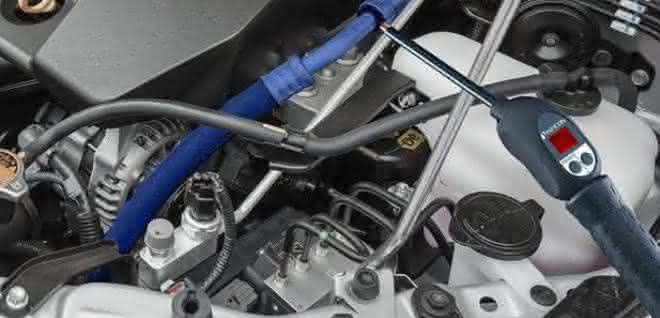
In the automotive industry, the quality of components is becoming increasingly important. This is often accompanied by higher demands on tightness - requirements that can no longer be met using traditional methods such as water bath or pressure drop measurement. In more and more applications, only modern test gas methods offer the accuracy and reliability required in the manufacturing process - whether it is heat exchangers for exhaust gas recirculation systems for nitrogen oxide reduction or charge air coolers for modern turbo engines. Precise leak testing is also essential at the various stages of the production process for traction batteries for EV/HEV vehicles. This is the only way to guarantee the operational safety and service life of the expensive battery - from the tightness of the individual battery cell to the cooling circuit and the entire housing.
Water bath or bubble test
Thirty years ago, the simple but unreliable water bath test was still the standard method used by most suppliers. In practice, its detection limit is a leak rate of 5∙10-2 mbar∙l/s. However, the validity of this test stands and falls with the daily form of the human tester, who has to recognize the bubbles. In addition, particularly in the case of complex geometries, such as heat exchangers, air sometimes escapes from the test part but does not detach and rise as an air bubble. It is then not perceptible. In addition, if components can tolerate moisture at all, they often have to be dried extensively after the water bath.
Pressure drop test
Some suppliers still rely on the supposedly cost-effective pressure drop test. This involves filling the test part with air up to a defined overpressure and measuring any changes in pressure over a defined time interval. If the pressure drops, there is a leak. The smallest leak rates that can ideally be determined in this way are in the order of 10-3 mbar∙l/s. However, a major problem with the method is its susceptibility to temperature fluctuations. If the temperature only rises by fractions of a Kelvin during the test, leaks often go undetected. If, on the other hand, the temperature drops, the pressure drop test detects phantom leaks. Attempts to compensate for temperature changes reduce this effect, but do not eliminate it completely.
Helium testing in the vacuum chamber
Test gas methods are far more reliable here. A vacuum leak tester such as the LDS3000 from Inficon is highly sensitive, allows very short cycle times and is therefore recommended for automated testing systems in production lines. With the vacuum method, the test specimen is placed in a hermetically sealed chamber in which pumps create a vacuum. The test specimen is also evacuated and filled with the test gas helium so that it can escape through any leaks into the vacuum of the chamber, where it is detected by the leak tester.
This means that even larger components can be tested against the smallest limit leakage rates - down to 10-12 mbar∙l/s under optimum conditions. Typical applications of vacuum testing are tests on air conditioning components - evaporators, condensers or filling valves (up to 10-5 mbar∙l/s) -, on common rail injection systems (10-6 mbar∙l/s) or on fuel systems and fuel tanks (10-5 mbar∙l/s).
Vacuum testing is also the method of choice for battery cells. Whether they are prismatic, round or pouch cells: Once the manufacturer has filled them with the flammable electrolyte and sealed them, he must test the tightness of the battery cell housings against leakage rates of 10-5 to 10-6 mbar-l/s. For this reason, 3 to 5 percent helium is often added to the electrolyte filling of the cells as a test gas.
Testing in the simple accumulation chamber
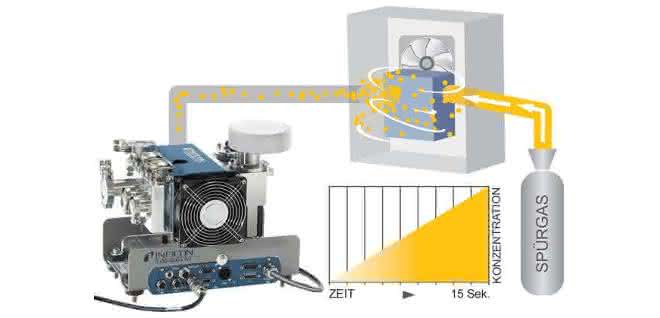
For small and medium-sized parts in particular, which are only tested for possible oil (10-3 mbar∙l/s) or water leaks (10-2 mbar∙l/s), testing in the simple and cost-effective accumulation chamber is recommended. This involves measuring how much test gas escapes from an oil, water or charge air cooler, for example, and accumulates in the accumulation chamber within a certain time interval.
In practice, a device such as the LDS3000 AQ from Inficon determines leak rates of up to 1∙10-5 mbar∙l/s in the accumulation chamber. Instead of helium, the device can also use less expensive forming gas, a non-flammable, commercially available mixture of 95 percent nitrogen and 5 percent hydrogen. Using the accumulation method, this device detects liquid leaks just as reliably as only helium vacuum testing could in the past - and at the same cost as a simple air test.
Dynamic robot sniffer leak detection
Sniffer leak detection with test gas is not only intended to identify leaks, but also to locate them precisely. It is also often used to determine whether the joints between components that have already been assembled are tight, for example before the vehicle is installed on pre-assembled air conditioning modules or if the tightness of a traction battery housing to the outside must be guaranteed in accordance with IP67 or IP69K. A distinction is made between static and dynamic sniffer leak detection. In the latter, the sniffer probe moves over a larger area of the test part.
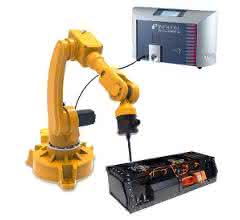
Dynamic robotic sniffer leak detection, in which the measuring head is attached to the tip of a robot arm and is automatically guided over the test part, is particularly technically demanding. Inficon devices such as the XL3000flex with the test gases helium or forming gas and the Protec P3000XL (with helium) are predestined for this scenario. They draw in the air to be tested at a very high gas flow of 3,000 sccm, whereas conventional multi-purpose leak detectors operate at just 60 sccm. Thanks to the high gas flow, the measuring head can maintain the required safety distance from the surface of the test part (often 5 or 6 mm) during dynamic and automatic sniffer leak detection and at the same time still identify leaks 100 percent even at higher feed rates of 10 cm/s or more. Typical limit leak rates that must be tested against in dynamic robot sniffer leak detection are 10-2 mbar∙l/s for water tightness, 10-3 mbar∙l/s for oil tightness and 10-4 mbar∙l/s for tightness against liquid fuels.
Multigas sniffer leak detection after installation
Even after the actual installation of the air conditioning components, the OEM still has to test the tightness of the connection points or check the refrigerant circuit of the installed traction battery for leaks. In such cases, a multi-gas sniffer leak detector such as the Ecotec E3000 can use the respective refrigerant -CO2 or R1234yf - itself as a test gas and detect any leaks directly. In fact, such a multi-gas sniffer leak detector is the only way to test the filling valve for leaks after it has been closed. It can also detect fuel leaks in the common rail connections. The smallest leak rate that can be detected with the device corresponds to 0.05 g/a of the refrigerant R134a or a helium leak rate of 10-6 mbar∙l/s.
Sandra Seitz, Market Manager Automotive Leak Detection Tools, Inficon / am
More about leak testing
Inficon offers even more information on the physical principles and application scenarios of "Leak testing in the automotive industry" in a detailed manufacturer-neutral guide. You can download this e-book free of charge here: www.inficon.com/automobilindustrie-ebook


You might also be interested in
Atlas Copco takes over long-standing sales partner
Atlas Copco has taken over Heide-Pumpen. The specialist for mobile pumps has been working closely with Atlas Copco in sales and service for a long time, especially for surface pumps for construction site dewatering and wastewater detour or in the...
 read more...
Lutz Pumpen at the Achema 2024
New mobile drum pump with battery drive
The new B3 Battery from Lutz Pumpen promises mobile and safe working with aggressive liquids without having to compromise on pumping performance compared to wired versions. The battery-powered drum pump will be on display at Achema, the world's...
read more...Maintenance and Pumps&Valves in February
Final preparations are underway in Dortmund: On February 21, 2024, maintenance will start as the leading trade fair for industrial maintenance and with it Pumps&Valves as the trade fair for industrial pumps, fittings and valves.
read more...Liquid separator keeps pumps dry
Vacuum clamping minimizes distortion and enables five sides to be machined in one clamping operation. The use of cooling lubricants poses a challenge: If they get into the vacuum generator, they can cause serious damage.
read more...Spring clutches for construction machinery
Spring clutches from Torsion Control Products (TCP) are ideal for use in construction machinery where modern diesel engines are used.
read more...Protection against cooling lubricant
Liquid separator from Schmalz keeps pumps dry
Anyone clamping with a vacuum during CNC machining must protect the pump from cooling lubricant. The NLS liquid separator from Schmalz separates the cooling lubricant and returns it to the running process - without interrupting the vacuum.
read more...Which clutch for what?
Mechanical engineering and its applications are multifaceted. Every application is special and requires a perfect machine design. Individual components in the system must also be optimally designed.
read more...Energy efficiency needs electrical engineering and IT
The energy crisis makes one thing clear: it is not enough to simply screw a photovoltaic system onto your roof or purchase green electricity. Industry is faced with the challenge of reducing consumption in order to counter the rise in energy prices,...
read more...Solutions for a networked and climate-neutral industry
At the world's leading trade fair for industry, around 4,000 companies from the mechanical engineering, electrical and digital industries as well as the energy sector will be showcasing solutions for the production and energy supply of the future.
read more...