
Inline camera inspection technology
Inline tested and accelerated
Inline camera inspection technology. In the fully automated production of electrical components at high speed, 100 percent inline inspections for final inspections have long been sought after or are even mandatory. Lutronic offers sophisticated camera inspection technology including programming.
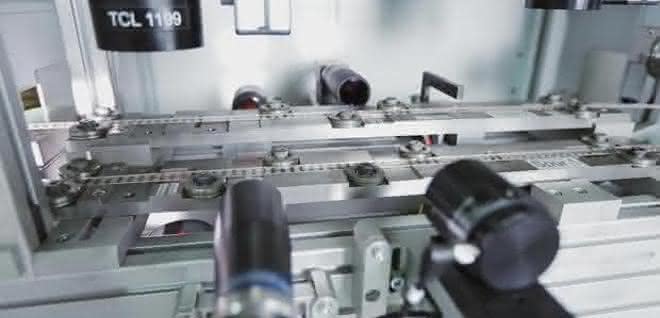
Lumberg, based in the Sauerland region of Germany, is a supplier of connector and contact systems. Its expertise lies in the in-house development and production of connectors, electromechanical components and mechatronic components. The more than 20,000 catalog products are used in the household appliance, building technology, automotive, communications and consumer electronics industries. The design and manufacture of tools is carried out in-house, as is the design and manufacture of high-performance assembly systems. 175 employees work in this area alone.
The sister company Lutronic has only been offering customized machines and systems for sale since this year. Individualized feeding systems, complete assembly units, inspection systems and packaging systems through to solutions for fully automated assembly technology are available here. Sophisticated camera inspection technologies, including programming, are also part of the mechanical engineering service. In principle, these systems are suitable for all industries in which demanding surfaces need to be inspected quickly and automatically. In many sectors, 100% inline inspections for final inspections have long been the aim or are even mandatory in order to guarantee promised product properties and detect any defects in advance.
Inline inspection is often unavoidable in the fully automated production of electrical components at high speed. This not only prevents potential economic damage caused by the production of defective parts, but also checks all quality-relevant characteristics and identifies deviating trends so that these can be responded to as quickly as possible. The attributive application in the form of surface inspection and/or presence testing is just as relevant as the metrological application for detecting dimensions.
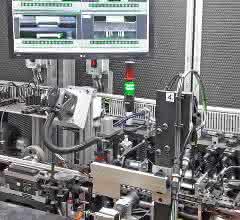
For in-line inspection in high-capacity systems, the first challenge is to bring the test specimen into a precisely positioned, steady and correctly illuminated test position. Care must be taken to ensure that vibrations and oscillations from the overall system are not transferred to the test specimen. The test position must have a high repeat accuracy in accordance with the overall tolerance in order to achieve stable test results. As the measuring system analysis or measuring equipment capability analysis plays a central role in the assessment of processes, it must be ensured in advance that the measurement can reflect reality and that the equipment used is selected correctly. Factors such as the resolution of the camera, the choice of the right lens and, of course, the use of the right lighting play a fundamental role here.
Whether to work with entocentric or telecentric lenses, with incident light or transmitted light must also be carefully evaluated before planning the project. Testing in transmitted light - assuming the design of the system allows this - has proven itself in practice, as many disturbance variables such as color, reflections from shiny or curved surfaces or extraneous light can be intercepted much better here.
The time window in which the inspection is carried out at up to 1,600 images per minute must also be precisely planned and taken into account in advance, as there are often only a few milliseconds available for the inspection. The mechanical sequence is therefore also a decisive factor for a solid inspection. If inspection requirements are incorporated into the system development at an early stage, this can help to reduce pseudo rejects. If this is around one percent in a normal optical inspection, it can be reduced to a good 0.1 percent. This significantly reduces inspection costs. In fact, the possibilities of product expansion and the variety of variants of a product must also be taken into account in the inspection setup and programming.
Of course, testing technology not only has to cope with high speeds, but also with ever-increasing quality requirements. For example, a product that is not manufactured at high speed can also require challenging testing. Examples include the positioning accuracy of chips or capacitors in electronic assemblies or functional component carriers in which many individual micro-components are toleranced in an overmolded finished part. Specifically, this could be several press-fit zones in one component, for example, where the functionality of the entire component is only guaranteed if all the press-fit zones fit together.
The calculation algorithm for the automatic evaluation of the individual images is located on the camera. If required, images and test results can be saved to the defined storage location such as an FTP server or your own computer. The system becomes completely self-sufficient when stored on an internal SD card located in the camera.
Individual test points are programmed by the camera specialists for the respective test specimen, the test environment and the parameters to be tested, and an individual user interface is set up to simplify operation.
W.Sprock, A. Radke/as


You might also be interested in
Basler acquires 76% of Indian image processor
Basler, supplier of image processing components for computer vision solutions, has acquired 76% of the Indian sales partner Alpha TechSys Automation.
 read more...
Process monitoring and fault detection
Cameras ensure quality during laser melting
Powder bed-based laser melting (PBF-LB/M) opens up new possibilities in additive manufacturing. Modern camera systems provide crucial process data to further increase quality and efficiency.
read more...Vision Sensor is three times faster than its predecessor
The 'CS-62' vision sensor from di-soric is around three times faster than its predecessor, the 'CS-60'. In combination with the 'nVision-i 25.1' software, it enables image processing solutions that were previously reserved for smart cameras.
read more...Thermal imaging cameras for quality control
Automated thermal imaging cameras are often suitable for quality control applications where temperature plays a role. However, while there are various solutions on the market for slow processes, it is challenging to select a camera that reliably...
read more...Easy entry into industrial VGA thermography
Reliable temperature measurement is a prerequisite for the success of many industrial processes. Berlin-based manufacturer Optris presents the Xi 640 infrared camera, a new member of its Compact Line, which enables non-contact temperature...
read more...Powder bed-based laser melting optimized
Aconity3D has set itself the goal of optimizing the stability of the manufacturing method of powder bed-based laser melting and thereby promoting its use in a wide range of industries. By using high-speed industrial cameras from SVS-Vistek, the...
read more...INDUSTRIAL Production Products of the year...
2nd place, category handling, assembly and production logistics: SICK
safeVisionary2 is the first 3D time-of-flight camera with Performance Level c safety certification. It enables safe three-dimensional environmental detection and won 2nd place in the competition for Product of the Year 2024 in the handling, assembly...
read more...Nomination Products of the Year 2024
SICK: Camera systems safeVisionary2
safeVisionary2 is the first 3D time-of-flight camera with Performance Level c safety certification. It enables safe three-dimensional environmental detection and has been nominated in the 2024 Product of the Year competition in the handling,...
read more...AI vision brings additional opportunities
The seamless integration of AI into the consumer sector has helped to improve our quality of life and make interactions with technology more efficient. In industry, AI vision with machine learning opens up new possibilities that are not covered by...
read more...