
Sensors
Gas turbines precisely controlled
MAN Energy Solutions specializes in highly efficient gas turbines. Measurement technology from Swiss manufacturer Kistler helps to control the combustion process.
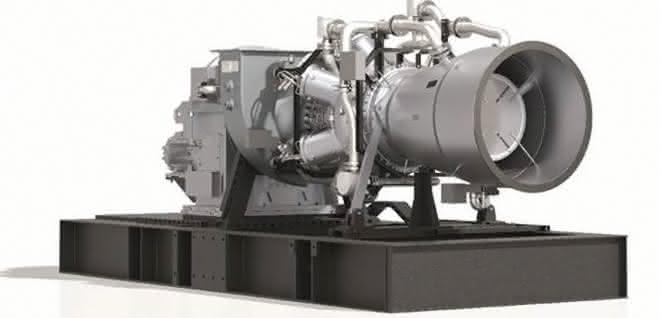
Gas turbines play an important role in the transition to the most efficient and environmentally friendly energy supply possible: they are the ideal solution, particularly where heat is required in addition to electricity - for example for municipal utilities or in industry. In addition, they can increasingly be operated with hydrogen instead of natural gas, which further improves their environmental footprint and fits into the desired energy mix.
Sustainable gas turbines
MAN Energy Solutions (MAN ES) in Oberhausen develops and builds such more sustainable gas turbines, which have very low emission values. The turbomachinery division based here emerged from GHH ("Gute Hoffnungshütte"), which was at times the largest mechanical and plant engineering group in Europe and whose beginnings in iron smelting date back to 1758.
Today, around 1,800 employees work in Oberhausen in the areas of gas turbine development and production as well as in comprehensive testing and service. Among other things, complete gas turbine and compressor trains can be tested on site - use as a drive unit for compressors (for example on gas pipelines) is another important field of application for gas turbines.
Integrated sensors monitor the combustion process
Dr. Bernhard Ćosić has been working at MAN Energy Solutions since 2015 and, as Team Leader Gas Turbine Combustion, has played a key role in the development of the MGT6000 and the new MGT8000 series. He describes the market development as follows "With our gas turbines with an electrical output of between six and twelve megawatts, we are providing a much more sustainable solution for generating electricity and heat compared to diesel, coal and heavy fuel oil power plants. The gas turbine achieves high levels of efficiency and is very efficient, particularly where high-temperature heat is required in addition to electricity - for example in paper production or in the food industry. However, they can also be used for decentralized power generation, especially in areas that are difficult to access, as the cost of commissioning is many times lower than that of a large engine."
High-temperature pressure sensors
MAN ES brought Kistler on board as a development partner to monitor the combustion process and realize further benefits such as fuel flexibility and real-time monitoring. The type 6021A piezoelectric high-temperature pressure sensors from Kistler are connected directly to the gas turbine's control system and provide data on the combustion process during continuous operation. "Thanks to their very high temperature resistance, we can bring the sensors, which are also very compact, close to the flame and thus obtain accurate and informative data. They are available to us and the customer 24 hours a day, 7 days a week via the MAN CEON cloud, creating the basis for condition monitoring and predictive maintenance."
Monitoring the combustion process
Kistler's sensors also play a major role in controlling and monitoring the combustion process. In addition to reducing emissions, the main focus here is on fuel flexibility: the MGT6000 series is dual-fuel capable, meaning that it can also be operated with liquid fuels such as diesel if natural gas is not available. According to Ćosić, shale gases and combustion gases with a high inert gas content, such as nitrogen or carbon monoxide, which often occur as a waste product and still have residual energy, can also be used: "We optimize the processes in the combustion chambers so that no instabilities occur even when the fuel is changed - the live data from the Kistler sensors helps us to do this."
Fuel of the future
In cooperation with MAN ES, Kistler developed a tailor-made electronic unit (Signal Conditioning Unit) that simplifies the entire measurement chain and contributes significantly to cost optimization. "Throughout the entire process, Marco Gnielka's team actively supported us, enabling us to find the optimal solution for us," continues Ćosić. "The initial challenges were solved quickly and with Christian Heer I had a very knowledgeable contact person at Kistler - we speak the same language, even though we come from different engineering backgrounds, so we quickly developed a trusting working relationship."
Variable gas mixtures
The next step in the further development of the gas turbine is the ability to handle variable gas mixtures up to 100 percent hydrogen - as this promises even cleaner combustion withCO2 emissions that are close to zero. In fall 2020, the first MGT8000 from MAN ES was put into operation - directly on site in Sterkrade, a district of Oberhausen and in the service of the local municipal utility EVO. "The new, state-of-the-art gas turbine can already be operated with a hydrogen content of 20 percent. In the short term, this proportion can be increased to 50 percent. In the medium term, even 100 percent is possible," explains Ćosić. "Hydrogen is highly reactive and therefore changes the characteristics of combustion - the flame burns faster, so to speak - so that the system has to be readjusted and optimized if the proportion of hydrogen in the gas mixture increases significantly. However, the key data such as output and efficiency do not change and you can continue to use our turbines."
Long service life
With gas turbines having a service life of 15 years or more, investment security is an important criterion for MAN ES customers. If more and more hydrogen is fed into the natural gas grid in the future, or even new, pure hydrogen systems are created, Kistler's measurement technology will also play its part in the future viability of MAN ES gas turbines - both in terms of optimizing combustion processes and maintenance and monitoring. Ćosić summarizes: "With Kistler, we have a partner who is very reliable and able to support our global business - for example, when we want to train personnel in China - but who is also flexible enough to provide individual and personal support and development. This puts us in a very good position for the growth expected in the coming years and decades as a result of the necessary coal and oil phase-out."


You might also be interested in
ESTIA aims to strengthen Europe's cloud
New tech alliance for EU sovereignty
Twelve companies, including Dassault Systèmes, are founding the European Sovereign Tech Industry Alliance (ESTIA). The initiative aims to strengthen Europe's technological independence and define requirements for sovereign cloud services. The start...
 read more...
Deutsche Telekom and Nvidia launch one of Europe's largest AI factories
With the Industrial AI Cloud in Munich, Deutsche Telekom and NVIDIA are creating one of the largest AI factories in Europe. Companies can train AI models, carry out simulations and access 10,000 GPUs.
read more...Leveraging data potential with AI and streaming
Huge data treasures are still lying dormant in many manufacturing companies. And yet it is high time that these treasures were unlocked. There is often a lack of resources and capacity to make data usable in real time. Streaming production data can...
read more...More awareness of noise
Dematic offers solutions that are tailored to different cloud environments and reduce environmental impact through reduced material consumption and improved energy efficiency.
read more...Generative AI in the automation environment
The mechanical engineering and automation industry is undergoing profound change. This transformation is being driven by more volatile global trade, geopolitical crises and increasing market pressure, which demands greater agility, technological...
read more...Rigid data structures have had their day
The traditional data center is no longer the center of data. A hybrid cloud storage approach enables manufacturing companies to both meet the current requirements of data-intensive processes and future-proof their infrastructure.
read more...Software as a service in three stages
CIM Database Cloud is a new out-of-the-box solution from Contact for end-to-end digital product development.
read more...How production can benefit from AI
Together with AI technology, IIoT networking makes it possible to better control machine parameters and optimize quality with predictive quality. Downtimes and set-up times can also be further minimized. Cloud platforms also make these technologies...
read more...More expertise for digital engineering
Altair, a computational science and artificial intelligence (AI) company, has acquired OmniV, a technology from Michigan, USA-based software company XLDyn.
read more...