

Explosion protection
Explosion protection in pressure measurement technology
Explosions can be extreme and usually cause a great deal of damage. The primary objective when constructing electrical devices for use in potentially explosive environments is therefore to completely prevent explosions. Certified products, including those from the field of measurement technology, for use in explosive environments ensure safe operation in a wide range of applications.
On 21 September 2001, 300 tons of artificial fertilizer exploded in a TotalFinaElf factory. The explosion killed 22 workers and 7 residents and injured 2,500 people. As with previous industrial disasters, the risks were known in advance and yet the exact causes remained contradictory after the accident.
On June 8, 1999, there was an explosion and fire at the Bayer site in Wuppertal. The consequences were over 100 injuries, millions in property damage and a landscape of ruins around the boiler house. Fortunately, the accident did not claim any lives, but the escaping chemicals and soot caused long-term breathing difficulties, headaches, nausea and eye and skin burns for countless people.
An explosion is a sudden chemical reaction of a flammable substance in the form of gases, dusts, vapors or mists in combination with oxygen with the release of high energy. An explosive atmosphere occurs when this mixture is present in a very specific concentration ratio. If the concentration is too high or too low, there is no explosion, only a stationary combustion reaction. Only in the area between the upper and lower explosion limits does the mixture react explosively when ignited. The ambient pressure and the oxygen content in the air influence the limits of explosive atmospheres.
Protect against ignition
The many devastating accidents in the past highlighted the necessity and importance of comprehensive explosion protection regulations 100 years ago. At that time, the first national regulations and laws were issued, which were valid until 1994. Since 1994, explosion protection has been regulated in European directives:
- ATEX 95 or 94/9/EC (product directive)
- ATEX 137 or 1999/92/EC (operator directive)
Companies operating in potentially explosive atmospheres are required to ensure two explosion protection measures wherever possible. In the primary measure, the operator must prevent an explosive atmosphere from occurring in the first place. The concentration ratio can be changed and made harmless with the following measures:
- Flammable substances are replaced by non-hazardous alternatives
- Flammable substances are neutralized by adding nitrogen, carbon dioxide, etc.
- The concentration is limited by means of natural or technical ventilation
If it is not possible to make an environment explosion-proof, as a secondary measure the hazard potential must be divided into three hazard zones according to the probability of an ignition source occurring. These three zones indicate whether an explosive atmosphere can occur permanently, occasionally or briefly. This allows the appropriate equipment to be selected that is suitable for use in the zones.
Explosion-proof products
Products that are used in a potentially explosive environment must be designed in such a way that they offer the necessary protection within the existing hazard class. Explosion-proof products for the European market are tested and certified in accordance with European Directive 2014/34/EU. All products for this market must be designed on the basis of the EN 60079 series of standards. These standards cover potentially explosive gas and dust atmospheres. Within this series, products are classified into ignition protection types. These define how a piece of equipment must be designed so that it cannot cause ignition in a potentially explosive environment.
In addition to products with ignition protection types d (flameproof enclosure) or ec (increased safety), Keller Druckmesstechnik mainly produces pressure transmitters, level probes and digital pressure gauges with ignition protection type i (intrinsic safety). Products with intrinsic safety certification limit the energy in such a way that neither a spark nor a thermal effect can trigger the ignition of an explosive atmosphere.
Keller is an internationally active company that is not limited to Europe. For this reason, the pressure measurement technology manufacturer offers a wide range of certifications that can be obtained for customer-specific products worldwide. These include the worldwide certification IECEx (International Electrotechnical Commission), for Europe ATEX (Atmosphères Explosibles) as well as certifications for the UK (UKCA) or Russia (EAC) and other customer-specific approvals.
All Keller explosion-protected products can be identified by their specific labeling. The labeling contains a key that includes the following information for gas explosion-proof products:
- Symbol Ex for ATEX
- Type of protection (example: ia)
- Gas group IIA, IIB or IIC
- Temperature class (example: T4-T6)
- Device protection level (example: Ga)
- Approval body
- Approval number
- X for special conditions for safe use, which are explained in more detail in manuals
Explosion-proof products in use
The range of applications for products in potentially explosive atmospheres is very broad. Keller has been producing explosion-protected pressure measurement technology since 1988. Thanks to this wealth of experience, the certified products are represented in many industries. In the following applications, the level, filling level or flow rate of a container is measured and monitored via the pressure. This common task poses very different risks in potentially explosive environments:
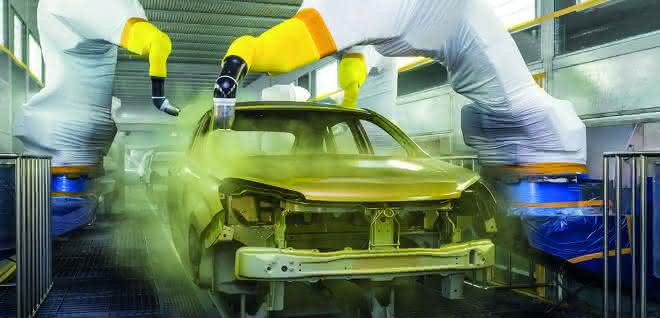
Painting robots in the automotive industry: mists can produce ignitable mixtures when atomized in the spray head
De-icing machines for aircraft: De-icing is carried out with a liquid that consists of at least 50% of highly flammable glycol in addition to water
Fill level monitoring at filling stations: There is a risk that an electrical spark could cause the gaseous atmosphere to explode
Monitoring chemical distribution: The warehouses of chemical manufacturers and distributors contain numerous different chemical drums with a wide variety of explosive and harmful contents
Measure and transmit
If the products are used in hard-to-reach places, the measured data cannot always be read out on site. Keller therefore offers remote transmission units that forward the measured values to a server or a cloud. The recorded measurement data is then retrieved and evaluated via a customer application or via the in-house Kolibri Cloud.
Remote transmission units such as the ARC1-SB box from Keller are not explosion-proof in themselves. Modules that are used in potentially explosive environments must therefore be installed outside the explosive atmosphere. Remote transmission units for certified explosion-proof products contain safety barriers that limit the electrical power output to the connected intrinsically safe product. This barrier prevents ignition and ensures explosion protection.
Keller is currently developing a new radio transmission unit that communicates via LoRaWAN or NB-IoT networks and can also be installed in hazardous areas. This development will make explosion protection even safer and the installation of pressure measurement technology in hazardous areas easier.


You might also be interested in
ESTIA aims to strengthen Europe's cloud
New tech alliance for EU sovereignty
Twelve companies, including Dassault Systèmes, are founding the European Sovereign Tech Industry Alliance (ESTIA). The initiative aims to strengthen Europe's technological independence and define requirements for sovereign cloud services. The start...
 read more...
Deutsche Telekom and Nvidia launch one of Europe's largest AI factories
With the Industrial AI Cloud in Munich, Deutsche Telekom and NVIDIA are creating one of the largest AI factories in Europe. Companies can train AI models, carry out simulations and access 10,000 GPUs.
read more...Leveraging data potential with AI and streaming
Huge data treasures are still lying dormant in many manufacturing companies. And yet it is high time that these treasures were unlocked. There is often a lack of resources and capacity to make data usable in real time. Streaming production data can...
read more...More awareness of noise
Dematic offers solutions that are tailored to different cloud environments and reduce environmental impact through reduced material consumption and improved energy efficiency.
read more...Generative AI in the automation environment
The mechanical engineering and automation industry is undergoing profound change. This transformation is being driven by more volatile global trade, geopolitical crises and increasing market pressure, which demands greater agility, technological...
read more...Rigid data structures have had their day
The traditional data center is no longer the center of data. A hybrid cloud storage approach enables manufacturing companies to both meet the current requirements of data-intensive processes and future-proof their infrastructure.
read more...Software as a service in three stages
CIM Database Cloud is a new out-of-the-box solution from Contact for end-to-end digital product development.
read more...How production can benefit from AI
Together with AI technology, IIoT networking makes it possible to better control machine parameters and optimize quality with predictive quality. Downtimes and set-up times can also be further minimized. Cloud platforms also make these technologies...
read more...More expertise for digital engineering
Altair, a computational science and artificial intelligence (AI) company, has acquired OmniV, a technology from Michigan, USA-based software company XLDyn.
read more...