

Measurement technology for industrial applications
Displacement-angle difference interferometer records several degrees of freedom
Tiny microchips and huge 8K displays could not be more different in their dimensions - and yet they have one thing in common: their structures are becoming ever finer and place increasing demands on production technology.
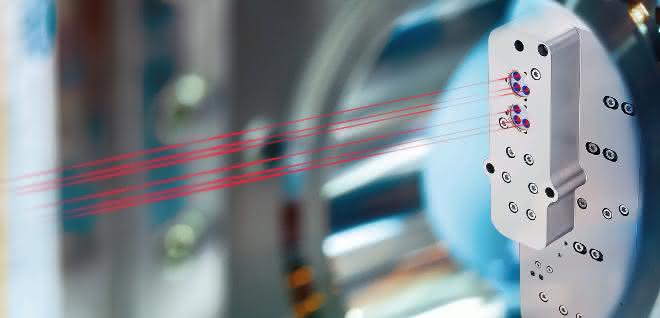
It is necessary to work with tolerances in the picometer range, which repeatedly pushes the measuring methods used to the limits of what is technically feasible. This is because the highly sensitive measurements do not take place under ideal laboratory conditions, but are exposed to disruptive environmental influences in an industrial environment, which quickly distort the results. For applications such as these, Sios Meßtechnik therefore develops high-precision differential interferometers with ultra-stable thermal and physical properties: Fluctuating parameters such as temperature, air pressure and humidity do not affect the very high measurement accuracy, even over long periods of time. The new and so far unique path-angle differential interferometer combines the advantages of differential interferometers with those of the proven three-beam interferometers and makes it possible for the first time to record several degrees of freedom both long-term stable and synchronously.
"High-tech display technology, in which a screen has several million pixels, is a good example of the current challenges facing industrial measurement technology and the semiconductor industry," says Dr. Denis Dontsov, Managing Director of Sios Meßtechnik GmbH. "The positioning accuracy required for stitching, i.e. the alignment of individual structures in the manufacturing process, is around 45 nm per meter. This order of magnitude is comparable to the perfect alignment of cherry pits over the entire area of Thuringia."
Semiconductor production has to face the same problem: The more compact and powerful chips become, the higher the demands on the precision of photolithography as a central production step. However, refractive index measurements in the optics industry and expansion measurements of materials also require increasingly accurate results and only allow tolerances in the nanometer or even picometer range.
At the same time, the complexity of the individual measurement tasks increases, such as position control of x-y tables, recording thermal material expansions, investigating the creep and drift behavior of objects, refractive index measurements and high-precision length and angle measurements. The problem is that all these measurements take place in production environments that cannot provide optimum laboratory conditions. The technology used must therefore be able to compensate for fluctuating environmental influences such as temperature, air pressure and humidity without distorting the results, in order to ensure stable repeatability of multiple measurements. To this end, Sios uses high-precision differential interferometers that achieve 25 times greater stability than comparable measuring systems.
Displacement-angle differential interferometer masters increasing demands on x-y positioning
However, the increasing demand for suitable solutions, particularly for x-y positioning, further challenged the expertise of the measurement technology specialists at Sios. Long-term stable measurements of several degrees of freedom had to be possible simultaneously over longer distances. To achieve this, they combined their high-precision SP 5000 TR three-beam interferometer, which is designed for simultaneous displacement and angle measurements, with the SP 5000 DI differential interferometer in order to benefit from its long-term stability. With the SP 5000 TR-DI path-angle differential interferometer, Sios has thus developed the world's only system that measures path and angle highly synchronously using two times three laser beams and - thanks to the compensation of environmental factors - is also ultra-stable. "The new SP 5000 TR-DI is now able to detect not only the tiniest movements, but also the smallest tilts over larger areas, without the results being subject to thermal and physical environmental influences," explains Dontsov.
The ultra-stable and fast path-angle difference interferometers also have a reference beam for each of the three measuring beams. "The total of six laser beams are guided out of the sensor head in parallel and hit a flexible and a static reflector. In this way, a large part of the distance between the interferometer and the measurement location can be optically compensated. The actual measurement concentrates on the difference in length between the measurement and reference beams, so that environmental influences that could affect the result can only affect this small measurement range. Thanks to the highly symmetrical design of the sensor head, a greater distance between sensor and measurement object is therefore also possible without having to accept distortion of the result. In addition, all differential interferometers are equipped with long-term stable sensors that have a temperature sensitivity of < 20 nm/K.
Precise differential interferometers for a wide range of measuring tasks
For more complex, multi-axis measurement setups, several differential interferometers can simply be combined and operated with just one control unit. Correct alignment of the measuring arrangement is quick and easy thanks to integrated optical alignment aids, even over several meters and axes. Thanks to the modular principle, in which the different components and versions are compatible with each other, Sios can generally react flexibly to individual measurement tasks and adapt optics, hardware or interfaces to specific applications within a short space of time. "It's not always about individual solutions: Like the new SP 5000 TR-DI path-angle differential interferometer, a large part of our product range has been developed in response to individual customer requests," Dontsov sums up.


You might also be interested in
Further simplify assembly processes
In addition to the proven racks with a length of one meter, Wittenstein alpha now offers optional two-meter racks for linear systems. They are particularly suitable for use in short axes, for example, in order to simplify assembly even further.
 read more...
Hiwin manufactures its own shaft gearboxes
Have you ever waited several months for an urgently needed corrugated gearbox? Hiwin has too. That's why the Offenburg-based drive specialist has decided to produce its own space and weight-saving reduction talent.
read more...Human-robot interaction at the trade fair
Sumitomo Drive Technologies is presenting its drive solutions for automation and robotics at Automatica 2023 together with the Lafert Group. The company will be showcasing two different applications of the Tuaka drive system for robot applications...
read more...Partial automation with robots
At Automatica, Promess will be showcasing its modular individual workstations and how these can be partially automated with robot support. The servo press manufacturer will also be providing information about the latest features of its Revolution X...
read more...A new benchmark for collaborative robots
At this year's Automatica, Denso Robotics will be showcasing its innovations in the field of robotics. The collaborative Cobotta Pro product family will be the focus of the presentations. Visitors to the trade fair can see all variants in various...
read more...Clamping system for a new milling machine
Investments in machinery often lead to further purchases - as is the case at Joma-Maschinenbau, whose modern production facility has recently been supplemented by a 5-axis milling machine.
read more...Schunk wants to simplify processes in automated production
The declared aim of automation specialist Schunk is to make its customers' processes comprehensible, simple and efficient. Data transparency plays an important role in this. It enables reliable processes and provides the basis for resource-saving...
read more...Festo and Hahn Automation develop battery tester for greater safety
The success and reputation of electric vehicle manufacturers depend on the safe and flawless functioning of batteries. Hahn Automation has therefore developed a battery tester that performs a fully automated 100% test of mobile energy storage...
read more...SPN Schwaben Präzision presents gearbox solutions for automation and industrial robotics
Short cycle times, robust technology, wear-free surfaces and compact designs have always been relevant for automation and robotics solutions. This year's Automatica trend topics include "Sustainable production" and "Digitalization and AI". SPN aims...
read more...