

Avoid downtimes
Determining the causes of bearing failures
Why do bearings fail? To understand this, the SKF experts investigate these components in the laboratory and in practical use.
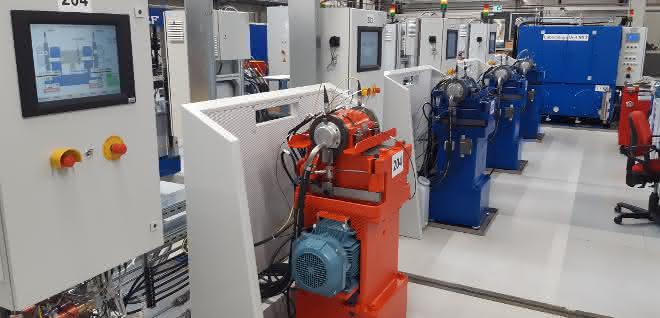
With the Brave test stand currently under construction and the use of artificial intelligence and big data analysis, SKF is finding new approaches and providing customers with new tools in the fight against unplanned downtimes.
"Customers come to us because our products and services help them to work more reliably, sustainably and efficiently," says Bernie Van Leeuwen. He is Head of SKF Research & Technology Development. "As a rule, they also get what they are looking for." More than 90 percent of bearings last longer than the machines in which they are installed.
"However, we also focus heavily on the bearings that fail at some point during use," explains Van Leeuwen. "Over the years, we have developed models with which we can determine their service life under certain operating conditions before the first signs of fatigue appear." In practice, however, things usually look different. "When the defective components came back to us from customers, we found through analysis that in nine out of ten cases the expected operating conditions had changed," says Van Leewen. "These include a lack of lubricant, contamination, corrosion or damage caused by stray currents." As the machines also have to function under difficult conditions, this can never be ruled out. "However, if we can predict them reliably, we can reduce their consequences," explains the expert. "It is much more economical to replace a bearing during a planned overhaul than to stop a production line for emergency repairs." This is why SKF is working on optimizing predictability.
Recognition, diagnosis and prognosis
Is there a problem or is there a possibility of a problem with my machine? What is the cause of the problem? Can I continue to operate my machine until the next scheduled maintenance interval? Is there anything I can do to keep it running? "To answer these questions, we often have to use completely new technologies," explains the SKF expert. "But it also often helps to apply well-established concepts in new ways." This applies to bearing tests, for example.
SKF operates numerous bearing test rigs in its laboratories around the world. Here, the products are run until they fail completely. This gives the technicians a better understanding of failure mechanisms and enables them to verify mathematical models. "These test procedures are quite simple," says Van Leeuwen. "We run the test bench until we detect a problem with the bearing. For our predictions, however, we need a different type of test: it has to start where a conventional test ends." This allows SKF to analyze how damage develops in a bearing and how quickly small faults grow into major problems.
A new test center is created
SKF is currently building a technology center in Houten in the Netherlands for this purpose. "The test rigs in the new center are called 'Bearing Rigs for Accelerated Verification Experiments' (BRAVE). They simulate the types of possible conditions that can be found in practice," explains Van Leeuwen. "On our test rigs, we can deliberately generate bearing damage, for example due to corrosion, lack of lubricant, contamination or electrical currents. We can also observe how different loads and speeds affect the spread of bearing damage."
Artificial intelligence (AI) and machine learning are currently very important topics at SKF. Last year, SKF further strengthened its AI group. The specialists are now adapting systems and processes throughout the organization accordingly. "For example, our latest test benches can collect much more data at a higher frequency than their predecessors," explains Van Leeuwen. "We store the information in our cloud so that teams around the world can access it. This allows them to train their algorithms and try out new ideas."
They also apply automatic analyses on this basis. "A very good example of this is an ongoing project from our reconditioning business," says the expert. Steelworks use many bearings in their conveyor technology. Due to the size and cost of the components, they are suitable for reconditioning. But what happens if a fault is not detected for too long, is it even possible? "Previously, we could only determine this when the bearing arrived at our premises," he says, describing the initial situation. To avoid unnecessary transportation, SKF is testing an automatic image recognition system.
The bearings are photographed by the customer when they are removed. The system then analyzes their condition and independently determines whether they can be repaired. This provides the customer with clear added value, as they receive a report on the possible cause of the damage. "One of the most interesting aspects of working with big data and AI is the way they complement each other," says Van Leeuwen. "Thanks to the combination of data from our new test benches, from sensors on customer machines and from images of damaged bearings, we can constantly refine and optimize our algorithms and mathematical models."
SKF has already achieved a number of breakthroughs, particularly in detection and diagnosis. These methods are already being used by selected customers. In view of the increasing reliability and applicability of the methods, SKF plans to offer new tools, products and services in the coming months and years.


You might also be interested in
ESTIA aims to strengthen Europe's cloud
New tech alliance for EU sovereignty
Twelve companies, including Dassault Systèmes, are founding the European Sovereign Tech Industry Alliance (ESTIA). The initiative aims to strengthen Europe's technological independence and define requirements for sovereign cloud services. The start...
 read more...
Deutsche Telekom and Nvidia launch one of Europe's largest AI factories
With the Industrial AI Cloud in Munich, Deutsche Telekom and NVIDIA are creating one of the largest AI factories in Europe. Companies can train AI models, carry out simulations and access 10,000 GPUs.
read more...Leveraging data potential with AI and streaming
Huge data treasures are still lying dormant in many manufacturing companies. And yet it is high time that these treasures were unlocked. There is often a lack of resources and capacity to make data usable in real time. Streaming production data can...
read more...More awareness of noise
Dematic offers solutions that are tailored to different cloud environments and reduce environmental impact through reduced material consumption and improved energy efficiency.
read more...Generative AI in the automation environment
The mechanical engineering and automation industry is undergoing profound change. This transformation is being driven by more volatile global trade, geopolitical crises and increasing market pressure, which demands greater agility, technological...
read more...Rigid data structures have had their day
The traditional data center is no longer the center of data. A hybrid cloud storage approach enables manufacturing companies to both meet the current requirements of data-intensive processes and future-proof their infrastructure.
read more...Software as a service in three stages
CIM Database Cloud is a new out-of-the-box solution from Contact for end-to-end digital product development.
read more...How production can benefit from AI
Together with AI technology, IIoT networking makes it possible to better control machine parameters and optimize quality with predictive quality. Downtimes and set-up times can also be further minimized. Cloud platforms also make these technologies...
read more...More expertise for digital engineering
Altair, a computational science and artificial intelligence (AI) company, has acquired OmniV, a technology from Michigan, USA-based software company XLDyn.
read more...