
Quality assurance
Check high-performance connections
High tensile stresses and vibrations put enormous strain on fasteners and can lead to breakage. Particularly in the aviation and motorsport industries, not only are special manufacturing processes used, but comprehensive material tests are also carried out.
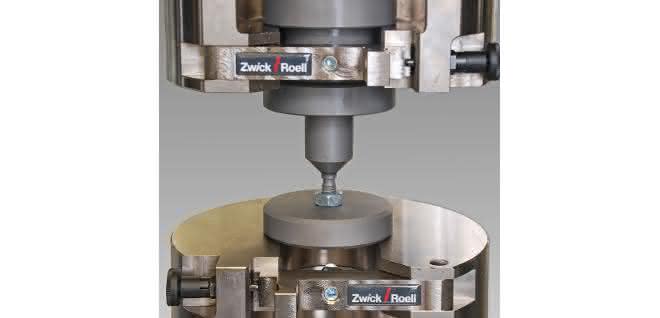
Fasteners such as screws are exposed to particularly high stresses in the aviation and motorsport industries. The requirements in terms of wear and corrosion resistance, repeated strength and temperature cycles, fluctuations in dynamic loads and high vibrations are correspondingly high. In addition to special manufacturing processes, this also requires extensive testing of the materials in quality assurance. One of the leading German manufacturers of fasteners in the high-end sector is the company Johann Maier in Stuttgart. The applications of the extensive portfolio range from use in the International Space Station and satellites to helicopters, jets, gearboxes and engines.
In order to achieve the required values for the respective applications, sophisticated manufacturing processes such as hot forging, heat treatment or thread rolling are used and the components are checked using destructive and non-destructive testing methods. "We call it proven safety," explains Dr. Oliver Lang, Managing Director of the company. "If we want to guarantee the maximum quality, highest precision and absolute safety of our products, we have to test them accordingly."
Cyclical stresses
In addition to static loads, fasteners are generally also subject to cyclical stresses such as vibrations. To determine the fatigue strength of components using uniaxial fatigue tests, the company uses a servo-hydraulic testing machine from ZwickRoell in Ulm. The strength of this drive principle lies in its wide range of options in terms of force, amplitude and frequency. They can also be used universally; for example, these testing machines can also be used to carry out durability tests or crash tests at speeds of up to 20 m/s.
The servo-hydraulic fatigue testing machine with a dynamic nominal force of 250 kN is part of the HA series, which is available in standard sizes from 50 to 500 kN. It is specially designed for determining material characteristics under oscillating loads and is particularly suitable for test set-ups in which temperature chambers or furnaces are mounted in the test chamber. The arrangement of the cylinder, which is located in the lower crosshead and below the test chamber, prevents heated air from rising upwards and heating up the cylinder. It also prevents oil from dripping into the heated test chamber.
Low-cycle fatigue tests are a typical application for servo-hydraulic testing machines. In these tests, the material is cyclically loaded to a low level of plastic deformation, usually at an elevated temperature. The specimen can only withstand a few thousand load cycles with this type of load. But the machine's controller is also challenged. As the stiffness of the specimen changes rapidly during the transition from elastic to plastic deformation, the controller must react within a very short period of time in order to guarantee a constant increase in the strain rate, for example. The high rigidity of the testing machine also plays a decisive role here.
Tensile strength and elongation at break
One of the central static tests on screws is determining the tensile strength in N/mm2. Johann Maier uses an electromechanical testing machine from ZwickRoell's AllroundLine series for these tests. It is specially designed for tensile, compression and flexure tests as well as shear and torsion and is equipped with backlash-free preloaded ball screws and a maintenance-free AC drive with motor feedback system. As a result, it achieves excellent synchronization properties even at low speeds in order to generate precise measured values.
In addition to the parameters of tensile strength, yield strength and elongation, another relevant parameter is elongation at break. This permanent plastic strain is an indicator of the deformability of the material and is measured on twisted bolts. The MakroXtens extensometer developed by ZwickRoell for strain measurement records the elastic and plastic deformations during the entire tensile test via its probes - even with high forces and brittle materials - and can be used up to specimen break. It is calibrated at the factory and fulfills class 0.5 of EN ISO 9513 from 20 μm change in length.
To clamp the specimens in the testing machine, so-called clip-on specimen grips with corresponding head and thread holders are used. This ensures, among other things, that the minimum specimen length specified in the ISO 898 1 standard for carbon steel and alloy steel bolts is adhered to. The specimen grips are available for testing bolts and nuts as well as for testing shoulder and thread head specimens in accordance with the relevant standards. With the aid of special test mandrels and dies, they can also be used for test load tests (tensile and compression tests) on nuts.
Test software and control electronics
The TestXpert III testing software developed by ZwickRoell is already equipped with a corresponding test specification for testing the strength values of bolts and nuts to ISO 898 1 and ISO 898 2. The minimum breaking force required by the standards is already stored and is compared with test results. In addition, the software offers an intuitive operating concept for all testing machines and testing devices and guides the operator from preparing and performing the test through to analyzing the results. The operator is also supported by the TestControl II control electronics, which, in conjunction with the testing software, enables extremely precise control of the strain rate via a closed control loop, even at very low strains.
With its wide range of modular testing machines, ZwickRoell demonstrates that even demanding tests on high-performance bolts can be performed efficiently. Force ranges tailored to the respective testing task and simple adaptation of the fixtures for bolts and nuts to other sizes contribute to this. Another advantage is the quick and easy loading and frontal access to the tools.


You might also be interested in
Protection against electrostatic discharge
StoFloor ESD KU 614 from StoCretec: dissipative flooring with the latest technology meets all ESD standards, is economical, extremely durable, mechanically and chemically resistant. The surface can be adjusted to be slip-resistant. The system is...
 read more...
Cables and wires from Helukabel
Food cultivation on a new level
Vertical farming - cultivation in multi-storey greenhouses - is considered one of the most exciting trends in food production. One of the pioneers in this field is the Romanian start-up Ultragreens. The company relies on solutions from Helukabel to...
read more...Further training for specialists to become security experts
With the "CESA - Certified Expert for Security in Automation" qualification, automation expert Pilz offers a two-day expert course designed to provide participants with compact security knowledge in line with the latest standards.
read more...Meaningful data on the service life of the seal
Seals prevent substances from penetrating or entering technical components. The intelligent seals from Freudenberg Sealing Technologies can significantly expand this core task in the future: the seal itself is also a sensor and becomes a "smart...
read more...Online stud configurator according to drawing
For standard bolts, with head, thread or hole
For standard bolts, with head, thread, bore or as a version with recess, mbo Osswald configurators map the standard specifications, are very easy to use, take a lot of work off the user's hands and save a lot of time.
read more...Safe palletizing with the Cobot
Verla-Pharm's medicinal products and food supplements have been available for decades. Ever-increasing throughputs result in ever-increasing logistics costs, whereby optimum utilization of the available production space is necessary.
read more...The tiger among processors
Since the move towards the Industrial Internet of Things (IIoT) and Industry 4.0 has picked up speed, processor boards and modules must be able to process exponentially growing amounts of data.
read more...VDWF publishes "Sustainability Compendium"
Nowadays, nobody can avoid "sustainability": In addition to a far-reaching presence in the media, it is also becoming increasingly important for companies in the tool and mold making industry to develop and implement appropriate concepts.
read more...More transparency and synergies with QM software
Weber, manufacturer of wood and metal sanding machines and extruders, has reorganized its quality management with ConSense IMS Professional. The software solution enables transparent documentation and more efficient processes.
read more...