
Condition assessment with noise emissions
Check compressed air tank with operating medium
In production plants, the strength of compressed air tanks is mainly tested using water pressure. This can result in longer downtimes because the containers have to be cleaned and dried afterwards.
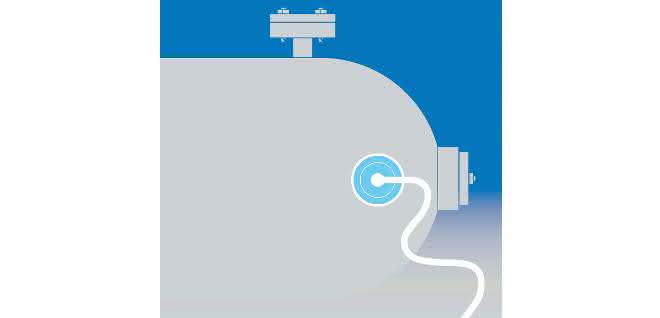
A method is therefore required that enables testing with an operating medium - i.e. with gas pressure. The acoustic emission test closes this gap.
Compressed air tanks must be inspected regularly in accordance with the German Ordinance on Industrial Safety and Health (BetrSichV). The aim is to detect leaks, cracks and corrosion at an early stage before they become critical. Testing is usually carried out using water pressure. To do this, the tanks are filled with water and emptied, cleaned and dried after the test. This involves longer downtimes. Alternative test methods may be used. However, the prerequisite for this is that the system operator's test concept provides equivalent information on operational safety and that this is confirmed by an approved inspection body (ZÜS). In this context, the acoustic emission test (SEP) is a suitable test method. The advantage: An SEP can be carried out with the operating medium as a gas pressure test and shortens the downtime.
Procedure and mode of operation
During the test, the pressure in the container is constantly increased and monitored with sensors. If the SEP is carried out as a gas pressure test, the test pressure PTSEP should be at least 1.1 times the maximum operating pressure POP. If this value is reached, the test also replaces an internal inspection of the pressure device.
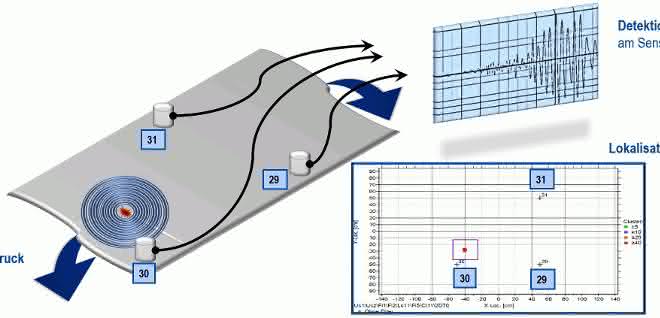
The increase in pressure causes active defects in the material of the container, such as cracks, to generate what is known as crack friction. This generates a mechanical jump in movement in the structure, which pushes its surroundings. This in turn springs back and triggers elastic sound waves. Piezoelectric sensors, which are attached to the outside of the container wall, pick up the sound waves and convert them into electrical signals.
Digital twin and data analysis
A computer records the electrical signals and transfers them to a digital twin. This allows the sound emission sources (SE sources) to be detected and localized(Figure 1). The signals are divided into clusters according to their local accumulation. The number of signals measured in a cluster describes the degree of activity in an area. The clusters are grouped into three classes depending on the degree of activity and intensity:
|
Classification of the |
Assessment |
Measures |
|
Class 1 |
Insignificant |
No measures required |
|
Class 2 |
Active |
Visual inspection and/or further NDT for follow-up and assessment |
|
Class 3 |
Very active/ critical |
Test interruption/interruption, pressure release, visual inspection and further NDT for follow-up inspection and assessment before recommissioning |
This facilitates data analysis and helps to derive suitable measures from the test results. Not only can SEP be used to detect changes in the structure of the material at an early stage, the test method often also provides a better basis for decision-making than traditional pressure and visual inspections. In addition, non-critical inhomogeneities and microcracks that do not grow during normal operation can be recognized as such and therefore left as they are.
Testing and continuous monitoring
The acoustic emission test makes defects visible as they develop or continue to grow. This makes the method suitable for monitoring systems during operation. With just a few sensors at fixed positions, containers of different sizes, even with complex structures or areas and installations that are difficult to access, can be easily and reliably tested and continuously monitored. The inspection process benefits from the steady increase in computing power in recent years. Several hundred anomalies per second can be easily recorded and mapped in the digital twin. Continuous monitoring also provides a comprehensive database that can be used effectively for planning maintenance and servicing measures. The measurement data can also be made available via the network or the cloud (online monitoring). If the SEP is supplemented with a separate ultrasonic measurement, the wall thicknesses of tanks and pipes can also be permanently monitored using the permanent monitoring method.
Case study: Compressed air tanks in pharmaceutical production
In pharmaceutical production, compressed air is used in various areas: on the one hand as process air for conveying pharmaceutical components or for manufacturing and packaging tablets, and on the other hand as a medium for cleaning system components and containers. The demands on the quality of the compressed air are therefore very high. The operating medium must always be clean, dry and free of germs and oil.
TÜV Süd Industrie Service was commissioned by Hexal to inspect a compressed air tank in production. The tank, made of heat-resistant structural steel (material P 235 GH) and built in 1991, has a volume of 3,000 liters. As the plant runs in three-shift operation, downtime had to be kept to a minimum. The first step was to carry out an internal inspection of the tank. Although this is not absolutely necessary for an SEP, the inside of the tank was easily accessible via the existing manhole. No relevant damage was found during the visual inspection and the wall thickness measured with ultrasound was also uncritical.
In the second step, piezoelectric sensors were attached to the outer wall of the container in preparation for the SEP. A total of eight sensors were sufficient to test the entire structure of the container. The maximum permissible operating pressure POP was 11 bar. The test pressure PTSEP was applied with an external compressor, set to 12.1 bar and held for 15 minutes. The tank was then ready for operation again. Analysis of the recordings showed that class 1 SE sources (insignificant sources) only occurred in a few areas. This meant that the stability of the pressure vessel was not at risk and safe continued operation was possible until the next periodic test.
M. Eng. Oliver Großgart, Plant Safety Expert, Plant Safety Business Unit, TÜV Süd Industrie Service


You might also be interested in
ESTIA aims to strengthen Europe's cloud
New tech alliance for EU sovereignty
Twelve companies, including Dassault Systèmes, are founding the European Sovereign Tech Industry Alliance (ESTIA). The initiative aims to strengthen Europe's technological independence and define requirements for sovereign cloud services. The start...
 read more...
Deutsche Telekom and Nvidia launch one of Europe's largest AI factories
With the Industrial AI Cloud in Munich, Deutsche Telekom and NVIDIA are creating one of the largest AI factories in Europe. Companies can train AI models, carry out simulations and access 10,000 GPUs.
read more...Leveraging data potential with AI and streaming
Huge data treasures are still lying dormant in many manufacturing companies. And yet it is high time that these treasures were unlocked. There is often a lack of resources and capacity to make data usable in real time. Streaming production data can...
read more...More awareness of noise
Dematic offers solutions that are tailored to different cloud environments and reduce environmental impact through reduced material consumption and improved energy efficiency.
read more...Generative AI in the automation environment
The mechanical engineering and automation industry is undergoing profound change. This transformation is being driven by more volatile global trade, geopolitical crises and increasing market pressure, which demands greater agility, technological...
read more...Rigid data structures have had their day
The traditional data center is no longer the center of data. A hybrid cloud storage approach enables manufacturing companies to both meet the current requirements of data-intensive processes and future-proof their infrastructure.
read more...Software as a service in three stages
CIM Database Cloud is a new out-of-the-box solution from Contact for end-to-end digital product development.
read more...How production can benefit from AI
Together with AI technology, IIoT networking makes it possible to better control machine parameters and optimize quality with predictive quality. Downtimes and set-up times can also be further minimized. Cloud platforms also make these technologies...
read more...More expertise for digital engineering
Altair, a computational science and artificial intelligence (AI) company, has acquired OmniV, a technology from Michigan, USA-based software company XLDyn.
read more...