

Image processing systems
Can embedded vision revolutionize image processing?
There are exciting applications for embedded vision systems in almost all areas of industry and everyday life, but will this technology really lead to a complete revolution in image processing?
Embedded vision systems make technical systems "see" in an innovative way. A comparison with humans shows what advantages this can bring: Sight is an indispensable prerequisite for many of our abilities. This applies to communicating with people, recognizing dangers and the environment or performing very fine motor tasks. Similarly, machine vision also allows technical systems to solve tasks that they would otherwise not be able to solve.
Although there is no generally accepted definition for the term "embedded vision", there is a common understanding of this technology: compact image processing systems based on customized camera modules are integrated directly into machines or devices, where they use tailored computer platforms and low power consumption to provide intelligent image processing in a wide range of applications without the need for a classic industrial PC. However, there are various forms of embedded vision systems.
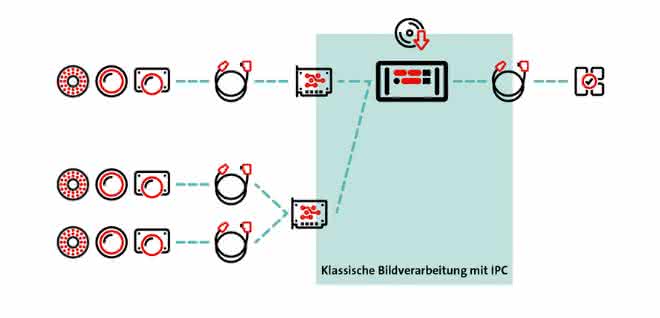
According to Peter Keppler, Director of Corporate Sales at Stemmer, the easiest distinction is between embedded vision systems and classic image processing systems: "The latter work on the basis of industrial PCs that are freely programmable using special image processing libraries. Images are captured by cameras equipped with suitable optics. An essential element is lighting, which should be optimized for the respective application, to ensure sufficient and application-specific illumination of the test objects."
After image acquisition, the recorded camera data is forwarded via suitable interface cables to frame grabber cards, which coordinate the actual image processing on the computer's CPU. Some of these cards, also known as frame grabbers, perform image pre-processing to reduce the load on the host CPU. In the end, such a system delivers the results of the evaluation, which are mostly used for quality assurance of manufactured goods.
Embedded and freely programmable
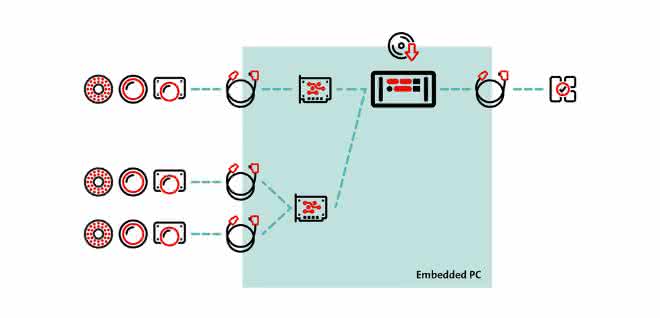
Embedded PCs differ from classic IPC systems in that the functionality of the image capture cards is already integrated into the embedded PC. Like classic industrial PCs, they also enable the connection of external standard cameras with all image sensors available on the market. Based on Windows Embedded operating systems, Embedded PCs are also freely programmable and allow flexible adaptation of the systems to the respective requirements via special libraries for industrial image processing. The connection to the machine is established via proprietary bus adapters or special Industrial Ethernet cards. According to Keppler, the Windows environments used have all the known advantages and disadvantages for the user. He cites the CVS Image Station Compact from Stemmer, the IPD GV family from Teledyne Dalsa and the Matrix series from Adlink as examples of embedded PC systems.
Easy to operate and intelligent
Smart cameras and vision sensors go one step further: in these systems, the camera sensor and image capture, the processor for image evaluation and the I/O interfaces, as well as lighting and optics in some cases, are usually combined in a very compact, robust housing. Vision sensors usually have a graphical "point and click" parameterization. These systems often also work with integrated lighting and optics, which simplifies the application but also reduces flexibility, Keppler points out: "Such systems are usually optimized for specific applications and do not allow a switch to a completely different application, for example from pure presence monitoring to measuring or reading tasks. Another limitation is the limited range of image sensors that can be used in such products."
There is no precise definition between smart cameras and vision sensors. Typical representatives of this class are the compact stand-alone products of the Insight family from Cognex and the Boa series from Teledyne Dalsa.
Specialized in one task
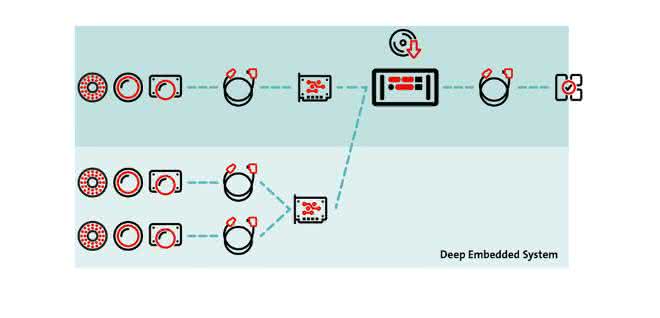
For fully integrated image processing systems that can also work without an operating system, Keppler suggests the term deep embedded vision system, which is not yet established on the market. "Such systems are specially developed for a specific task and are not freely programmable. The communication options of such systems are already firmly defined at the design stage and can only be changed at a later date with relatively high effort." The system design of such deep-embedded vision systems incurs high initial costs, which can only be amortized through large quantities. As a rule, such products are characterized by very low power consumption, which enables long operating times even when operated by battery.
A current example of such deep-embedded vision systems is the Realsense technology from Intel. These camera systems are based on the Realsense vision processor D4 with the most advanced algorithms to process the raw image streams from the integrated image sensors and calculate precise 3D depth information with high resolution at an impressive frame rate and output these 3D images as a result for further processing.
Another example of such deep-embedded vision systems comes from the field of text recognition: compact modules with an integrated camera, OCR software and wireless connection are mounted directly on mechanical counters and enable cost-effective automatic recording without replacing the existing counters with electronic versions: They transmit the meter readings directly to the master computer at set intervals. This eliminates the need for manual readings. Due to the extremely low power consumption and the short switch-on phases, these modules have a maintenance-free service life of around ten years.
Extreme flexibility
According to Keppler, System On Chip (Soc) is a young, recently emerging embedded computer technology with extreme flexibility. "Socs allow customized systems and easy adaptation of a wide variety of image sensors via standard cameras and numerous standard interfaces such as GigE Vision, USB3 Vision or MIPI. By integrating powerful hardware such as FPGAs, GPUs or DSPs, they provide local pre-processing and data reduction if required. Standard-compliant image distribution for further processing and standard-compliant machine communication via OPC UA are also possible." According to Keppler, further advantages of such ARM-based systems under Linux when using the right software environment include source code compatibility with PC systems, free programmability via C/C++ and access to image processing libraries with optimized algorithms. Compact designs, simple integration and low power consumption also characterize these systems.
"As Socs only require low initial investment and system costs and can also be easily duplicated, I believe this technology has the potential to revolutionize image processing," says Keppler.
Selecting the optimum system
The world of automation is becoming increasingly complex. Buzzwords such as Industry 4.0, Internet of Things (IoT) and the Industrial Internet of Things (IIoT) extension, cloud computing, distributed computing, artificial intelligence, machine learning and many other technologies are an expression of the many innovative developments that present users and developers of machine vision systems with major challenges when selecting the optimum system for their particular application.
"Against this backdrop, it is becoming increasingly important that users can rely on advice from competent partners for this key technology," Keppler is convinced. "Stemmer has been focusing on industrial image processing for 30 years, has played a decisive role in shaping the development of the industry and covers all the technologies described with its portfolio."
Keppler describes software as the key to the optimal image processing system for the respective application: "It should be independent of the hardware platform and operating system and also be compatible with common source codes and standards in order to offer the necessary flexibility." Here too, Keppler believes that his company is ideally positioned to provide users with the best possible support on the path to successful application development thanks to its in-house software development, the Common Vision Blox software platform that has been established for years and professional support.
Keppler does not believe that classic image processing could soon become obsolete due to the rapid developments in the field of embedded vision: "Embedded vision systems have experienced an enormous upswing in recent years, both in terms of their performance and their versatility, and offer their users flexible options. Nevertheless, there will still be numerous applications in which classic PC-based image processing systems are the optimal solution." Peter Stiefenhöfer/as


You might also be interested in
ESTIA aims to strengthen Europe's cloud
New tech alliance for EU sovereignty
Twelve companies, including Dassault Systèmes, are founding the European Sovereign Tech Industry Alliance (ESTIA). The initiative aims to strengthen Europe's technological independence and define requirements for sovereign cloud services. The start...
 read more...
Deutsche Telekom and Nvidia launch one of Europe's largest AI factories
With the Industrial AI Cloud in Munich, Deutsche Telekom and NVIDIA are creating one of the largest AI factories in Europe. Companies can train AI models, carry out simulations and access 10,000 GPUs.
read more...Leveraging data potential with AI and streaming
Huge data treasures are still lying dormant in many manufacturing companies. And yet it is high time that these treasures were unlocked. There is often a lack of resources and capacity to make data usable in real time. Streaming production data can...
read more...More awareness of noise
Dematic offers solutions that are tailored to different cloud environments and reduce environmental impact through reduced material consumption and improved energy efficiency.
read more...Generative AI in the automation environment
The mechanical engineering and automation industry is undergoing profound change. This transformation is being driven by more volatile global trade, geopolitical crises and increasing market pressure, which demands greater agility, technological...
read more...Rigid data structures have had their day
The traditional data center is no longer the center of data. A hybrid cloud storage approach enables manufacturing companies to both meet the current requirements of data-intensive processes and future-proof their infrastructure.
read more...Software as a service in three stages
CIM Database Cloud is a new out-of-the-box solution from Contact for end-to-end digital product development.
read more...How production can benefit from AI
Together with AI technology, IIoT networking makes it possible to better control machine parameters and optimize quality with predictive quality. Downtimes and set-up times can also be further minimized. Cloud platforms also make these technologies...
read more...More expertise for digital engineering
Altair, a computational science and artificial intelligence (AI) company, has acquired OmniV, a technology from Michigan, USA-based software company XLDyn.
read more...