

Automated checks
Automation trends in materials testing
Materials testing is becoming increasingly automated, as even the smallest disturbances change the measured values. Even time-consuming or monotonous tasks are increasingly being performed by robots. There are numerous ways to automate material testing - from the automation of small series testing using collaborative robots to fully automated testing laboratories. By David Kalke
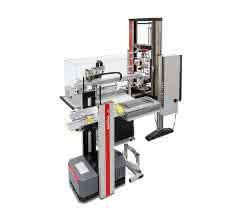
Robotic inspection systems, for example those based on industrial robots, have been used successfully for years. Thanks to their high load capacity, they are able to move even heavy test specimens safely. Thanks to extensive sample magazines, they are suitable for long test series - hundreds or even thousands of test specimens can be processed independently, magazine by magazine. For example, the various roboTest testing systems from ZwickRoell, in conjunction with the respective testing machine, are not only suitable for standard tensile tests on metal or plastic specimens under normal conditions. Flexure tests, temperature-controlled tensile tests, notch impact tests and puncture tests as well as ball indentation hardness measurements can also be automated.
The actual test is performed without further intervention by an employee. ZwickRoell builds autonomous testing laboratories with AGVs (Automated Guided Vehicles) and other handling robots. The latter are coordinated by the ZwickRoell autoEdition 3, as are the robots used for testing. If required, they run around the clock and independently perform material tests from the delivery of specimens on a conveyor belt to the output of destroyed specimens.
What is still left to humans is sample production and preparation. A fully automated test laboratory is particularly worthwhile in the case of quality assurance alongside ongoing production with a high material throughput. Once the workpieces or materials have been removed from the production process, the samples are brought into the required shape and size. In addition, each test specimen is given a barcode or 2D code and can therefore be automatically and clearly identified in the system.
All that remains is to transfer the samples to the robot testing laboratory. There, the test specimens are recognized by their code, assigned to the correct test and testing machine and sorted onto the corresponding tray. Further transportation is carried out by AGVs, which take the trays to the respective testing machine. They use the integrated laser navigation system to create a map of their surroundings and independently find the route to their destination. Thanks to their autonomous navigation, they are superior to conventional solutions, which have to follow a wire embedded in the road or a contrast line stuck on, for example. The solution used by ZwickRoell, on the other hand, is able to avoid obstacles and thus secure the transport chain.
Once at the designated testing machine, the AGV loads the specimens into the testing system's magazine. One of ZwickRoell's robotic testing systems, such as roboTest L, takes over the processing of the specimens: The loading of the testing machine, the testing process and the transfer of data to the customer's software systems as well as the removal of the destroyed specimens are fully automated. Here too, the identification numbers of the test specimens are read by cameras in order to correctly link the test data with the respective specimen. An AGV picks up the emptied trays and transports them back to sample preparation, where they are loaded again.
Automate small series testing
What works excellently on a large scale and saves a lot of time was previously completely uneconomical on a small scale. Setting up stationary robot inspection systems is complex and requires time and specialists. Depending on the system, comprehensive safety measures are also necessary. Powerful industrial robots are not designed to work directly with humans. They lack the ability to react to their environment. Protective fences are therefore usually used. Small series testing has therefore remained firmly in human hands until now. In the past, it was much quicker to entrust an employee with 20 tensile tests or 50 impact tests than to set up one of the large robot testing systems.
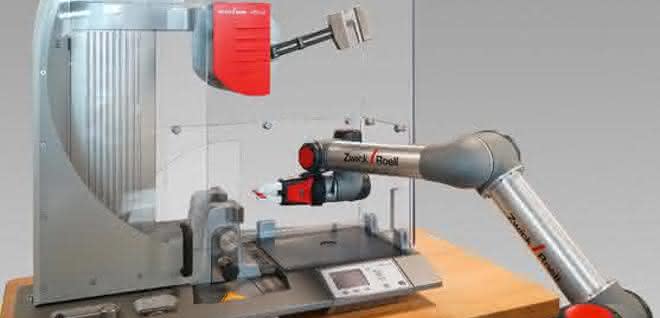
With roboTest N, ZwickRoell offers the option of automating low-volume series tests with lower specimen weights. Based on a Smart Robot, the system is fully integrated into the ZwickRoell autoEditon 3 and testXpert III. This means that neither a robot operator terminal nor special knowledge of programming and operating robots is required.
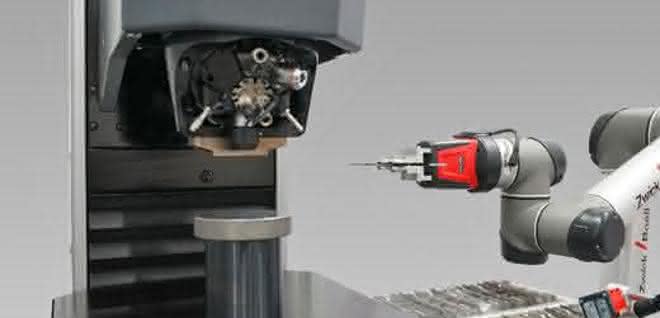
The Smart Robot's working speed and force correspond to human proportions. Sensors detect external influences and stop the system if something gets in its way. This means that roboTest N can work alongside humans without any further protective measures.
The lightweight robot is mounted on a mobile robot table. This allows it to be easily moved to the respective testing machine and connected to the system. This enables the uncomplicated processing of changing small batches and the automated execution of various tests. Tensile and compression tests can be carried out just as autonomously as three-point bending tests, notched bar impact tests or hardness tests. The movable base also offers space for individually manufactured magazines. Started shortly before closing time, the robot extends the working day by one magazine content. The automation of monotonous standard tests frees up qualified employees for more complex testing applications. Thanks to the uniform motion sequences, user errors or inaccuracies can be eliminated and the reliability of the test results increased.
Robotic testing systems offer several advantages in series testing, from time savings to improved reliability of test results. With its various roboTest testing systems, ZwickRoell covers the entire range of test automation - from short-term support for constantly changing small series tests in the laboratory to fully automated testing laboratories without human intervention.
David Kalke, specialized journalist


You might also be interested in
Basler acquires 76% of Indian image processor
Basler, supplier of image processing components for computer vision solutions, has acquired 76% of the Indian sales partner Alpha TechSys Automation.
 read more...
Process monitoring and fault detection
Cameras ensure quality during laser melting
Powder bed-based laser melting (PBF-LB/M) opens up new possibilities in additive manufacturing. Modern camera systems provide crucial process data to further increase quality and efficiency.
read more...Vision Sensor is three times faster than its predecessor
The 'CS-62' vision sensor from di-soric is around three times faster than its predecessor, the 'CS-60'. In combination with the 'nVision-i 25.1' software, it enables image processing solutions that were previously reserved for smart cameras.
read more...Thermal imaging cameras for quality control
Automated thermal imaging cameras are often suitable for quality control applications where temperature plays a role. However, while there are various solutions on the market for slow processes, it is challenging to select a camera that reliably...
read more...Easy entry into industrial VGA thermography
Reliable temperature measurement is a prerequisite for the success of many industrial processes. Berlin-based manufacturer Optris presents the Xi 640 infrared camera, a new member of its Compact Line, which enables non-contact temperature...
read more...Powder bed-based laser melting optimized
Aconity3D has set itself the goal of optimizing the stability of the manufacturing method of powder bed-based laser melting and thereby promoting its use in a wide range of industries. By using high-speed industrial cameras from SVS-Vistek, the...
read more...INDUSTRIAL Production Products of the year...
2nd place, category handling, assembly and production logistics: SICK
safeVisionary2 is the first 3D time-of-flight camera with Performance Level c safety certification. It enables safe three-dimensional environmental detection and won 2nd place in the competition for Product of the Year 2024 in the handling, assembly...
read more...Nomination Products of the Year 2024
SICK: Camera systems safeVisionary2
safeVisionary2 is the first 3D time-of-flight camera with Performance Level c safety certification. It enables safe three-dimensional environmental detection and has been nominated in the 2024 Product of the Year competition in the handling,...
read more...AI vision brings additional opportunities
The seamless integration of AI into the consumer sector has helped to improve our quality of life and make interactions with technology more efficient. In industry, AI vision with machine learning opens up new possibilities that are not covered by...
read more...