
Vision sensors for cobots
A blind eye to automation
Collaborating robots support the automation of manual work. Cobots from Universal Robots are already easy to program; combined with VeriSens vision sensors, they are suitable as a simple solution for vision-guided robotics applications.
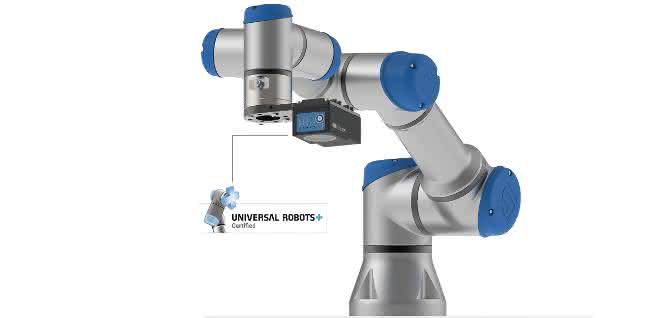
I can see what I'm doing - easy for humans, a challenge for robots. Image processing is playing a key role in anchoring robotics applications in more and more areas of automation. Vision sensors such as the Baumer VeriSens XF900 and XC900 models can provide support here. They combine a complete image processing system in one housing and can be easily parameterized. This makes image processing much easier for users.
What are the benefits of image processing for robots?
Robots orient themselves to taught-in, fixed waypoints and follow them in sequence. Image processing extends this functionality enormously. A simple vision sensor already enables the robot to reliably identify objects. At the same time or alternatively, quality control can also be implemented, which the robot supports by moving the sensor to defined positions. By using the data in the robot program, objects can then also be sorted automatically.
The "supreme discipline", however, is controlling the robot itself, in which image processing determines the position of objects, transfers it to the robot and thus enables it to grasp freely beyond previously fixed waypoints. Objects can be positioned in any orientation on a surface. Position, rotation and optionally other data such as their location are determined and transferred by the image processing system.
Universal Robots uses so-called caps for certified accessories, similar to the "app concept" familiar from smartphones: software plug-ins that make attachments such as a VeriSens vision sensor usable in the Universal Robots programming environment PolyScope.
The image processing task itself is parameterized via the VeriSens Application Suite - independently of the cobot in the most suitable environment. The functions of the VeriSens URCap are generic and thus address all conceivable applications, including the accompanying or stationary arrangement of the vision sensor.
In addition to the installation routine shown in the URCap, only two additional "nodes" (commands) are required to program the Universal Robot, with which image processing is incorporated into the robot programming. For object identification or quality control, for example, a single node is sufficient to trigger an image processing job on the VeriSens in the robot program and make the results available as a variable in the program sequence for decision-making. This means that the cobot can already sort objects.
The second node is added for image-based gripping, which supplements the fixed waypoints with dynamic, image-based ones. An optional wizard specially created for this purpose helps with the simple implementation of pick-and-place applications.
The highlight with automatic calibration
Robots and vision sensors work in their own coordinate systems, which only becomes functionally relevant when object positions are transferred from the VeriSens to the cobot. The coordinates of the vision sensor must be converted to correspond to the robot coordinate system. Until now, the necessary coordinate transformation was determined as a "hand-eye calibration" by manually positioning the cobot several times with a probe tip on a special calibration target. A procedure specified by the manufacturer is run through in many individual steps. This is laborious and also inaccurate and error-prone due to the manual intervention in terms of human control of the probe tip.
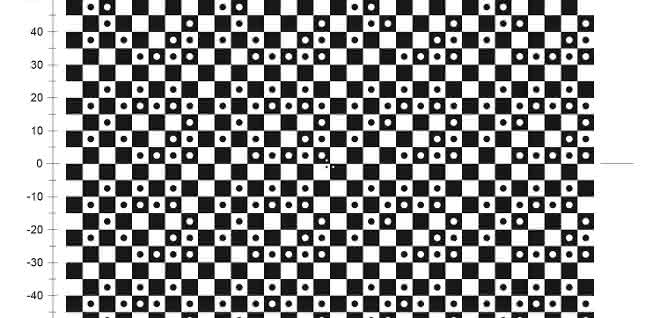
With the patent-pending SmartGrid, Baumer is taking a new approach to automatic calibration for its VeriSens vision sensors. The highlight lies in the intelligent bit pattern, which is hidden in the usual checkerboard format. It provides valuable additional information that VeriSens can read as an intelligent image processing device. One of this information is the position of the vision sensor above the pattern. As the cobot always knows its coordinates, a few linear and rotational movements are sufficient to automatically align the coordinate systems with each other. This procedure is not only very accurate and free of manual errors - it is also very easy to carry out on the cobot's touchscreen.
2D vision sensor for 3D robots
Finding objects is solved from the point of view of coordinates. However, SmartGrid achieves much more: VeriSens also uses the grid to learn an ideal image. The vision sensors can then rectify captured images in real time to correct lens distortion. As the bit pattern also provides data on the size of the SmartGrid used in each case, VeriSens now has all the information it needs for scaling. Conversion to world coordinates is therefore already set automatically.
The SmartGrid also supports semi-automatic Z-calibration, with which VeriSens learns its position in space and can also apply the data from image rectification in space. This solves one last challenge for vision-guided robotics: the 2D vision sensor must provide data to a 3D robot. It would not be very user-friendly to only be able to use the coordinates of a single plane, the image plane. A robot also needs coordinates in other planes of the Z-axis, e.g. for gripper access or for recognizing important markings. Thanks to Z-calibration, the automatic adjustment of coordinates in other "heights" is possible. as


You might also be interested in
Hamburg Regional Court issues preliminary injunction against Elite Robots Germany
In the copyright dispute between Teradyne Robotics and Elite Robots Germany, the Hamburg Regional Court has issued an interim injunction. The distribution of the software and products concerned is prohibited, and there is also a comprehensive...
 read more...
Schunk founds tech spin-off for humanoid robot hands
Schunk is bundling its activities in humanoid robotics by founding its own spin-off at the beginning of January. The aim of the new company is to develop modular humanoid robot hands for industrial applications.
read more...Partnership for humanoid robotics
Schaeffler and Neura Robotics jointly develop humanoids
Schaeffler and Neura Robotics will work together in the future to develop and supply key components for humanoid robots. The systems will also be integrated into Schaeffler's global production network.
read more...Yaskawa at the Automatica 2025
AI meets robotics
At this year's Automatica, everything at Yaskawa revolves around AI-based robotics solutions for the smart factory and beyond. As a trade fair highlight, the manufacturer is presenting its new Motoman Next product concept.
read more...Kassow Robots at the Automatica
7-axle vehicle in action
At Automatica, Kassow Robots will be presenting a wide range of industrial applications for production and logistics tasks that provide new impetus for efficiency and flexibility in industrial automation.
read more...Robotics and automation in six exhibition halls
From June 24 to 27, 2025, Automatica, the trade fair for intelligent automation and robotics, will bring industry and research together in six exhibition halls. Preparations are in full swing.
read more...Interview with Jörg Rommelfanger
Robotics in 25 years
The annual IFR report shows that the number of industrial robots is steadily increasing worldwide. They have already played an important role in ABB's portfolio for decades. In an interview with INDUSTRIAL Production, Jörg Rommelfanger, Head of...
read more...Reliable end effector for cobots
Collaborative robots are now widely used for a wide range of handling tasks. SMC offers three versions of the RMH pneumatic gripper for this purpose; it is compatible with cobots from a total of twelve companies.
read more...7-axis cobots with controller in robot base
With the Edge Edition, Kassow Robots has launched the world's first 7-axis cobots with a controller integrated into the robot base.
read more...