
Robotop funding project
Robotics as an opportunity for SMEs during the crisis
Robots increase the efficiency of small and medium-sized companies. Until now, however, access to automation solutions has mainly been available to experts, particularly in large companies. The Robotop platform is designed to make it easier to get started.
The Covid-19 pandemic will also have a significant impact on SMEs and provide a further boost to automation through the use of robots. This is because robots not only make it easier to implement hygiene rules such as social distancing in production processes, but also strengthen the resilience of production companies as a whole: automated systems are fail-safe and ensure consistent quality at manageable costs. They also increase the flexibility of companies by enabling small batch sizes and thus a high product mix. These advantages will become even more important in the coming years, as new capacities are being built up in many countries in order to free themselves from global supply chains, the vulnerability of which became clear during the coronavirus crisis. The current economic downturn should therefore be used by SMEs in particular to gain a competitive advantage.
Until now, the main obstacles to the introduction of robot-based automation solutions in small and medium-sized enterprises (SMEs) have been a lack of expertise and experience. The Robotop funding project from the PAiCE Digital Technologies for the Economy technology program, which is supported by the Federal Ministry for Economic Affairs and Energy (BMWi), now makes it possible to configure custom-fit robots and implement them in your own company, even without prior knowledge. The time-consuming market analysis required to identify suitable robot models is no longer necessary, nor is the laborious search for service providers for assembly or logistics.
The introduction of new systems or equipment for production used to be a lengthy process. It often took many months to get from the initial planning stage, to the creation of a specification sheet, to the order, to the engineering of the individual solution and finally to the safety acceptance and commissioning of the system. With the Robotop platform, this process should not only be shortened, but also made so easy that not only engineers, but also those who know what requirements the automation solution they are looking for should fulfill, can configure a robot.
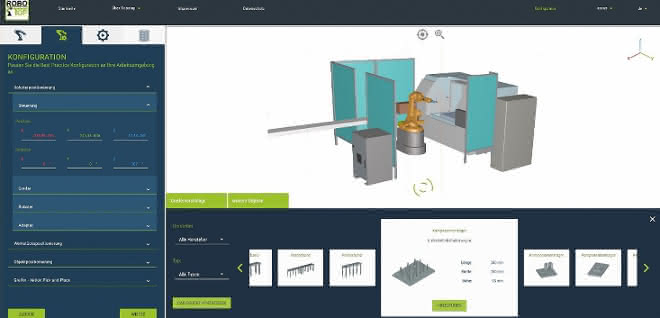
This is made possible by two special features that Robotop offers: Firstly, the Robotop configuration is always based on a best-practice solution that has already proven itself in practice. In the first step, the configurator uses appropriate questions to provide an overview of proven robot offerings that already meet many of the requirements. In the next step, and this is the second special feature of Robotop, components such as grippers, sensors or the controller can be replaced as required. The difficult conception phase is literally solved in a playful way with the configurator.
For example, 3D simulations integrated into the configurator can be used to virtually test whether a gripper is actually suitable for the required task. Robotop offers the option of transferring your own spatial requirements into the virtual space. This makes it possible, for example, to use the realistic model to estimate whether the robot, which can move in six axes with the selected gripper, will actually reach all work points as desired and without collision.
Thanks to the chosen entry point via best-practice solutions that have already proven themselves in practice, small and medium-sized companies benefit from the experience of others and can tap into the mass market for robots in service, logistics and manufacturing applications even without their own development department or expert knowledge. The configurator also supports companies in their search for suitable partners to implement the automation solution. In joint projects between companies, the know-how of the partners can already be mapped in the configurator.
Robotop is therefore particularly suitable for companies that want to invest in robots for the first time, for example to relieve employees of repetitive, risky or unpleasant tasks. The skilled workers that are so important for SMEs in particular can be deployed for more creative tasks such as quality control and optimization.
The current high prices for robots and automation components will clearly fall if they can be established on a large scale in manufacturing. In Germany in particular, this means that robot-based automation solutions must be easily accessible and feasible for SMEs. This is exactly what Robotop aims to achieve with its platform and configurator.
Jan-Peter Schulz / as


You might also be interested in
Further simplify assembly processes
In addition to the proven racks with a length of one meter, Wittenstein alpha now offers optional two-meter racks for linear systems. They are particularly suitable for use in short axes, for example, in order to simplify assembly even further.
 read more...
Hiwin manufactures its own shaft gearboxes
Have you ever waited several months for an urgently needed corrugated gearbox? Hiwin has too. That's why the Offenburg-based drive specialist has decided to produce its own space and weight-saving reduction talent.
read more...Human-robot interaction at the trade fair
Sumitomo Drive Technologies is presenting its drive solutions for automation and robotics at Automatica 2023 together with the Lafert Group. The company will be showcasing two different applications of the Tuaka drive system for robot applications...
read more...Partial automation with robots
At Automatica, Promess will be showcasing its modular individual workstations and how these can be partially automated with robot support. The servo press manufacturer will also be providing information about the latest features of its Revolution X...
read more...A new benchmark for collaborative robots
At this year's Automatica, Denso Robotics will be showcasing its innovations in the field of robotics. The collaborative Cobotta Pro product family will be the focus of the presentations. Visitors to the trade fair can see all variants in various...
read more...Clamping system for a new milling machine
Investments in machinery often lead to further purchases - as is the case at Joma-Maschinenbau, whose modern production facility has recently been supplemented by a 5-axis milling machine.
read more...Schunk wants to simplify processes in automated production
The declared aim of automation specialist Schunk is to make its customers' processes comprehensible, simple and efficient. Data transparency plays an important role in this. It enables reliable processes and provides the basis for resource-saving...
read more...Festo and Hahn Automation develop battery tester for greater safety
The success and reputation of electric vehicle manufacturers depend on the safe and flawless functioning of batteries. Hahn Automation has therefore developed a battery tester that performs a fully automated 100% test of mobile energy storage...
read more...SPN Schwaben Präzision presents gearbox solutions for automation and industrial robotics
Short cycle times, robust technology, wear-free surfaces and compact designs have always been relevant for automation and robotics solutions. This year's Automatica trend topics include "Sustainable production" and "Digitalization and AI". SPN aims...
read more...