

Mobile robots
Strong together
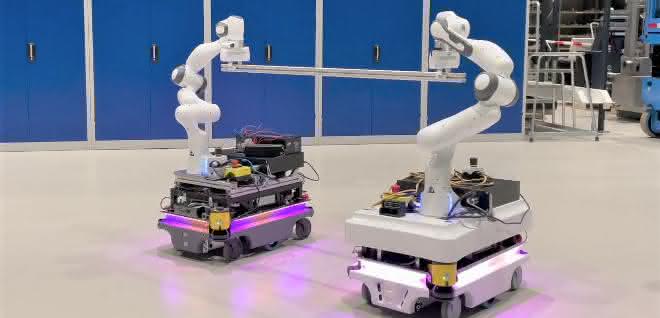
The Institute of Assembly Technology at the University of Hanover is working on the collaboration of several mobile robots for the assembly of large components.
Robot-assisted automation can be very expensive. Depending on the application, a modern robot cell can cost anywhere from 100,000 to over 500,000 euros. Only a comparatively small proportion of this is spent on the actual arm structure. Around two thirds of the costs are usually incurred for peripherals such as assembly devices, conveyor belts and safety fences as well as grippers or tools. Such high costs are particularly problematic when it comes to a highly specialized system that is only used to a limited extent. An obvious solution is to use less specialized, more universal robots. In the field of stationary robots, however, this is not readily possible, as only a certain amount of peripherals can be accommodated in the robot's working area and because the various requirements of the different processes can rarely be met economically by just one robot.
Mobile robots ensure efficiency and flexibility
This is where mobile robotics can help. Mobile robots can move flexibly through production and therefore have an almost unlimited workspace. At the same time, they reduce the need for feeding and transport equipment. Another advantage of mobile robots is that several robots can work together. As part of the SCALE research project - Scalable Production Systems of the Future - the Institute of Assembly Technology (match) is developing methods to enable several mobile robots to perform the task of a larger robot together. This cooperation between several universally deployable small robot units enables them to perform tasks that would be impossible for a single unit. As many mobile robots as are required for the task in question are always combined. This makes the so-called multi-robot systems extremely versatile and highly scalable.
The match's research focus in mobile robotics is on solving application-related problems in the areas of programming, control and regulation as well as task planning and distribution. A particular research challenge is the degree of freedom of the overall system and the associated complexity in modeling and identification. In addition to the mobile robot platform, which can already move freely in space, each mobile unit also has a manipulator with six or seven joints. If several so-called mobile manipulators, as shown in the illustrations, are working on a common object, all the drives of both robots must be moved in precise coordination with each other.
Without the precise coordination of all drives, there will be tension in the object and in the robots, which can cause mechanical damage. In view of this, it is a particular challenge that communication between the mobile platforms must be wireless in order to maintain the autonomy and flexibility of the individual robots. For this reason, the match is researching the use of 5G communication in order to be able to exchange data with the lowest possible latency. In addition, methods are being developed to detect errors and the resulting component stresses at an early stage and to cushion them through the compliant behavior of the manipulator.
Precise process planning
Correct planning of the process sequence is just as important as controlling the manipulators. In particular, it must be determined which robots are to be used, how many and in what arrangement. The number and arrangement of robots is crucial for the distribution of weight and process forces to the individual robots. When determining the optimum arrangement, a number of boundary conditions must be taken into account. On the one hand, the points at which the existing grippers can grip the component must be taken into account. Secondly, collisions between the robots must be avoided.
In addition to the problems mentioned above, match also deals with general problems of mobile robotics such as localization and path planning. The institute thus covers a large part of industrial mobile robotics both in terms of research and application.


You might also be interested in
Spectra Launches 5G RedCap Router for Industrial IoT Applications
With its new 5G RedCap routers, Spectra is expanding its portfolio to include a mobile communication technology for industrial applications designed to bridge the gap between traditional 5G and established IoT standards such as LTE-M and NB-IoT.
 read more...
5G in the industrial IoT
The Chair of Production Systems at Ruhr-Universität Bochum LPS is researching industrial applications with a local 5G network in the context of Industry 4.0.
read more...Implement milling tasks economically
Milling covers a wide range of applications - from the machining of large free-form surfaces in the aviation industry and in the manufacture of wind turbines to the milling of cavities and highly automated mass production.
read more...Mitsubishi Electric invests in the future
Further production building in Owariasahi City
Due to the growing importance of the Japanese region of Owarisahi in Aichi, Mitsubishi Electric Corporation is increasing its planned investments and announcing the construction of a second production building.
read more...Industrial Connectivity Lab opens
Siemens customers test wireless technologies
Siemens has opened a new test lab for industrial connectivity technologies at its Erlangen site. Embedded in the Siemens Technology Center on the Erlangen campus, the Industrial Connectivity Lab offers 300 square meters of space for testing...
read more...A sustainable foundation for the industry
The networks are growing together - this refers to the ongoing merging of IT and OT. Christian Korff, Managing Director Global Accounts and Member of the Management Board, Cisco Germany, explains the challenges and levers involved.
read more...It started with a timer for X-ray machines
In 2023, the automation expert Omron can look back on 90 years of innovative company history, in which many technological boundaries have been crossed and milestones set.
read more...Flexible component transport in production
Stein Automation presents the Stein 400 workpiece carrier system for parts weighing up to 80 kilograms and the C5G logistics control system.
read more...Extended image processing options
High-performance multispectral line scan camera with 5GigE
The new Linea2 4k Multispectral 5GigE camera takes machine vision systems to the next level with its performance and value, offering a 5GigE interface with five times the bandwidth of the Linea GigE camera.
read more...