

Robot control
Industrial robotics from the cloud
Scientists at the Fraunhofer Institute for Production Systems and Design Technology IPK are researching the potential of cloud technologies for industrial robotics together with the Technical University of Berlin.
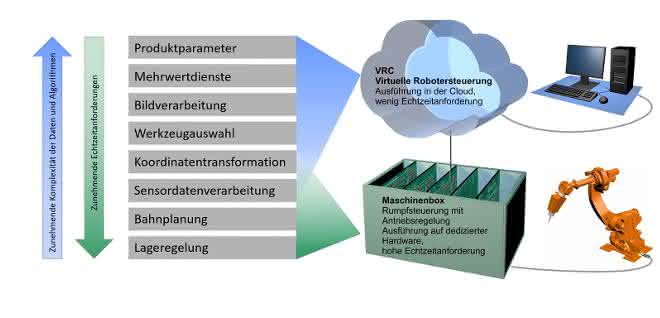
Industrial robots are traditionally used for monotonous, dangerous or force-intensive tasks in rigid cells or lines. The same tasks are always stored and executed on a dedicated controller in the robot's control cabinet and require tedious configuration and programming in the event of a change to the production process.
The increasing number of variants in many industries and sectors, as well as the increasing complexity of products and programs, requires a rethink of control technology for industrial production in general and for robotics in particular.
Modularized and outsourced control
The standard use of industrial robots follows the scheme of the active chain of numerical motion control. This active chain includes the preparation and forwarding of data, from the triggering of a process step by a cell or line cycle, through the selection and execution of subroutines and movement commands, to the interpolation and control of the movement path. The integration of additional sensor technology is possible through defined anchor points in the subroutines.
To increase the adaptability of industrial robots, modularization is achieved by decoupling the work steps into phases:
- Recording the sensor data in a central control system,
- Processing and fusion of the data with production parameters,
- Decision and configuration of the next robot action,
- execution of the action.
Phases 1 and 4 involve communication with the field level, while phases 2 and 3 can be outsourced to a cloud.
Interfaces and services
At the lowest field level, the automation devices, such as industrial robots, conveyor belts, sensors and other peripherals, such as grippers and tools, are connected to the cell controller via a fieldbus system. The sensor data is now transferred IP-based (e.g. in accordance with the OPC UA specification) directly to the higher-level control system without processing. The movement commands are sent from the central control system to the robot cell via the return channel.
The production-tactical logic of what influence the sensor data should have on the process can be implemented by an independent value-added service, for example using the pay-per-use method. Depending on the degree of abstraction of the higher-level communication layers, this service can be accessible in the company's own network, an edge cloud node or even in a publicly accessible cloud. The architecture even makes it possible to combine any services at any locations in order to achieve the desired behavior of the robot.
Camera integration and AI-supported image processing
The handling of objects during a manufacturing or assembly process can change significantly with new variants on the same line. The new parameters must be recorded by using existing sensor technology as well as by quickly installing and integrating additional sensor technology. The central service-based control system is much better able to integrate new sensors and, in particular, new algorithms due to its localization in the data center and its inherent ability to scale flexibly.
For example, robot cells can be retrofitted with RGB-D cameras that enable high-resolution segmentation, identification and localization of objects in the robot's workspace. The image processing algorithms must of course be trained accordingly. The training data, and even more so the learned parameters, can be transferred to other cells and processes at any time with minimal effort thanks to the centralized approach.
The robot-assisted handling process is now independent of the actual object and is available for the mass production of individual products with existing means of production. The modularization and distribution of industrial robot control components within a digital and networked production landscape enable new approaches to process control and individualization. Bundled computing power and modern communication technology enable batch size 1 production on mass production lines through to 100% quality control with AI.


You might also be interested in
ESTIA aims to strengthen Europe's cloud
New tech alliance for EU sovereignty
Twelve companies, including Dassault Systèmes, are founding the European Sovereign Tech Industry Alliance (ESTIA). The initiative aims to strengthen Europe's technological independence and define requirements for sovereign cloud services. The start...
 read more...
Deutsche Telekom and Nvidia launch one of Europe's largest AI factories
With the Industrial AI Cloud in Munich, Deutsche Telekom and NVIDIA are creating one of the largest AI factories in Europe. Companies can train AI models, carry out simulations and access 10,000 GPUs.
read more...Leveraging data potential with AI and streaming
Huge data treasures are still lying dormant in many manufacturing companies. And yet it is high time that these treasures were unlocked. There is often a lack of resources and capacity to make data usable in real time. Streaming production data can...
read more...More awareness of noise
Dematic offers solutions that are tailored to different cloud environments and reduce environmental impact through reduced material consumption and improved energy efficiency.
read more...Generative AI in the automation environment
The mechanical engineering and automation industry is undergoing profound change. This transformation is being driven by more volatile global trade, geopolitical crises and increasing market pressure, which demands greater agility, technological...
read more...Rigid data structures have had their day
The traditional data center is no longer the center of data. A hybrid cloud storage approach enables manufacturing companies to both meet the current requirements of data-intensive processes and future-proof their infrastructure.
read more...Software as a service in three stages
CIM Database Cloud is a new out-of-the-box solution from Contact for end-to-end digital product development.
read more...How production can benefit from AI
Together with AI technology, IIoT networking makes it possible to better control machine parameters and optimize quality with predictive quality. Downtimes and set-up times can also be further minimized. Cloud platforms also make these technologies...
read more...More expertise for digital engineering
Altair, a computational science and artificial intelligence (AI) company, has acquired OmniV, a technology from Michigan, USA-based software company XLDyn.
read more...