
Data analysis
Data, the raw material in assembly
Data is the basis for digitalization and the application of artificial intelligence algorithms. It is seen as a "raw material" and therefore increasingly as a co-decisive production factor. In today's assembly, a holistic view of the product, process, operating resources and their data must be taken.
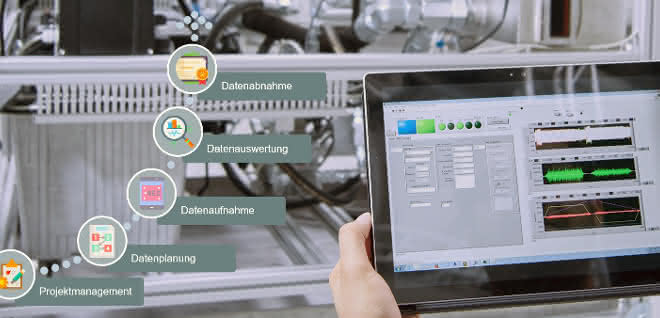
First of all, data ensures transparency in production and can therefore be used for process monitoring and optimization, for example through meaningful visualizations or statistics. This allows problems to be identified and rectified more quickly, especially in complex assembly systems. The forecasting capability of a production system also makes it possible to assess the condition of equipment so that wear and faults can be detected at an early stage. Finally, automated adaptation of the system and its processes can be achieved through the autonomy of the assembly system. The term "autonomy" describes the assembly system's ability to learn independently and make autonomous decisions.
Technical hurdles with industrial data
However, the industrial application of machine learning to real production data is proving difficult. In addition to technical hurdles, such as data aggregation, organizational and socio-technical factors in particular lead to low data quality and availability. A brief overview of common errors:
- Undocumented changes to program sequences or parameters as well as mechanical interventions lead to (inexplicable) changes in the data
- Physical plausibility of the data is not given
- The data does not contain any information. Data is recorded according to the motto: "A lot helps a lot". However, the flood of data makes it difficult to extract relevant data
- Manual data, for example in shift books, is not entered in a way that can be analyzed automatically
Recording data correctly
A methodological guide was developed as part of workshops with small and medium-sized enterprises and research partners. It helps to implement the organizational requirements of sustainable data collection and use in future assembly systems and data projects.
Project interfaces and responsibilities are initially defined through classic project management. Data planning is then carried out to ensure the sustainable use of the data. For this purpose, the objectives of a data analysis and corresponding key figures are defined, which can be used to check whether the objectives have been achieved. The characteristics required to determine the key figures or changes must then be identified and defined using standards. Existing process knowledge should always be used. The selection of appropriate sensors to record the characteristics can be made after successful data planning, taking the requirements into account. Once the sensors have been implemented, a database can be created by recording the data. AI algorithms can then help to determine relevant features, but these results should only serve as a guide for interpretation. A manual plausibility check of the data can be carried out by an interdisciplinary team. The data can then be checked and approved on this basis. In contrast to data analysis, this involves monitoring the data and not the processes.
For successful and sustainable data collection, the software architecture should implement at least the following components:
- A broker that merges sensor signals from various sources and makes them available in a standardized communication protocol
- A processing unit in which the individual signals are translated into the specified formats and units if necessary
- A memory that archives the data for the long term
Visualizations and AI algorithms can access the database, which consists of live data from processing and historical data from the memory. The results of the AI algorithms are fed back into the data preparation so that they can be saved and used for adaptation. Corresponding control commands can be derived there and transmitted to the process control system by the broker.
The methodology and guidelines presented are to be continuously improved and expanded in further research projects and validated in other companies. The existing software architecture is to be offered as an open source solution. Anne Blum, Martin Karkowski, Dr. Leenhard Hörauf, Prof. Dr. Rainer Müller / as


You might also be interested in
Plagiarius 2024 negative prize
On January 26, 2024, the Plagiarius campaign awarded its dreaded "Plagiarius" negative prize for the 48th time to manufacturers and retailers of particularly brazen counterfeits and fakes.
 read more...
Ivalua honors winners of the Generative AI...
AI-supported "add-ons" for buyers within 48 hours
Ivalua, provider of cloud-based spend management solutions, announced the winners and innovations of the first Generative AI Innovation Cup. The competition took place in December 2023. It was open to all Ivalua partners and employees - more than...
read more...Efaflex celebrates 50 years of high-speed...
The emphasis is on "fast"
Since day one, Efaflex has wanted to use new technologies as early as possible and drive progress in the industry. This year, the family business is celebrating its 50th anniversary under the motto "Fast Forward".
read more...Security of supply even during power outages
In the winter of 2022, Germany was worried about energy shortages. The drugstore retailer dm did not paint any horror scenarios, but nevertheless saw the possibility of controlled, temporary, regional power cuts (brownouts).
read more...Safety technology in mechanical engineering
Modules with new functions
Euchner's product highlights at EMO 2023 include the communication-capable solenoid interlocks.
read more...Transforming the paper industry towards climate neutrality
Together with partners from industry and research, Voith is developing a project for the optimization of energy and material flows in paper production. The aim of the research project is to develop a digital framework that enables effective process...
read more...Up to 95 percent less flue gas thanks to direct extraction
The requirements for occupational safety measures and safety technology are also constantly increasing in welding technology. The Technical Rules for Hazardous Substances (TRGS) stipulate that welding fumes and harmful substances must be extracted...
read more...Competitive advantages with large machines
Whether 3D-printed components for machines and systems, prototypes or aids for design: additive manufacturing is almost indispensable for modern companies in mechanical and plant engineering and automation if they want to play in the premier league.
read more...Transport technology from the modular system
Many transport tasks can be realized with the help of linear technology. Pre-configured solutions are available to simplify the interaction between the linear unit, motor, gearbox and controller. This minimizes the effort required for research and...
read more...