
Ergonomics at the workplace
Collaborative assembly stations in the context of handedness
When designing an assembly workstation, consideration should be given to whether it will be used by a right-handed or left-handed person. This should also be taken into account when working with collaborative robots.
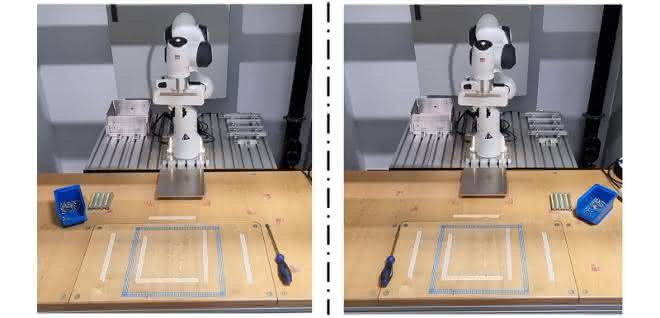
Aspects of dexterity and ergonomics have a significant influence on the design of assembly workstations. However, dexterity is usually only included in the process design when there are high fine motor requirements and is often neglected in the positioning of components, the design of control panels or the use of tools. An influence on the physical strain and an increased risk of accidents for left-handed people using a right-handed workstation has not yet been scientifically investigated. In the context of workplace design, a precise assessment of the strain on both hands when carrying out manual tasks using the key characteristic method is recommended.
However, methods that enable optimization for different manual skills have not yet been demonstrated. Human-robot collaboration is a pioneering technology that makes it possible to improve the ergonomics of manual assembly activities. Initial applications can demonstrate the potential for improving the ergonomics of lifting and holding activities, but do not take human dexterity into account either. Here, adaptive assembly processes offer the opportunity to make workflows more efficient and less stressful thanks to simple and intuitive robot programming options.
Handedness and collaborative working
With the aim of systematically investigating the factors influencing dexterity in human-robot collaboration, assembly tests were carried out with 50 test subjects at the Bremen Institute of Structural Mechanics and Production Systems (bime). In the experiments, which were designed according to scientific standards, the focus was on interaction with a collaborative robot during the execution of an assembly process. An assembly process is carried out in three variants. Variant A depicts a purely manual assembly, variant B primarily supports the right hand of the test participants and variant C, as a mirrored setup, primarily supports the left hand.
In order to optimally record the experiments, the results are recorded in the form of an observation sheet and the test subjects are asked to provide their subjective assessments via a questionnaire. In addition, images are recorded and analyzed using hand tracking and eye tracking systems.
Consideration for handedness increases added value
The evaluation of the tests shows that the number of non-value-adding handling activities can be significantly reduced if the test setup is adapted to the participants' handedness. In the test variants with robot support, a significant reduction in hand changes was achieved if the robot programming was optimized for the respective handedness.
Small components in particular are gripped preferentially with the dominant hand, while handedness is not decisive for gross motor processes. This effect can be observed equally in left-handed and right-handed test participants. If employees are supported in the process by a collaborative robot, this can also have a negative impact on ergonomics if assembly processes are optimized for the wrong handedness.
Both the participants' self-assessment and the evaluation of the test data from hand and eye tracking show a deterioration in ergonomics for people with a dominant right hand at a workstation optimized for left-handedness.
Ergonomics for the well-being of employees
In summary, it can be said that taking hand position into account can have a positive effect on the ergonomics of assembly workstations and the well-being of employees. Particularly in the area of collaborative assembly, where humans and robots work on an assembly object at the same time, taking handedness into account can be crucial. Adaptive robot programming can prevent collisions, reaching or working in non-ergonomic postures.


You might also be interested in
Simply in good hands
The organization of workwear for the team usually also includes lockers, waste bins and, above all, locker systems. DBL offers solutions here. A look into practice.
 read more...
Logimat 2025: Gripping and lifting
Even more ergonomics in intralogistics
At vacuum expert Schmalz, trade fair visitors can experience grippers and lifting aids for picking and moving various goods and components.
read more...Relief for the back
More and more companies are realizing this: Exoskeletons make jobs more attractive and help to attract and retain skilled workers.
read more...Exoskeletons in industrial workplaces
To what extent can exoskeletons relieve employees and which exoskeletons are suitable for what? These questions are answered by a working group at the University of Innsbruck.
read more...Working more easily with the S700 exoskeleton
More strength, less load. With the S700 active shoulder exoskeleton, activities above the head and at chest height are demonstrably and noticeably easier. The exoskeleton can also be individually adapted to the user. The S700 offers prevention...
read more...Welding solutions in the name of resource efficiency
At the Welding & Cutting trade fair in Essen (September 11-15), Fronius will be focusing on the major drivers in welding technology. Quality requirements are increasing in all industries, but the required welding specialists are scarce. In...
read more...E-scooter with customizable damping
The startup Scuddy has significantly improved the flexibility, performance, customizability and ergonomics of its second-generation foldable e-scooter of the same name - thanks in part to damping technology from ACE.
read more...The active shoulder exoskeleton S700 from exoIQ
The advantage of an active exoskeleton is obvious. Like passive systems, they transfer the load from weaker to stronger parts of the body. Following intensive biomechanical analyses, the Hamburg-based company exoIQ has developed an active...
read more...Digital assembly processes to combat the shortage of skilled workers
The increasing shortage of skilled workers is putting even well-established companies in manual assembly under pressure. According to the "DIHK Skilled Workers 2022 Report", 58% of industrial companies were unable to fill vacancies in the long term....
read more...