

Circular economy
Electric motors and batteries in a circuit
Batteries and electric motors are electromobility components that contain valuable raw materials. The "Zirkel-Konsortium" has set itself the task of developing technologies to feed these raw materials into a circular economy. One key to an efficient recycling process is the automated dismantling of the components.
Repair, refurbish, remanufacture and recycle are core principles of the circular economy. In order to conserve resources, as many raw materials and components as possible should be reused or recycled in products. In practice, well-intentioned approaches often fail due to the costs - if the recovery of these raw materials involves too much manual work or is too costly due to the nature of the product. The Zirkel consortium uses the example of electric motors and high-voltage storage systems in cars to show how things can be done better - with a product design that takes subsequent dismantling into account and with automated, highly efficient dismantling processes to recover valuable raw materials.
Electric motors are key components of electromobility. Their inner workings consist to a large extent of sought-after metals such as copper and aluminum and rare earths such as neodymium. These are all materials whose recovery is becoming increasingly essential in view of the growing scarcity of resources and geopolitical dependencies. Over the past three and a half years, the Zirkel project, which is funded by the German Federal Ministry of Research, Technology and Space, has developed practical solutions for the automated dismantling and sophisticated recycling of highly integrated components from battery-powered electric vehicles. While part of the consortium concentrated on high-voltage battery storage systems, the Fraunhofer IWU focused on the electric motor and its material recycling.
Demonstrator for loosening screw connections

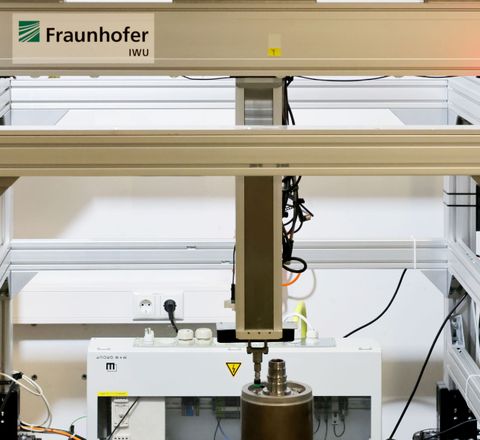
How can bolted joints be loosened quickly and efficiently, even if the components are dirty or worn? In response to this key question, Fraunhofer IWU has developed an adaptive, robot-assisted demonstrator for the automated loosening of bolted joints. Instead of a classic industrial robot, a gantry robot is used. With the help of machine vision and AI algorithms, the system is able to recognize the position and condition of screw connections and loosen them in a targeted manner, which also works with heavily soiled or worn components.
The starting point was a multi-stage disassembly workshop at Fraunhofer IWU, in which rear-axle and front-axle engines from the Volkswagen Group were disassembled, analyzed and the process steps documented. This resulted in detailed disassembly instructions, which served as the basis for defining automated processes. The knowledge gained flowed directly into specific design recommendations for circuit-compatible constructions - for example to standardize screw connections or to improve the accessibility of connecting elements during disassembly.
Particular attention was paid to the magnets installed in the rotor, which contain the element neodymium, one of the most valuable raw materials for electromobility. Various remanufacturing processes were tested in the project, such as mechanical removal after prior separation of the laminated core or targeted removal using hydraulic presses. The result is a practical method for recovering and reusing the magnets with as little damage as possible.
The cycle only becomes economical with Design for Recycling
The aim of the project was to further develop disassembly and remanufacturing processes technologically so that even complex battery storage systems and electric motors can be largely automated and thus economically dismantled. Numerous processes and work steps now describe the path from CAD-supported dismantling planning to automated screw recognition and the experimental remanufacturing of magnetic materials.
The developed solution has the advantage of being adaptive, which significantly reduces set-up times. First of all, the system recognizes in a rough alignment that a component is in the disassembly cell. Subsequently (fine alignment), the system searches for joints that have already been taught in. Disassembly can now be carried out independently of the component; the only requirement is that the screw head has been trained once. Any number of screw heads can be trained. Standard stereo cameras are sufficient for the low-cost hardware solution developed. A key finding is that design for recycling must be an integral part of product development in order to close loops technologically and economically.
Fraunhofer-IWU, www.iwu.fraunhofer.de


You might also be interested in
Pro-K Publishes Template for EU Declaration of Conformity
Starting August 12, 2026, the PPWR will require manufacturers of various types of packaging to provide a formal EU declaration of conformity. Pro-K has now provided a sample template for this purpose. At the same time, the association warns that...
 read more...
When heat slows down production
Cooling concept for industrial halls with significantly reduced energy requirements
Infranorm is developing a cooling concept for industrial halls based on two-stage adiabatic cooling. According to the company, energy consumption can be reduced by up to 95 percent.
read more...Environmental technology as the industry of...
Ifat reports record figures for its 60th anniversary
Ifat Munich 2026 records record numbers with 3,400 exhibitors and 142,000 visitors The circular economy and water technologies are becoming key global industries.
read more...Sustainability needs decisions
To mark Earth Day, Nagarro is calling for a rethink: sustainability should no longer be documented, but actively managed - with artificial intelligence as a central lever. Because AI brings light into the darkness of global supply chains.
read more...Siemens Nanjing plant becomes Lighthouse Factory
The World Economic Forum has recognized the Siemens plant in Nanjing as a Lighthouse Factory. The factory was recognized for its AI-supported, fully digitalized production and significant improvements in productivity, quality and sustainability.
read more...Foundry modernizes plant park with continuous wire belt shot blasting system
The Spanish foundry Funosa is modernizing its equipment fleet with an RDGE 1250 wire belt continuous shot blasting machine from Rösler. Focus: sand removal from heavy iron castings, energy efficiency, ease of maintenance and ESG strategy.
read more...Maintenance instead of replacement
The circular economy starts with the machinery
Sustainability in industry starts with machines, says our guest author from Deguma: How maintenance, modernization and the 5R strategy save resources, energy and CO₂.
read more...Alpla continues to grow: 5.2 billion euros turnover
Alpla can look back on a successful financial year 2025 despite the difficult global economic situation. With revenue of 5.2 billion euros, the packaging and recycling specialist remains on course for growth.
read more...Interview with Prof. Dr. Vanessa Just
How sustainable is AI? Expert explains opportunities and limits
Artificial intelligence is changing the economy and society: but how sustainable is the AI boom really? In this interview, Prof. Dr. Vanessa Just talks about sustainable digitalization, responsible technologies and the role of the next generation in...
read more...