

MRK
AR connects humans and robots
Augmented reality (AR) technologies are increasingly being used in an industrial context. AR glasses can be used to augment the real environment with virtual objects. These are anchored in the real environment.
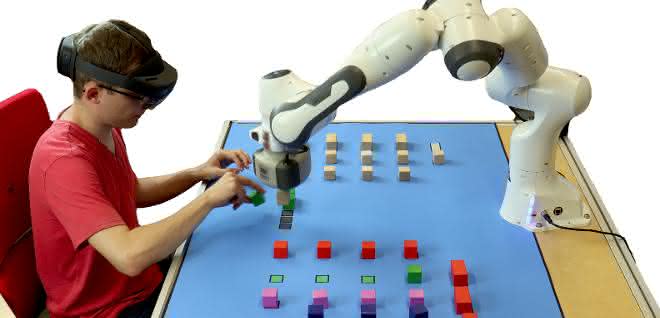
Building on this, the creative possibilities of AR are open. Animated models of real objects can be created that can be changed by the user by gripping and moving them. AR thus promises simplified operation, greater safety and easier learning when handling robots and machines.
The wide availability of collaborative lightweight robots enables the integration of robots into existing manufacturing processes. A distribution of tasks that utilizes the strengths of humans (dexterity, adaptability) and robots (strength, precision) is particularly suitable for small-batch production of products with many variants. One challenge is to coordinate the joint work of humans and robots. Traditionally, this is done by means of a predetermined plan. Creating this is time-consuming: Collisions must be avoided and the overall duration should be minimized.
This requires the movements of humans and robots to be estimated as accurately as possible and humans to be trained in the process. On the other hand, the potential of humans to react flexibly to deviations and gradually improve processes under real conditions is not fully exploited. Just as when working with a human, it would be desirable for the human-robot team to be able to familiarize itself with the process in order to be able to optimally complete the manufacture of a product. During this phase, both partners try out different approaches. They have to react flexibly to each other.
The Chair of Robotics at the University of Bayreuth is working on methods for recognizing the human approach and announcing the robot's movement. Figure 1 illustrates the interaction between humans and robots in a synthetic assembly task. The human can choose from a large number of variants as to how the individual components of the product are assembled. In each of the variants, the components are picked in a different order and placed in the robot's workspace at different times. For the robot, this means that it has to adapt flexibly to which assembly step is possible and sensible next. Playing through all variants is not an option, as the possible arrangements of just a few subtasks already generate too many variants. Instead, artificial intelligence and neural networks are used to learn a simplified model of how humans behave. Based on the model prediction, the robot estimates what the human will do next and adapts its work step accordingly.
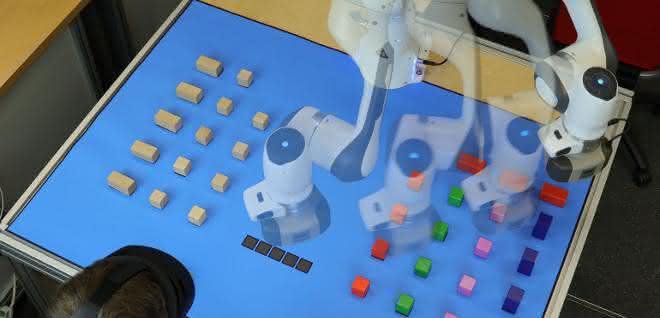
AR technologies play a key role in the process. Virtual objects support both assembly and interaction with the robot. For assembly, the steps still to be completed on the product are displayed. There is no need to look to the side for a task description, and it is possible to work with full focus on the product right from the start. The robot's next step is also highlighted in the display. The human takes this into account and thus avoids trying to complete the same work step as the robot. Another aspect is the avoidance of collisions with the robot. As both are working in the same workspace and on the same product, it is helpful to roughly coordinate who wants to reach where next. The robot uses the above-mentioned model of human behavior for this purpose. At first, it is difficult for humans to estimate how the robot will move. This is where the three-dimensional display in the workspace in Figure 2 comes in handy. In contrast to conventional displays, the human can see directly whether the arm movement could collide with the robot path and can take preventive action to avoid it.
Overall, the combination of artificial intelligence and augmented reality results in a fluid work rhythm. Time-consuming advance planning and division of the individual work steps is not necessary. Frustration is avoided as humans and robots do not block each other or try to start the same assembly step.
Nico Höllerich, Prof. Dr. Dominik Henrich, Chair of Applied Computer Science III (Robotics and Embedded Systems), University of Bayreuth


You might also be interested in
Fraunhofer IOSB Opens Humanoid Robots Lab
The Fraunhofer IOSB is opening a Humanoid Robots Experience Lab in Karlsruhe, Lemgo, and Ilmenau. Companies and organizations can use these facilities to test potential applications for humanoid robots and develop pilot projects.
 read more...
Artificial Intelligence in Manufacturing
Trumpf and IPAI Are Expanding a European AI Network for Industry
The high-tech company Trumpf is an official partner of the IPAI AI network in Heilbronn. Together, the partners aim to exchange experiences, develop new AI applications for industrial use, and advance the development of artificial intelligence in...
read more...Case Study: Networked Manufacturing Platform for Toolmaking
Using a networked manufacturing platform, Escha GmbH & Co. KG, a manufacturer of industrial fastening technology, has comprehensively modernized its toolmaking operations.
read more...Barcelona Declaration on Robotics and...
Robotics Associations Adopt Global Automation Strategy
The global robotics industry is stepping up its collaboration. The associations AER Automation, A3, IFR, and VDMA Robotics + Automation have formed a long-term alliance by signing the “Barcelona Declaration on Robotics and Automation 2026.” The...
read more...Jane Heffner is the new president of the International Federation of Robotics
Jane Heffner is the new president of the International Federation of Robotics. Adrien Brouillard has been appointed vice president of the global federation.
read more...Greater Transparency in the Robotics Market
RoboFinder Launches as an Independent Comparison Platform
Launch at Gitex Europe: 'RoboFinder' aims to bring more transparency to the professional service robotics market. In this interview, founder and CEO Brian Engels discusses market potential, challenges, and the goals of the new platform.
read more...Artificial Intelligence for the Physical Space
Alibaba Expands Qwen Model Family with a Robotics Suite for Physical AI
Alibaba is expanding its Qwen model family with a robotics suite for Physical AI. The three models—for manipulation, navigation, and simulation—are designed to assist autonomous robots with complex tasks in real-world environments.
read more...International Federation of Robotics
U.S. Robotics Industry Sees Double-Digit Growth
In the U.S., sales of industrial robots rose by 11% compared to the previous year: 38,000 units were newly installed in 2025. This significant recovery is driven by robust growth in the food industry and other non-manufacturing sectors. However, the...
read more...Development Collaboration for Humanoid Robotic Hands Launched
Schunk is entering into a new development partnership with Robert Bosch Robotics. Their shared goal is to develop an industrial-grade robotic hand that can be integrated into various humanoid robot systems.
read more...