
Display
With AI to autonomous production
One of the core ideas of Industry 4.0 is to make all processes in industrial production largely autonomous. Artificial intelligence (AI) is an important basis for this, but many projects do not make it past the test phase.
Industrial companies are facing enormous challenges. Today, individuality is more in demand than ever before, so they have to be able to process smaller order quantities faster and faster while maintaining the required time-to-market, and all of this as sustainably as possible with seamlessly traceable supply chains. Massive investments are needed to reduce their own ecological footprint and switch from fossil fuels to renewable energies.
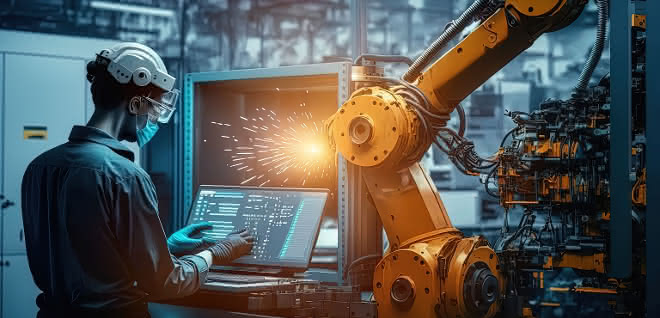
The perceived ongoing crisis since spring 2020, with disrupted supply chains and massively increased raw material and material costs, has forced companies in the manufacturing industry to become more flexible and agile in order to withstand increased competitive pressure, for example through new business models. It is becoming increasingly important to turn machines, some of which are decades old, into IoT devices via their sensors and actuators and to transfer their data from the edge to the cloud so that they can be analyzed and controlled from there.
However, for production and all the processes involved to be truly autonomous, the necessary intelligence is required, i.e. artificial intelligence and machine learning (AI and ML). The advantages are obvious in many cases and can be found in the HPE white paper "From automated to autonomous production - mastering the last mile", including an illustrative application example:
Learn more about autonomous production and implementation in the whitepaper now:
KI OFFERS MANY ADVANTAGES FOR INDUSTRIAL PRODUCTION
In 2017, management consultants McKinsey published a large-scale study on the use of AI in the German industrial sector and saw significant positive effects in manufacturing processes for the aerospace, automotive and semiconductor industries as well as for suppliers:
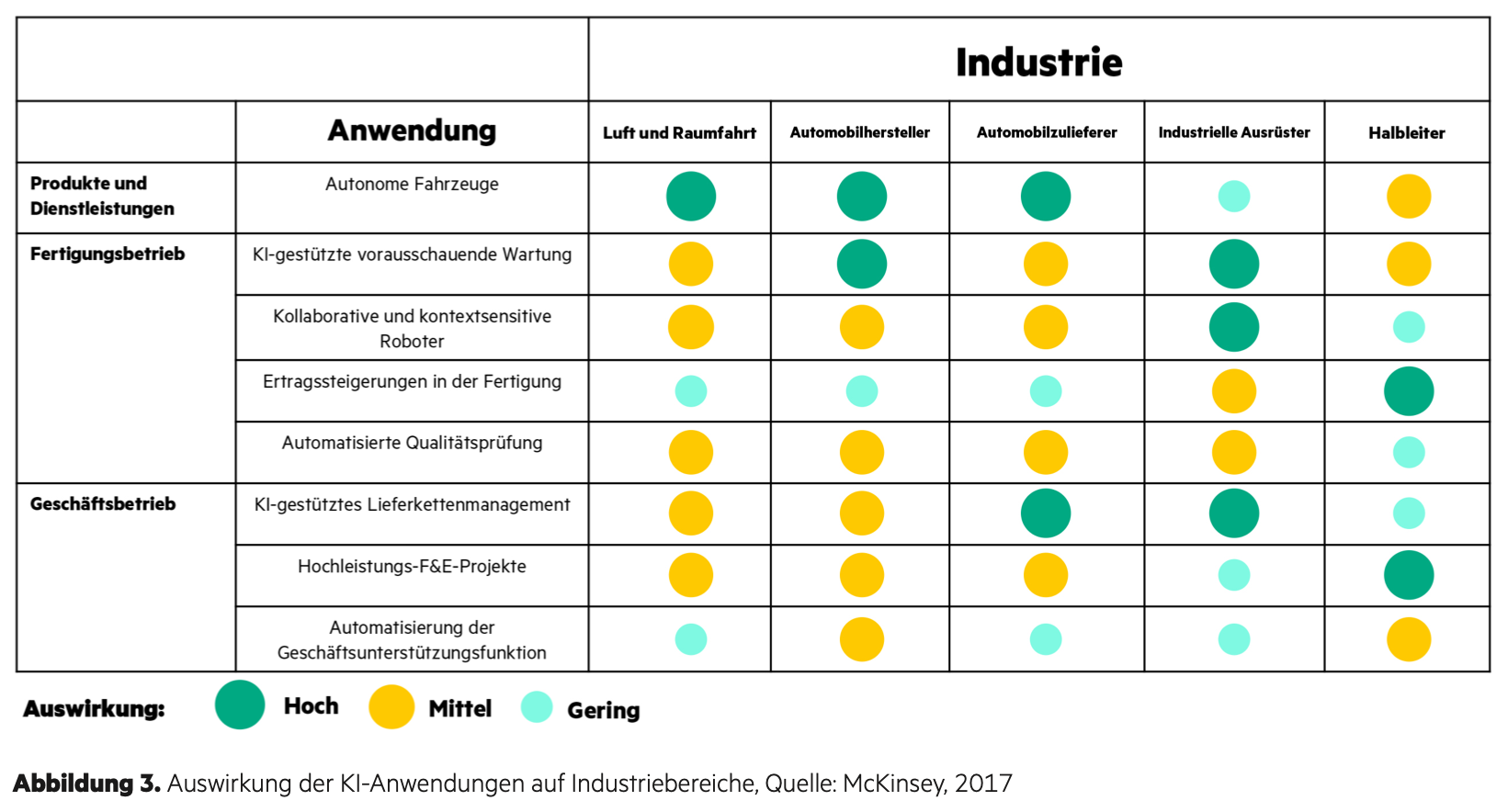
The data from the now six-year-old study entitled "Smartening up with Artificial Intelligence (AI) - What's in it for Germany and its Industrial Sector?" on the use of AI and ML in manufacturing is certainly no longer up to date, but still speaks for itself:
- 20 percent increase in plant productivity and effectiveness with a simultaneous 10 percent reduction in maintenance costs
- 30 percent less yield loss due to a reduction in reject rates and testing costs
- 50 percent more productivity thanks to automated quality checks and a defect detection rate that is up to 90 percent higher than human inspection
- Up to 20% increase in productivity thanks to AI-supported improved human-machine interaction and context-aware robots
- Research and development costs reduced by 10 to 15 percent and time-to-market improved by 10 percent at the same time
In addition to the benefits mentioned by McKinsey, there are further advantages:
- Better planning reliability: AI can also help with warehouse management, for example, in order to predict bottlenecks in supply chains and respond to them quickly.
- More flexibility to be able to adapt production processes more quickly and precisely to various new requirements and customer needs
- Greater IT & OT security, because AI-supported better monitoring of work processes and detection of hazards and risks is possible, for example to prevent accidents
- AI-supported data and trend analyses for better and faster decision-making by managers
Finally, in addition to predictive maintenance, AI also supports prescriptive maintenance to further optimize maintenance and its intervals, save costs and ensure smooth production with 100% availability.
MANY PROJECTS RUN AGROUND, A STRONG PARTNER HELPS OVER THE POC MOUNTAIN
The problem with all the advantages that AI and ML offer, however, is that only around 20 percent of existing application examples are used and most projects do not make it past the proof-of-concept (PoC) or test phase.
It is therefore important to have a strong partner like Hewlett Packard Enterprise at your side for such industrial projects. 90 percent of the Fortune 500 are HPE customers. The company has more than 17,000 experts and an ecosystem of over 100 partners worldwide.
HPE therefore has the necessary head start in terms of concentrated experience and know-how to help industrial customers "go the last mile" from the PoC phase to profitable operations. Strategies, initiatives and digital transformation activities for B2B customers follow HPE's proven approach and are interlinked. The three major trends mentioned at the beginning - individualization, flexibilization and sustainability in production - are incorporated into the initiative and planning before the various building blocks are then transferred into the corresponding solutions, for example for the standardization of IT and OT or for AI- and ML-supported quality analyses and control processes.
From the IoT connection and networking from the edge to the cloud to the intelligent evaluation and use of the data obtained, HPE also has the necessary technological requirements in its portfolio - all from a single source.
Conclusion: AI in industrial production offers many advantages, but in most cases these are not sufficiently utilized and projects hardly get beyond the PoC or test phase because companies lack the necessary experience and expertise. But it doesn't have to stay that way, because a strong partner like HPE can help to exploit the full potential of AI and ML in the manufacturing industry.


You might also be interested in
ESTIA aims to strengthen Europe's cloud
New tech alliance for EU sovereignty
Twelve companies, including Dassault Systèmes, are founding the European Sovereign Tech Industry Alliance (ESTIA). The initiative aims to strengthen Europe's technological independence and define requirements for sovereign cloud services. The start...
 read more...
Deutsche Telekom and Nvidia launch one of Europe's largest AI factories
With the Industrial AI Cloud in Munich, Deutsche Telekom and NVIDIA are creating one of the largest AI factories in Europe. Companies can train AI models, carry out simulations and access 10,000 GPUs.
read more...Leveraging data potential with AI and streaming
Huge data treasures are still lying dormant in many manufacturing companies. And yet it is high time that these treasures were unlocked. There is often a lack of resources and capacity to make data usable in real time. Streaming production data can...
read more...More awareness of noise
Dematic offers solutions that are tailored to different cloud environments and reduce environmental impact through reduced material consumption and improved energy efficiency.
read more...Generative AI in the automation environment
The mechanical engineering and automation industry is undergoing profound change. This transformation is being driven by more volatile global trade, geopolitical crises and increasing market pressure, which demands greater agility, technological...
read more...Rigid data structures have had their day
The traditional data center is no longer the center of data. A hybrid cloud storage approach enables manufacturing companies to both meet the current requirements of data-intensive processes and future-proof their infrastructure.
read more...Software as a service in three stages
CIM Database Cloud is a new out-of-the-box solution from Contact for end-to-end digital product development.
read more...How production can benefit from AI
Together with AI technology, IIoT networking makes it possible to better control machine parameters and optimize quality with predictive quality. Downtimes and set-up times can also be further minimized. Cloud platforms also make these technologies...
read more...More expertise for digital engineering
Altair, a computational science and artificial intelligence (AI) company, has acquired OmniV, a technology from Michigan, USA-based software company XLDyn.
read more...