

Employee relief
Support from exoskeletons
Flexibility in production also brings with it ever new tasks for people. Various types of exoskeletons are being developed and tested at the University of Innsbruck to support employees in physical activities.
Globalization and the resulting increase in competition present companies with various challenges. In addition to the need for short production times at low costs, the increasing demand for individualized products leads to greater product variance and thus the need for flexible production processes and a variety of activities. The necessary flexibility often makes the use of rigid automation solutions inappropriate and instead requires the use of targeted assistance. In addition to cognitive assistance technologies such as virtual (VR) and augmented reality (AR), physical support systems such as exoskeletons are a way of relieving the physical strain on employees.
In order to support employees individually and depending on the context, exoskeletons must be adapted to the support situation - which is an interplay of people, activity and technology. Individual, task- and user-specific requirements and the technical mode of operation play an important role here. Individual support describes the ability of the system to adapt to the person with their experience and qualifications. In addition to the basic design, which must adapt to people's anthropometry, the system should take into account the individual abilities, working methods and physical condition of employees with regard to functionality and support performance. Support should also be considered in relation to the context. The context describes the activity with central characteristics in a specific working environment that is carried out by a person, possibly with the aid of appropriate tools, under the prevailing external influences.
Exemplary exoskeletons
Three specially developed active systems for individual and context-dependent support serve as examples:
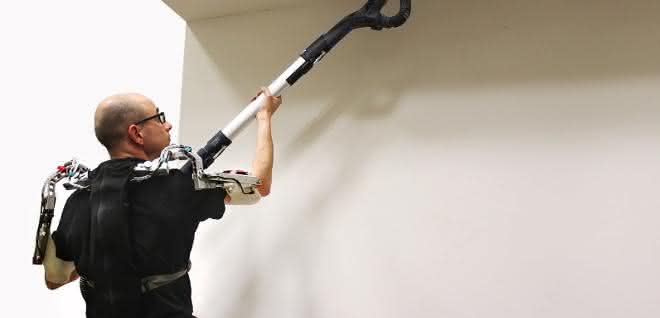
The Lucy exoskeleton (Fig. 1) uses pneumatic actuators and has a hybrid basic structure with a flexible back section and rigid shoulder-arm kinematics to support activities at head height and above. Due to its good dynamic properties and natural compressibility, the compressed air used is suitable for actuating an inherently safe system and therefore for safe interaction with people. The kinematics can be adapted to the user's individual anthropometry via a quick-release system and to the support characteristics via a control element. In addition to the support height, the support curve can also be adjusted.
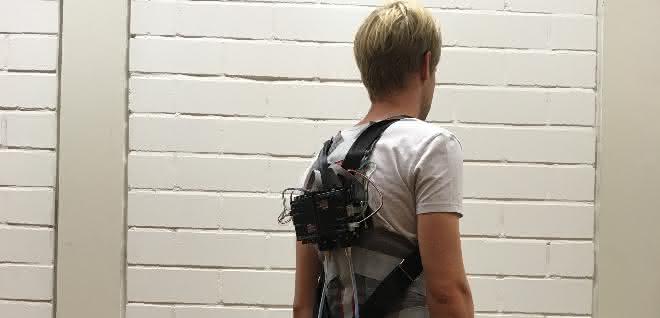
The back exoskeleton (Fig. 2) is a system with a biomimetic structure and textile kinematics that uses a twisted-string actuator for the actuators. The exoskeleton supports the lifting of loads and the performance of activities in the upper body position. Electric motors twist built-in ropes to create a translational shortening that enables support.
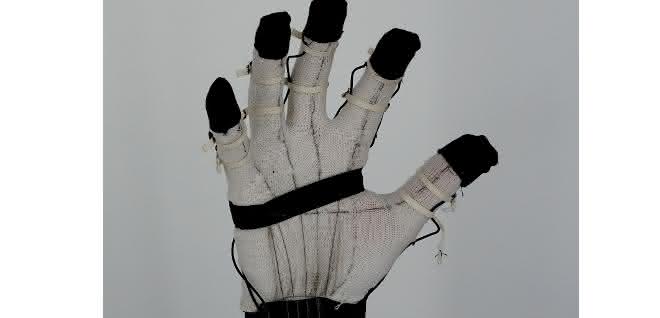
Figure 3 shows an exoskeleton for gripping force amplification that is operated with pneumatic actuators. The biomimetic structure supports human gripping force with artificial tendons that conduct the force of the actuators along the palm to the fingertips. An appropriate locking system ensures that the tendons are safely guided during movement. Support is provided automatically depending on the force applied to the fingertips and the user's individual settings.
Behavior appropriate to the situation
The exoskeletons presented can use data from the integrated sensors to infer situations or activities, which enables the support characteristics to be adapted. Based on the possibility of context-specific adaptation, it is possible to evaluate ergonomics in real time. To this end, sensor technology is used to assess work processes and workplaces on the one hand and to adapt system design and behavior on the other. Experience shows that assistive technologies must always be adapted to the user, activity and environment. This is the only way to achieve good and sustainable relief, which in turn can have a positive effect on the quality of work, acceptance of assistive technologies or work-related sick days.
Oliver Ott, Lennart Ralfs, Niclas Hoffmann, Robert Weidner, University of Innsbruck, Institute of Mechatronics, Department of Mechanical Engineering, Production Engineering Group


You might also be interested in
Motors, gearboxes and encoders: Faulhaber expands Ø 16 mm portfolio
Faulhaber is expanding its portfolio with new DC motors from the SXR and GXR family, a 16 mm planetary gearbox and the IEX3 magnetic encoder for compact drive solutions.
 read more...
New drive solutions for industrial automation and robotics
Faulhaber presents drive solutions with the new GXR and SXR motor family, which offer high efficiency and flexibility in combination with powerful gearboxes and encoders. These optimized components open up new possibilities for applications in...
read more...Marco Altherr becomes new Chief Financial Officer
The Supervisory Board of Ziehl-Abegg has appointed Marco Altherr as the company's new Chief Financial Officer (CFO). Altherr will take up his post in May 2025.
read more...Hydrogen storage in metal hydride
With its focus on storage systems for green hydrogen in solid form (metal hydride), GKN Hydrogen presents itself as a pioneer in safety and efficiency for the industry. GKN Hydrogen offers safe storage systems for green hydrogen and focuses on two...
read more...INDUSTRIAL Production Products of the year...
2nd place, Robotics category: EGS Automation
The SUMO automation systems from EGS Automation - economical standard solutions for automating a wide range of processes in plastics and metalworking - took second place in the robotics category in the competition for Product of the Year 2024.
read more...More productivity with Drive Intelligence
The trends in automation are productivity, sustainability and connectivity. Baumüller is launching new products on the market that address these trends, including new tools for smart energy monitoring, condition monitoring in the drive and new...
read more...Intelligence in Motion
At SPS, Koco Motion will be showcasing its expertise in customized drive solutions based on DC and BLDC motors, stepper motors, servo motors, linear drives and controllers.
read more...Nomination Products of the Year 2024
EGS Automation: SUMO automation systems
The SUMO automation systems from EGS Automation, economical standard solutions for automating a wide range of processes in plastics and metalworking, have been nominated in the Robotics category in the competition for Product of the Year 2024.
read more...Transport technology from the modular system
Many transport tasks can be realized with the help of linear technology. Pre-configured solutions are available to simplify the interaction between the linear unit, motor, gearbox and controller. This minimizes the effort required for research and...
read more...