
Safety light grid
Short response times and free of dead zones
Thanks to extremely short reaction times and the absence of dead zones, safety light grids move even closer to the danger zone. Where safety, flexibility, simple wiring and fast commissioning are required, these light grids set standards in the segment of barrier-free safety solutions.
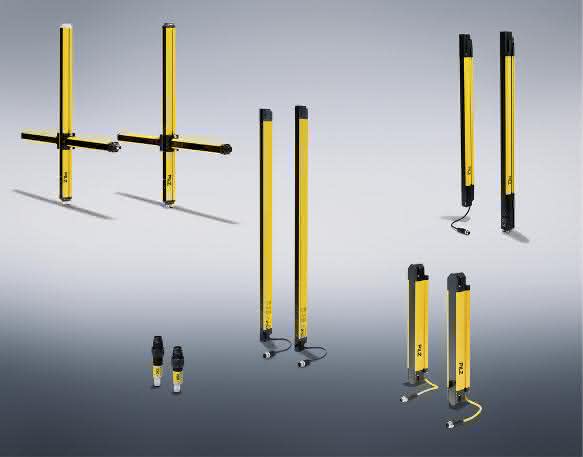
Safety solutions based on light grids are always the first choice in production and logistics when continuous supply and removal, accessibility or the exchange between man and machine is required for process or production-related reasons.
New type class for light grids
In accordance with the Machinery Directive 2006/42/EC, suitable safety measures must be taken for machines and systems to eliminate or reduce the risk to people to a responsible level. They must correspond to the determined risk level and the normative specifications. In 2015, the IEC/EN 61496 standard established a link for the first time between the type classes of electro-sensitive protective equipment (ESPE), the safety requirement level (Safety Integrity Level SIL - in accordance with IEC 62061) and the degree of reliability with which a control system must fulfill a safety function (Performance Level PL - in accordance with ISO 13849).
As a result, type 2 light curtains have only been allowed to be used in applications up to performance level PL c or SIL 1 and SIL CL 1 since May 2015. Type 3 light barriers were not available on the market until then, forcing users to switch to type 4, which is intended for PL e requirements, in order to meet PL d safety requirements. In most cases, this was significantly oversized - with correspondingly higher costs.
External specifications, framework changes and the resulting consequences often trigger innovative processes. Even before the change to the standard came into force, automation specialist Pilz decided to close this "type gap" with a Type 3 light curtain that is precisely tailored to it. The PSENopt II type 3 safety light grid, which completely eliminates dead zones, is designed for applications up to PL d in accordance with EN/IEC 61496-1.
Barrier-free, safe and versatile at the same time
Flexible safety solutions that meet the required safety categories and do not restrict handling or productivity are a basic requirement for light curtains. In their basic function, light curtains therefore also secure a defined area against any intrusion. At their core, they are based on a simple transmitter-receiver principle consisting of individual, invisible infrared beams. If one or more of these beams are interrupted, the control system brings potentially dangerous movements to a safe stop.
However, the special thing about light curtains is their flexible functions: In addition to safety features such as finger, hand and body protection, a variety of additional functions such as muting, blanking and cascading can be implemented. This allows light grids to be optimally adapted to the desired requirements.
Another requirement is impact resistance. It must be functionally covered when it comes to harsh environments in which vibration or collisions are prevalent. In addition, an extremely fast response time and absolute protection of the surrounding area must be ensured: With short response times of up to 6 ms and an absolute absence of dead zones, Pilz light curtains, for example, also safeguard such danger zones. They have an extremely high impact resistance of 50 g and are therefore extremely robust. The body-resolving version bridges distances of up to 50 m and reliably secures access to robot cells, packaging machines or presses. The status of all photoelectric sensors in this series can be easily read via the LED diagnostics, even under these conditions.
Special solutions are required for harsh environments, but space constraints are just as important. In terms of spatial arrangement, light grids must be able to be installed freely and flexibly according to the implementation requirements without impairing their functionality. Coding can be the solution here, so that even light grids installed close together do not interfere with each other. If several pairs of light grids are in use, they are coded differently. If a receiver unit receives light from an external transmitter unit, there are no consequences. Safety areas can be set up cost-effectively with the mirror columns accessory. If, for example, three sides of a robot application need to be safeguarded, one pair of light curtains in conjunction with two mirror columns is sufficient.
Muting, blanking or cascading are often an issue. Models that offer all of these functions are required here. This is because where infeeds and outfeeds regularly transport objects through the light grid, machine downtime as a result of the interruption of light beams is undesirable. Muting is used to allow defined exceptions in a protective field. Alternatively, muting can also be implemented with retrofittable light grids. With the mushroom light grids, the integrated muting function can be implemented in conjunction with the small controller PNOZmulti 2. If a component or machine part permanently protrudes into a defined protective field due to the process or design, this part can be blanked out by software. The blanking function blocks this part of the protective field permanently (fixed blanking). If objects only temporarily protrude into a protective field, "floating blanking" is used. Cascading is a suitable solution for applications that require either high protective fields or protection from behind. The light grids arranged one above the other and connected in series reduce the amount of wiring required.
Intuitive software
Software tools tailored to light grids provide support during installation, commissioning and handling. Pilz, for example, has special software for its light curtain portfolio: the PSENopt Configurator makes every single beam visible. From alignment to functions such as muting, blanking and cascading, the light barriers can be configured with just one tool. Fast and targeted diagnostics; the location and cause of an interruption can be traced immediately. It is also possible to read out the fault memory with plain text messages. All these options reduce downtimes and increase the availability of a system. With this tool, users can also transfer the configuration once it has been created to other machines with little effort using the programming adapter.
Flexibility with regard to space is one thing, the other is the aspect of spatial constriction. After all, there is not always enough space in production or at the place of use. If a high degree of flexibility is required at the same time, narrow light grids come into question. Their compact size and versatile mounting options bring them even closer to the scene of the action. The high resolution supports fast shutdown without compromising safety. This ultimately leads to lean system concepts with reduced space requirements.


You might also be interested in
Protection against electrostatic discharge
StoFloor ESD KU 614 from StoCretec: dissipative flooring with the latest technology meets all ESD standards, is economical, extremely durable, mechanically and chemically resistant. The surface can be adjusted to be slip-resistant. The system is...
 read more...
Cables and wires from Helukabel
Food cultivation on a new level
Vertical farming - cultivation in multi-storey greenhouses - is considered one of the most exciting trends in food production. One of the pioneers in this field is the Romanian start-up Ultragreens. The company relies on solutions from Helukabel to...
read more...Further training for specialists to become security experts
With the "CESA - Certified Expert for Security in Automation" qualification, automation expert Pilz offers a two-day expert course designed to provide participants with compact security knowledge in line with the latest standards.
read more...Meaningful data on the service life of the seal
Seals prevent substances from penetrating or entering technical components. The intelligent seals from Freudenberg Sealing Technologies can significantly expand this core task in the future: the seal itself is also a sensor and becomes a "smart...
read more...Online stud configurator according to drawing
For standard bolts, with head, thread or hole
For standard bolts, with head, thread, bore or as a version with recess, mbo Osswald configurators map the standard specifications, are very easy to use, take a lot of work off the user's hands and save a lot of time.
read more...Safe palletizing with the Cobot
Verla-Pharm's medicinal products and food supplements have been available for decades. Ever-increasing throughputs result in ever-increasing logistics costs, whereby optimum utilization of the available production space is necessary.
read more...The tiger among processors
Since the move towards the Industrial Internet of Things (IIoT) and Industry 4.0 has picked up speed, processor boards and modules must be able to process exponentially growing amounts of data.
read more...VDWF publishes "Sustainability Compendium"
Nowadays, nobody can avoid "sustainability": In addition to a far-reaching presence in the media, it is also becoming increasingly important for companies in the tool and mold making industry to develop and implement appropriate concepts.
read more...More transparency and synergies with QM software
Weber, manufacturer of wood and metal sanding machines and extruders, has reorganized its quality management with ConSense IMS Professional. The software solution enables transparent documentation and more efficient processes.
read more...