

Occupational safety
Using ladders correctly in the workplace
Improper selection and use of ladders are a considerable source of danger. The article provides tips on how employees can climb safely.
In a ranking of the most important inventions of mankind, the ladder would certainly take a top place. There is evidence that they were used as early as the 3rd millennium BC and even today, ladders are still indispensable as work equipment for many industries. However, anyone who uses unsuitable or defective climbing aids or carelessly uses a ladder incorrectly due to time pressure or convenience runs the risk of falling. The following tips should help to make working at height safer and avoid serious accidents with all their consequences.
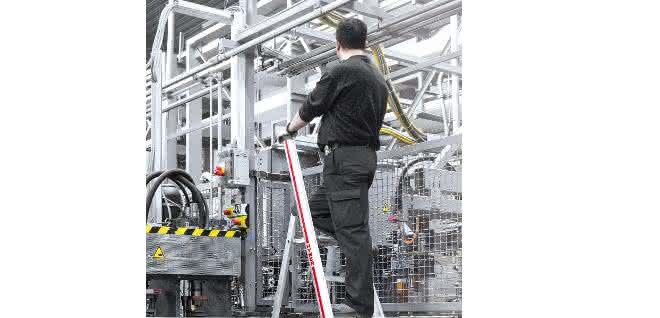
For most painters and plasterers, cleaning and agricultural businesses, working without a ladder is almost unimaginable. Step and rung ladders are also ubiquitous in industry, construction and trade. But working at heights can be dangerous: In 2019, the German Social Accident Insurance recorded more than 12,000 accidents involving ladders.
"Ladder falls are among the most serious accidents and result in lengthy medical procedures," warns Markus Nowak, Head of Access Technology Sales at Hymer-Leichtmetallbau. "In addition to the damage to health, the economic damage can also be immense."
In most cases, human error is the cause. The most common errors include: incorrect set-up with insufficient stability, one-sided loading, for example by leaning out to the side, the use of defective or poor-quality climbing aids and working with a lot of force on an unsecured ladder.
"To prevent accidents involving ladders, there are a number of standards and guidelines that every employer and their employees should be aware of," Markus Nowak continues. It is the employer's duty to ensure that only safe work equipment is made available. The user is also responsible for using the work equipment as intended. "If both parties pay attention to this and the work equipment is checked regularly, nothing stands in the way of safe working with ladders."
Tip 1: Keep an eye out when buying a ladder
The European standard EN 131 applies to ladder manufacturers, so users should ensure that they only purchase ladders produced in accordance with the standard. This will reduce the risk of an accident occurring due to poor ladder quality. It is very important for users to differentiate between professional (professional) and non-professional use (private). Professional ladders, which are used on a daily basis, undergo more test cycles and are tested with higher loads. The ladder used should therefore be explicitly designed for professional use.
Tip 2: Risk assessment and inspection
The German Ordinance on Industrial Safety and Health (BetrSichV) also defines the basic obligations of employers and employees when using work equipment. Before using a ladder, every employer is obliged to carry out a risk assessment to determine and document whether a ladder is suitable as safe work equipment for the intended activity (inspection).
Markus Nowak advises in this regard: "Defective ladders are a major safety risk, especially during continuous use, which puts a strain on materials. Inspections should therefore be carried out regularly. The last inspection can be documented on the ladder sticker, in a ladder inspection book or in a digital inspection app, for example."
Tip 3: Observe new rules on operational safety
Anyone who has already worked with rung ladders knows that working with them involves a higher risk. Ascending and descending require more concentration and an unsteady stance increases the risk of falling. Since December 2018, extended Technical Rules for Operational Safety (TRBS) 2121-2 have therefore been in force, which further specify the existing legal basis of the BetrSichV.
As a general rule, stepladders rather than rung ladders and the duration and height of the work determine the choice of work equipment. If the user determines that the use of a ladder is not permitted for the work to be carried out, an alternative climbing aid such as mobile scaffolding must be used.
Tip 4: Rung ladders only in exceptional cases
Working from the ladder rung is only permitted in exceptional cases, such as when working in narrow shafts or when harvesting fruit. However, this must be recorded in writing in the risk assessment.
Markus Nowak comments: "For longer work, stepladders or platform ladders are recommended, as the new TRBS requires employees to stand with both feet on a step with a tread of at least 80 mm in depth or on a platform. However, existing rung ladders can still be used if their stability is increased by additional equipment such as suspended steps or click-in steps."
Tip 5: Choosing the right ladder
Choosing the right work equipment always depends on the location. Some working environments require special products in order to work safely. For example, a stepladder can be optimally adapted to the working conditions in a stairwell. If the ground is very soft, such as in a meadow, fruit tree ladders can provide a secure footing. They are specially designed for this type of use and therefore ensure greater stability on soft ground.
Also important: To avoid falls, a stepladder should never be used as a single ladder.
Tip 6: Increased stability with accessories
Additional equipment can significantly increase the safety of a ladder. A suspended step, for example, can be conveniently hooked into rung ladders to ensure a safe and stable stance. This makes it possible to work on a rung ladder for longer periods of time.
If you are working on soft ground such as a meadow, steel tips increase the stability of a ladder.
Tip 7: Correct behavior when handling ladders
Before using a ladder, you should always read the instructions and carry out a safety check. Particular attention should be paid to the maximum weight that a ladder can carry. For example, tools and materials used on the ladder must not weigh more than 10 kilograms.
If both hands are required to carry a tool, it is no longer possible to hold on to the ladder securely. Leaning out to the side also increases the risk of accidents.
Climbing aids should always be positioned so that they are at an angle of between 65 and 75 degrees to the horizontal. The "elbow method" * can be used to determine whether the ladder is positioned correctly.
Tip 8: Manufacturers are happy to advise
Access technology specialist Markus Nowak concludes: "Even if the right ladder has been selected, incorrect handling of the work equipment can lead to an accident." Regular inspection of all access equipment in the company to ensure that it is in proper condition is therefore necessary for the prevention of accidents in the workplace and is therefore also prescribed by the German Ordinance on Industrial Safety and Health. "As a manufacturer and solution specialist, we are happy to advise our customers in detail on this topic and also offer seminars and further training in this area. For further information, we are now also making a free white paper available to download from our website."


You might also be interested in
Protection against electrostatic discharge
StoFloor ESD KU 614 from StoCretec: dissipative flooring with the latest technology meets all ESD standards, is economical, extremely durable, mechanically and chemically resistant. The surface can be adjusted to be slip-resistant. The system is...
 read more...
Cables and wires from Helukabel
Food cultivation on a new level
Vertical farming - cultivation in multi-storey greenhouses - is considered one of the most exciting trends in food production. One of the pioneers in this field is the Romanian start-up Ultragreens. The company relies on solutions from Helukabel to...
read more...Further training for specialists to become security experts
With the "CESA - Certified Expert for Security in Automation" qualification, automation expert Pilz offers a two-day expert course designed to provide participants with compact security knowledge in line with the latest standards.
read more...Meaningful data on the service life of the seal
Seals prevent substances from penetrating or entering technical components. The intelligent seals from Freudenberg Sealing Technologies can significantly expand this core task in the future: the seal itself is also a sensor and becomes a "smart...
read more...Online stud configurator according to drawing
For standard bolts, with head, thread or hole
For standard bolts, with head, thread, bore or as a version with recess, mbo Osswald configurators map the standard specifications, are very easy to use, take a lot of work off the user's hands and save a lot of time.
read more...Safe palletizing with the Cobot
Verla-Pharm's medicinal products and food supplements have been available for decades. Ever-increasing throughputs result in ever-increasing logistics costs, whereby optimum utilization of the available production space is necessary.
read more...The tiger among processors
Since the move towards the Industrial Internet of Things (IIoT) and Industry 4.0 has picked up speed, processor boards and modules must be able to process exponentially growing amounts of data.
read more...VDWF publishes "Sustainability Compendium"
Nowadays, nobody can avoid "sustainability": In addition to a far-reaching presence in the media, it is also becoming increasingly important for companies in the tool and mold making industry to develop and implement appropriate concepts.
read more...More transparency and synergies with QM software
Weber, manufacturer of wood and metal sanding machines and extruders, has reorganized its quality management with ConSense IMS Professional. The software solution enables transparent documentation and more efficient processes.
read more...