

Maintenance planner
Safety for the life of the machine
Regulations, directives and standards govern the requirements for machine safety. Depending on the machine and system, companies must ensure different inspections and maintenance, take their intervals into account and provide legally compliant documentation.
The best way to map all these obligations is with a software tool. This helps to prevent system failures and increase occupational safety.
Before commissioning, the CE marking identifies a machine as legally compliant in accordance with EU requirements and the basic health and safety requirements. This fulfills the EU Machinery Directive, transposed into German law as the Machinery Ordinance. The CE marking is preceded by the conformity assessment procedure, which ends with the declaration of conformity.
If machines are converted, which often happens in the context of networking through Industry 4.0, a conformity assessment is required again in the event of a significant change or a (new) entirety of machines. This includes determining the limits of a machine - including space requirements, operating time and maintenance intervals, but also potential misuse. Risks are identified and protective measures defined.
But building or converting a machine or system is not enough. The German Ordinance on Industrial Safety and Health (BetrSichV) stipulates periodic inspections of machines and systems. This involves checking that the system is in perfect condition and that the safety devices are functioning correctly. In some cases, the manufacturer's test instructions specify exactly what needs to be inspected.
The test is successful if all necessary parts have been checked and the requirements have been implemented. In the event of defects or necessary repairs, the system should not be used until these have been rectified. According to BetrSichV, the results of the inspection must be documented and stored. This includes the type of inspection, the scope and the result. Regular inspections allow damage and wear to be detected more quickly and repairs to be carried out promptly.
Only experts may test
It is important to note that these periodic inspections may only be carried out by people with specialist knowledge, so-called "qualified persons". These inspectors have professional training and appropriate experience.
Testing electrical machines in accordance with DIN VDE 0113-1 (EN 60204-1), for example, requires a qualified electrician who is authorized in accordance with the Technical Rules for Operational Safety (TRBS 1203), a component of DGUV Regulation 3. For example, production systems, printing machines, CNC milling machines or robot systems are tested. Such a machine inspection consists of many individual steps and is defined by the product standard of the machine. If this is missing, DIN VDE 0113-1 prescribes the following steps, among others: Checking the conformity of the system and its technical documentation, checking the automatic switch-off and the voltage and function test.
A periodic inspection is mandatory if work equipment is exposed to influences and changes that cause damage and thus lead to hazards for employees. The deadlines must be determined in accordance with Section 3 (6) BetrSichV. A periodic inspection must be carried out no later than two months after the due date. Exceptional events with a detrimental effect on safety, such as accidents, natural phenomena or even the shutdown of a machine, require the employer to react immediately and carry out an extraordinary inspection.
The safety of a machine must therefore be ensured before commissioning, but also after modifications and recommissioning. Sources of error often lie in the unclear definition of the tests, which parts they affect and in unspecified deadlines.
Machine safety is a continuous task
Machine safety and thus occupational safety is a permanent task that is ensured through inspections, maintenance and servicing - for the safety of employees and to avoid downtime and accidents.
Companies are faced with the challenge of keeping track of the various inspection regulations and periods. This is where the different types of equipment with different maintenance requirements come into play. In addition, there are different inspection intervals depending on the type, which incidentally apply to the entire range of equipment, not just machines. In addition to knowledge of the mandatory maintenance and its intervals, legally compliant documentation of the inspections represents a further hurdle. Here too, specific regulations govern when and how maintenance must be carried out, what it involves and who approves it.
If companies fail to comply with their inspection obligations or lack the correct documentation, they are left with the costs in the event of an accident and, in the worst case, are liable because insurance companies do not accept liability and employers' liability insurance associations refuse to pay benefits. With a log that shows exactly when and with what result a technical inspection took place, companies can prove in the event of an accident that they complied with inspection deadlines in accordance with regulations and that the machine was in perfect condition. The records also have a concrete added value: they provide information on where defects and repairs accumulate and what can facilitate troubleshooting.
Software provides an overview and transparency
Companies can comply with the regulations for the maintenance and servicing of machines and systems, including the documentation requirements. However, they should not rely on conventional tools such as handwritten lists, Excel sheets or self-developed databases, which usually cause problems and are very time-consuming and error-prone. It is better to use software that fully covers all aspects of equipment maintenance. It then has all the maintenance and servicing regulations, a calendar for planning maintenance tasks and the option of generating maintenance orders in the test reports.
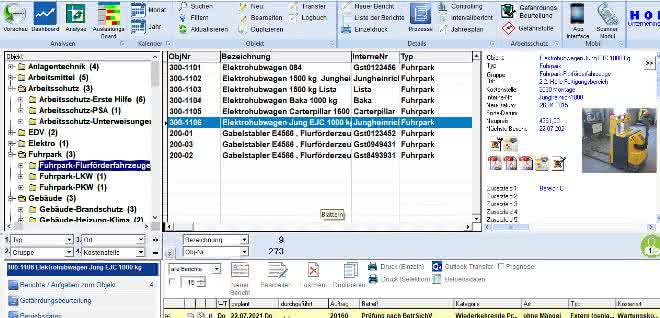
Occupational health and safety specialists can create, archive and maintain documents with just a few clicks. All systems and test objects are recorded with relevant data. For example, the maintenance planner from Hoppe Unternehmensberatung is divided into the following classifications: maintenance, inspection, repair, overhaul, inspection date and instruction. Key maintenance figures are displayed graphically and can be imported and exported in various formats.
"On the one hand, our maintenance management software reduces the amount of work involved in a company's inspection obligations and, on the other hand, inspection reports are always to hand during company audits," says Senior Consultant Ulrich Hoppe. The tool is based on DIN EN ISO 9001 and complies with the recommendations of the employers' liability insurance associations for inspection period management. It also makes it easier to carry out risk assessments and the requirements of ISO 14001 for environmental protection and OHSAS 18001 are also supported.
With the right software, inspections of machines and systems can be planned, carried out and documented in a structured manner. This ensures that legal requirements are met and guarantees that the functional condition of operating systems and machines is maintained or quickly restored. Regular maintenance also reduces downtimes and lowers servicing and maintenance costs.
A tool for the maintenance and servicing of machines and systems simplifies the work involved in testing and documentation. Transparency and legal certainty in maintenance and servicing management are ensured, accidents at work and the resulting costs or employee absences are reduced, as is machine or plant downtime. In this way, maintenance develops from a pure cost factor to a genuine value-adding factor.


You might also be interested in
Protection against electrostatic discharge
StoFloor ESD KU 614 from StoCretec: dissipative flooring with the latest technology meets all ESD standards, is economical, extremely durable, mechanically and chemically resistant. The surface can be adjusted to be slip-resistant. The system is...
 read more...
Cables and wires from Helukabel
Food cultivation on a new level
Vertical farming - cultivation in multi-storey greenhouses - is considered one of the most exciting trends in food production. One of the pioneers in this field is the Romanian start-up Ultragreens. The company relies on solutions from Helukabel to...
read more...Further training for specialists to become security experts
With the "CESA - Certified Expert for Security in Automation" qualification, automation expert Pilz offers a two-day expert course designed to provide participants with compact security knowledge in line with the latest standards.
read more...Meaningful data on the service life of the seal
Seals prevent substances from penetrating or entering technical components. The intelligent seals from Freudenberg Sealing Technologies can significantly expand this core task in the future: the seal itself is also a sensor and becomes a "smart...
read more...Online stud configurator according to drawing
For standard bolts, with head, thread or hole
For standard bolts, with head, thread, bore or as a version with recess, mbo Osswald configurators map the standard specifications, are very easy to use, take a lot of work off the user's hands and save a lot of time.
read more...Safe palletizing with the Cobot
Verla-Pharm's medicinal products and food supplements have been available for decades. Ever-increasing throughputs result in ever-increasing logistics costs, whereby optimum utilization of the available production space is necessary.
read more...The tiger among processors
Since the move towards the Industrial Internet of Things (IIoT) and Industry 4.0 has picked up speed, processor boards and modules must be able to process exponentially growing amounts of data.
read more...VDWF publishes "Sustainability Compendium"
Nowadays, nobody can avoid "sustainability": In addition to a far-reaching presence in the media, it is also becoming increasingly important for companies in the tool and mold making industry to develop and implement appropriate concepts.
read more...More transparency and synergies with QM software
Weber, manufacturer of wood and metal sanding machines and extruders, has reorganized its quality management with ConSense IMS Professional. The software solution enables transparent documentation and more efficient processes.
read more...