
Safety technology on the grinding machine
Grinding - with safety
Special grinding machines are used in the production of silicon wafers for photovoltaic modules. To ensure maximum safety and processing quality, one manufacturer equips its systems with special machine protection components.
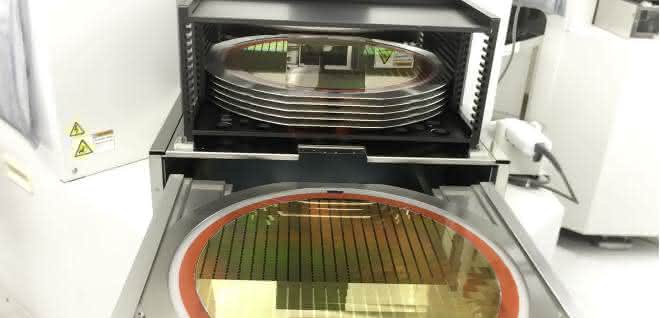
The proportion of electricity generated from sunlight will increase significantly in the coming years. This is shown in a guideline published last year by the Fraunhofer Institute for Solar Energy Systems (ISE), in which the experts assign photovoltaics (PV) a "significant role in our sustainable energy future". However, many PV systems still need to be installed in order to achieve the goal of covering Germany's energy needs entirely from renewable energies.
This opens up a large market for manufacturers of photovoltaic modules and their suppliers. The modules are based on so-called wafers made of monocrystalline or polycrystalline silicon. To produce them, quartz sand is melted, cleaned and then cast into semiconductor ingots. These ingots are cut into uniform blocks using a diamond wire saw before a grinding machine takes over the finishing work until only a thin silicon slice remains.
One manufacturer of these grinding machines is Abwood Machine Tools from the UK. Founded in the 1920s, the company now focuses on the construction of grinding machines for the photovoltaic industry and special machines. The one-, two- and four-spindle machines achieve a removal rate of up to 1,000 mm3/s and are used for surface grinding and edge processing as well as for top and back grinding.
Safety is the top priority
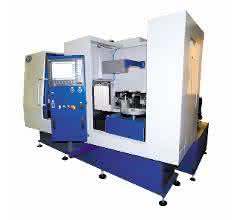
Abwood attaches great importance to high operational safety for its grinding machines. This is why the company contacted the local representative of Hema Maschinen- und Apparateschutz a good 15 years ago. The decision to equip all machines with Hema components was quickly made: "The British competition is cheaper than us, but their products are not of the same quality as ours," says Regional Sales Manager Andreas Seifert from Hema. He looks after the customer and has also supported Abwood's latest project: the design of the CM1500H creep feed grinding machine.
The machine was specially developed for grinding irregularly shaped silicon blocks and has four axes with travels of up to 2,500, 800 and 600 mm (X, Y and Z axes). The rotary axis is equipped with a rotary table on which the silicon block to be processed is placed for measurement.
To hold the rotary table exactly in position, Abwood uses the RotoClamp rotary position clamping system from Hema. This clamping system was specially designed for rotating guides or drives and is available in an internal and an external clamping version. Customers can also choose between versions with air clamping or automatic clamping.
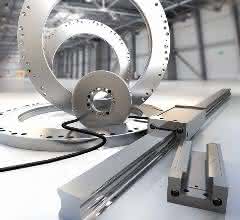
The special feature of this clamping system is that it clamps quickly and with great force even in the event of a pneumatic failure. As the system is pneumatically operated, it is clean to use and comparatively inexpensive. Another advantage of the RotoClamp is its simple installation. It can be used immediately because it does not have to be adapted to the respective environment first. The internally clamped version is available in numerous sizes and is suitable for almost all rotating applications. It can be installed on a turntable, as with Abwood, but also on swivel heads that are operated with a torque motor. To further increase the safety of the RotoClamp, it is possible to apply additional compressed air (so-called "booster function"). This allows the clamping force to be increased with little effort.
Reliable fixation for precise machining
After measurement, the silicon blocks must be fixed in position for processing. This is done by the LinClamp clamping systems from Hema. The LinClamp was developed for use on linear guides and for clamping linear drives. They are particularly suitable for transmission applications where an emergency braking function is also required. Depending on the requirements, Hema offers the clamps with brake shoes made of resistant sintered linings or steel linings. The former achieve the highest braking and clamping forces, while the latter are predestined for use in machined surfaces.
The LinClamp with integrated quick-release valve ensures particularly fast clamping. This version reduces the reaction time of the system by a further 30 percent. LinClamp achieves holding forces of up to 10,000 N and is available in different versions for a wide range of applications. The clamping system is designed for operating pressures of 4 or 6 bar. Types S, SK and SA can be used as clamping and braking systems.
As a lot of dust is generated during the processing of silicon blocks, careful protection of axes and linear guides is essential. Abwood has therefore covered the lower Z-axis with Samurai bellows from Hema. These are a further development of the Elastic bellows used on the CM1500H to protect the upper Z-axis as well as the spaces between the clamp supports and the X-axis. The Samurai version provides the bellows with additional protection against hot or sharp-edged chips. Stainless steel plates are attached to the upper edge of the bellows for this purpose. The bellows are suitable for all harsh environments.
Safety windows and LEDs for good visibility
Optimum lighting of the machining area also contributes to the safety of a machine. Abwood uses Hema LED lights for this purpose. This also reduces energy costs. To prevent flying chips from injuring operating personnel, Abwood equips its machines with special safety windows from Hema. They are made from a combination of polycarbonate and safety glass and are sealed on all sides to resist coolant. The panes therefore have a high retention capacity and retain their protective function for at least five years. Conventional protective panes made of simple polycarbonate, on the other hand, usually become brittle after just a few months.
According to documents from Hema / am


You might also be interested in
Further simplify assembly processes
In addition to the proven racks with a length of one meter, Wittenstein alpha now offers optional two-meter racks for linear systems. They are particularly suitable for use in short axes, for example, in order to simplify assembly even further.
 read more...
Hiwin manufactures its own shaft gearboxes
Have you ever waited several months for an urgently needed corrugated gearbox? Hiwin has too. That's why the Offenburg-based drive specialist has decided to produce its own space and weight-saving reduction talent.
read more...Human-robot interaction at the trade fair
Sumitomo Drive Technologies is presenting its drive solutions for automation and robotics at Automatica 2023 together with the Lafert Group. The company will be showcasing two different applications of the Tuaka drive system for robot applications...
read more...Partial automation with robots
At Automatica, Promess will be showcasing its modular individual workstations and how these can be partially automated with robot support. The servo press manufacturer will also be providing information about the latest features of its Revolution X...
read more...A new benchmark for collaborative robots
At this year's Automatica, Denso Robotics will be showcasing its innovations in the field of robotics. The collaborative Cobotta Pro product family will be the focus of the presentations. Visitors to the trade fair can see all variants in various...
read more...Clamping system for a new milling machine
Investments in machinery often lead to further purchases - as is the case at Joma-Maschinenbau, whose modern production facility has recently been supplemented by a 5-axis milling machine.
read more...Schunk wants to simplify processes in automated production
The declared aim of automation specialist Schunk is to make its customers' processes comprehensible, simple and efficient. Data transparency plays an important role in this. It enables reliable processes and provides the basis for resource-saving...
read more...Festo and Hahn Automation develop battery tester for greater safety
The success and reputation of electric vehicle manufacturers depend on the safe and flawless functioning of batteries. Hahn Automation has therefore developed a battery tester that performs a fully automated 100% test of mobile energy storage...
read more...SPN Schwaben Präzision presents gearbox solutions for automation and industrial robotics
Short cycle times, robust technology, wear-free surfaces and compact designs have always been relevant for automation and robotics solutions. This year's Automatica trend topics include "Sustainable production" and "Digitalization and AI". SPN aims...
read more...