

Protective clothing in the company
Increasing the acceptance of PPE
No ice hockey player wants to voluntarily stand on the pitch without head and body protection. In professional practice, however, personal protective equipment (PPE) is often not used consistently by employees. Employers and managers can do a lot to increase the acceptance of protective clothing in the workplace.
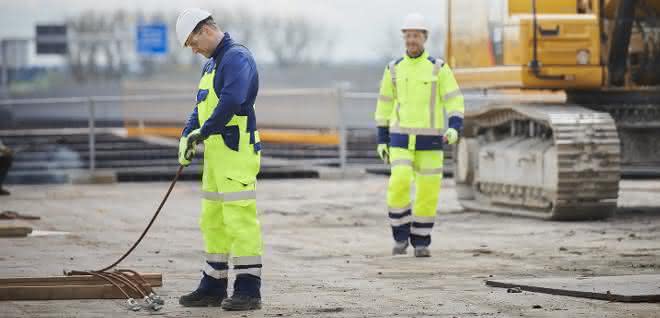
If existing PPE is not used by employees, this is often due to time pressure, a lack of hazard awareness or a lack of comfort. Psychology also plays a role: if team colleagues find the PPE "uncool", the otherwise responsible employee will also be reluctant to put on their equipment.
What to look out for when choosing
All protective clothing must be certified in accordance with the applicable standards. However, there are sometimes major differences in terms of comfort and design. Michael Ballermann, Head of Occupational Safety at Mewa: "The use of modern high-tech fabrics, ergonomic cuts and modified garment construction have significantly improved the wearing properties of protective clothing. In addition, the protective equipment can be adapted to the company's team look." This new generation of PPE is much better accepted by employees. It has also been shown that employees are more likely to accept protective clothing if they are involved in the selection process. Ballermann: "Then they see: this is about me!"
Where PPE is prescribed, it must be worn
Wearing protective clothing is mandatory as soon as the risk assessment stipulates this. However, in day-to-day operations it is almost impossible to monitor the correct use of protective clothing by everyone. Behavior-oriented occupational safety is therefore aimed at motivation. Ballermann: "The protective task of PPE must be explained in a way that everyone can understand." Wearing protective clothing should be part of the safety culture embedded in the company. Supervisors and managers can make a big difference as credible role models, says the Head of Occupational Safety.


You might also be interested in
Textile protection in explosive environments
People working in potentially explosive atmospheres must be protected from electrostatic charge. This is because uncontrolled spark discharge can have devastating consequences wherever flammable substances are handled.
 read more...
Automatic quality inspection makes high-visibility clothing safer
Together with textile service provider Mewa, Fraunhofer IGD has developed an automated system to check the quality of high-visibility clothing more quickly and reliably.
read more...Protection against electrostatic discharge
StoFloor ESD KU 614 from StoCretec: dissipative flooring with the latest technology meets all ESD standards, is economical, extremely durable, mechanically and chemically resistant. The surface can be adjusted to be slip-resistant. The system is...
read more...Cables and wires from Helukabel
Food cultivation on a new level
Vertical farming - cultivation in multi-storey greenhouses - is considered one of the most exciting trends in food production. One of the pioneers in this field is the Romanian start-up Ultragreens. The company relies on solutions from Helukabel to...
read more...Further training for specialists to become security experts
With the "CESA - Certified Expert for Security in Automation" qualification, automation expert Pilz offers a two-day expert course designed to provide participants with compact security knowledge in line with the latest standards.
read more...Meaningful data on the service life of the seal
Seals prevent substances from penetrating or entering technical components. The intelligent seals from Freudenberg Sealing Technologies can significantly expand this core task in the future: the seal itself is also a sensor and becomes a "smart...
read more...Online stud configurator according to drawing
For standard bolts, with head, thread or hole
For standard bolts, with head, thread, bore or as a version with recess, mbo Osswald configurators map the standard specifications, are very easy to use, take a lot of work off the user's hands and save a lot of time.
read more...Safe palletizing with the Cobot
Verla-Pharm's medicinal products and food supplements have been available for decades. Ever-increasing throughputs result in ever-increasing logistics costs, whereby optimum utilization of the available production space is necessary.
read more...The tiger among processors
Since the move towards the Industrial Internet of Things (IIoT) and Industry 4.0 has picked up speed, processor boards and modules must be able to process exponentially growing amounts of data.
read more...