

Workplace systems
For inclusion and efficiency
Highly qualified, motivated - and yet unemployed. Conventional workplaces are often a barrier for people with disabilities. However, with a modern and flexible system, work environments can be designed in such a way that employees receive exactly the support they need for their work. This makes it easy to compensate for deficits in motor skills or mobility.
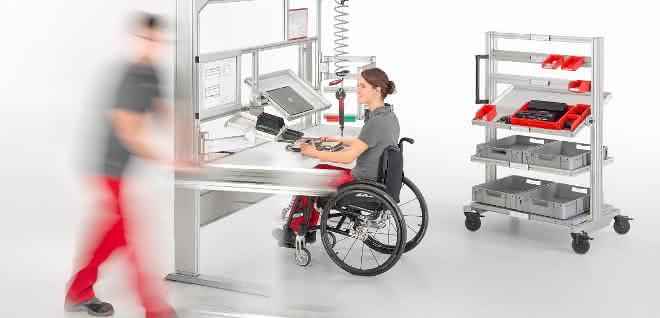
For people with disabilities, access to the labor market is much more difficult than for non-disabled people. Neither the UN Convention on the Rights of Persons with Disabilities nor the goal of inclusion have done much to change this. According to the Federal Employment Agency (BfA), the unemployment rate among people with severe disabilities has fallen continuously since 2007, but at around 12%, it is still around twice as high as among people without disabilities. This is mainly due to the fact that many companies are reluctant to hire a disabled employee for fear of high additional costs.
"But these fears are unfounded. In most cases, it is possible to create workstations that are suitable for disabled employees with little effort," says Marius Geibel, Product Manager at item. In view of the shortage of skilled workers, investments in workplaces suitable for disabled employees are also investments in the future.
Companies in Germany with 20 or more jobs are obliged to employ severely disabled people. Companies that do not comply with this obligation must pay a compensatory levy for every unfilled mandatory job. Many companies accept the compensatory levy. At the same time, they certainly benefit from the creation of workplaces that are suitable for people with disabilities: For example, public contracts can be acquired more easily. So it's not just about social responsibility, but also very specifically about economic aspects. In addition, there are financial support options that companies can take advantage of when setting up disabled-friendly workplaces.
Barrier-free workplace systems
The unrestricted participation of disabled people in working life requires workplaces that meet their special needs. The term "accessibility" also plays a role in this context. A workplace for employees with disabilities is barrier-free if the following requirements are met: structural facilities, transportation and work equipment, information processing systems, acoustic, visual and tactile information sources and communication facilities are accessible and usable without any particular difficulties and, in principle, without assistance from others. To achieve this, there are, for example, modern and modular workstation systems which, in contrast to conventional workbenches, enable the ergonomic and barrier-free design of working environments.
Different needs depending on the handicap
When designing workstations for the disabled, it is important to know the needs of the employee. Companies can find many suitable products in item's portfolio to implement tailor-made solutions. People who are in wheelchairs or have difficulty walking or standing often have limited reach. It is usually not possible to bend or stretch the body to reach objects that are more than an arm's length away. "Therefore, all required work equipment such as tools or components must be located in the immediate reach area," recommends Marius Geibel.
Multi-axis swivel arms, for example, enable individually adaptable material provision. A needs-based, mobile parts supply system with height-adjustable gripping containers, which are positioned within easy reach of the employee, also makes gripping easier for employees with disabilities. To extend the radius of action for gripping movements, the workstation should also be wheelchair accessible. "Conventional workbenches do not allow this. However, the solution is very simple: C-shaped tables ensure that the furniture offers maximum legroom," says Geibel. In order to minimize physical strain, work tables must be height-adjustable for ergonomic reasons. This makes it easy to adopt an ideal sitting or standing position. Chairs or footrests should also always be adjusted precisely to the employee and the task to be performed in order to avoid poor posture. If employees have problems moving, they need non-slip surfaces to keep workpieces in place. Visually impaired people, on the other hand, need high-contrast surfaces, which should otherwise be avoided. Visually impaired people also need significantly higher illuminance levels than employees without impairments.


You might also be interested in
Simply in good hands
The organization of workwear for the team usually also includes lockers, waste bins and, above all, locker systems. DBL offers solutions here. A look into practice.
 read more...
Logimat 2025: Gripping and lifting
Even more ergonomics in intralogistics
At vacuum expert Schmalz, trade fair visitors can experience grippers and lifting aids for picking and moving various goods and components.
read more...Relief for the back
More and more companies are realizing this: Exoskeletons make jobs more attractive and help to attract and retain skilled workers.
read more...Exoskeletons in industrial workplaces
To what extent can exoskeletons relieve employees and which exoskeletons are suitable for what? These questions are answered by a working group at the University of Innsbruck.
read more...Working more easily with the S700 exoskeleton
More strength, less load. With the S700 active shoulder exoskeleton, activities above the head and at chest height are demonstrably and noticeably easier. The exoskeleton can also be individually adapted to the user. The S700 offers prevention...
read more...Welding solutions in the name of resource efficiency
At the Welding & Cutting trade fair in Essen (September 11-15), Fronius will be focusing on the major drivers in welding technology. Quality requirements are increasing in all industries, but the required welding specialists are scarce. In...
read more...E-scooter with customizable damping
The startup Scuddy has significantly improved the flexibility, performance, customizability and ergonomics of its second-generation foldable e-scooter of the same name - thanks in part to damping technology from ACE.
read more...The active shoulder exoskeleton S700 from exoIQ
The advantage of an active exoskeleton is obvious. Like passive systems, they transfer the load from weaker to stronger parts of the body. Following intensive biomechanical analyses, the Hamburg-based company exoIQ has developed an active...
read more...Digital assembly processes to combat the shortage of skilled workers
The increasing shortage of skilled workers is putting even well-established companies in manual assembly under pressure. According to the "DIHK Skilled Workers 2022 Report", 58% of industrial companies were unable to fill vacancies in the long term....
read more...