
ESD gloves
Protection against electrostatic discharge
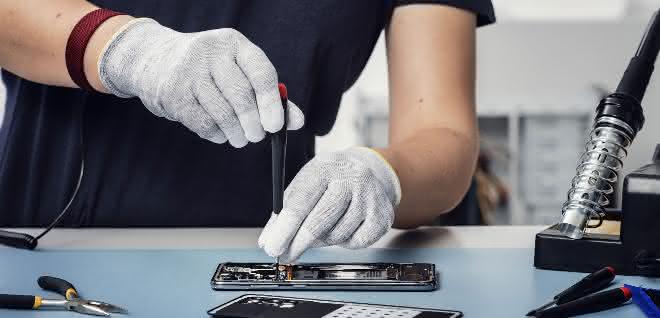
ESD gloves are of central importance in the production and processing of electronic components and small processors. "Ejendals has had nine new ESD glove models on the market since fall 2021 so that we can use the right glove for every ESD work area," says Veronika Seliger, Technical Training & Support Manager at Ejendals. Antistatic ESD gloves must be as thin as possible for good dexterity, have a good grip, be flexible and, of course, be comfortable to wear. "These attributes apply to all of our new nine models," emphasizes the PPE expert. "The ergonomic structure is adapted to the hand and thus supports the natural way it works. To this end, the gloves are ergonomically knitted, which makes them particularly adaptable. Of course, touchscreen capability is also relevant." With its extensive range, Ejendals offers customers complete freedom: the glove can be tailored precisely to the employee, workplace and component - for all ESD work areas.
The new Tegera 806 model is an ultra-thin, uncoated ESD glove that uses CRF technology fibers. It cools, does not rub or itch and is very light.
Ejendals has developed the Tegera 877 as the thinnest glove with a PU coating and very good grip. The integrated carbon fiber provides the ESD properties. This glove also has PU-coated palms, while the new Tegera 801 has PU-coated fingertips that are ideal for inserting circuit boards. Another new model is the Tegera 801, which, with its dipped fingertips and good feel, is suitable for soldering electrical parts or inserting circuit boards.
The coatings of ESD gloves are made of PU or nitrile and are used depending on the activity. PU is marginally thinner-walled than nitrile, gives plenty of freedom of movement and is particularly suitable when a very good grip is required. Nitrile, on the other hand, is the more elegant solution from an ecological point of view. This coating or glove is very durable, has good heat resistance and cut resistance. Thick wool socks, which have an insulating effect, and dry hands or feet can impair ESD protection. "We therefore have appropriate ESD socks in our range. We also offer gloves that are Ökotex or Dermatex certified and therefore protect sensitive skin. As we focus on holistic protection, around 97% of our shoes are also ESD-certified," says Seliger.


You might also be interested in
ESD protection in electronics production
Work voltage-free
Electrostatic discharge (ESD) is an everyday phenomenon and usually harmless to humans. However, sensitive electronic components can be damaged or even destroyed as a result.
 read more...
Protection against electrostatic discharge
StoFloor ESD KU 614 from StoCretec: dissipative flooring with the latest technology meets all ESD standards, is economical, extremely durable, mechanically and chemically resistant. The surface can be adjusted to be slip-resistant. The system is...
read more...A new benchmark for collaborative robots
At this year's Automatica, Denso Robotics will be showcasing its innovations in the field of robotics. The collaborative Cobotta Pro product family will be the focus of the presentations. Visitors to the trade fair can see all variants in various...
read more...Four decades of robotics
Epson, manufacturer of Scara robots, will present the new Scara GX-B series at Automatica, the latest generation of high-performance Scara robots based on the existing GX series.
read more...Controlling machines more intelligently
At embedded world, Bopla Gehäuse Systeme will be presenting new HMI systems for customized machine control in the field of printed electronics. The focus is on complex interfaces via USB or RFID as well as an ultra-flat design and cost-effective...
read more...Process control with traceability through soldering tips with microchips
RS has added a new 300 W manual soldering platform to its range with the WXsmart from Weller. The station combines all soldering applications in a single device and comes with a new range of intelligent soldering tips. In this way, the WXsmart...
read more...Florian Becker is the new Managing Director at Krieg
Generation change at Krieg in Heimsheim: Andreas Krieg handed over the management of the company to Florian Becker on October 1, 2022. The company, which specializes in workplace systems and office furnishings, intends to focus even more strongly on...
read more...The fuel cell under control
The fuel cell is a serious solution for emission-free mobility. Having disappeared from the scene for a long time, it is now establishing itself as a viable option for zero-emission strategies.
read more...The modular system for pure production
Designing pure process environments quickly, modularly and safely - Item showed how this can be done at Cleanzone in Frankfurt. The company has added numerous components to its modular system.
read more...