
Visualizations for IIoT applications
Individually parameterize and configure user interfaces
Machines, systems and production processes continuously generate data. Companies that succeed in generating added value from this data will be successful in the future.
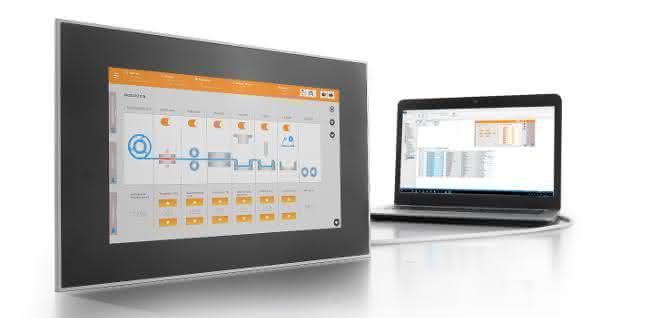
To achieve this, however, the large amount of data generated must be easily accessible to the user via the HMI (human-machine interface). With the u-create Procon-Web Scada and Procon-Web Embedded System software tool, Weidmüller provides visualization solutions with dynamic user interfaces that can be individually parameterized and configured without any programming knowledge. The user can implement data acquisition from machines with the display of operating statuses via a browser, e.g. on mobile devices, and transfer to the cloud using simple project planning. Procon-Web is particularly suitable for future-proof machine visualization, which focuses on the user-centric display of machine data and thus allows ideal interaction with the production process.
The challenge is to select, bundle and process the large amount of information in a meaningful way. Easily scalable and platform-independent HMI and Scada solutions, such as Procon-Web from Weidmüller, can be used flexibly and make relevant machine data available everywhere. They facilitate fault processing as well as data recording and management and thus support the control of complex processes. Intuitive operating concepts for any end device can be easily created with the Procon-Web HMI/Scada software. The result is a flexible, web-based machine operating concept that makes the machine data available where the user needs it, customized for his task. Additional advantages result from the use of a wide range of web-enabled end devices. This means that users' own devices such as smartphones or tablets can be used as HMIs, and defective hardware can be replaced quickly and easily.
From data collection to data systematics
The path of a data record from the plant field to an ERP system traditionally leads via countless gateways and usually has to be created individually. In contrast, the IIoT opens up completely new possibilities. Weidmüller makes this potential accessible with the HMI/Scada software Procon-Web. It allows users to create platform-independent user interfaces based exclusively on HTML5 and JavaScript. This opens up support for smartphones and tablets in an adaptive design, individually for each user. Coupling to any control system and to higher-level MES and ERP systems is possible via numerous proprietary and standardized communication interfaces (e.g. OPC-UA). The use of Procon-Web therefore allows freedom of choice in the selection of control systems. This also applies to communication in the cloud: this is also platform-independent.
Prepare data in a user-centered way
The web HMI user interface of u-create Procon-Web is programmed as a browser application in JavaScript using an integrated web server and therefore runs without a plug-in such as Flash, Java or Silverlight in any HTML5-compliant browser. This means that it can be used on almost all web-enabled end devices without any software installation. The user receives all relevant information prepared and displayed in a user-centered way and is thus supported in his tasks in the best possible way. This makes it possible to react earlier and more effectively to deviations from the target status and increase plant efficiency. And all this without the IT department having to deal with the testing and installation of additional, possibly manufacturer-specific software. The extensive portfolio of communication drivers guarantees flexible integration into existing and new machines and systems.
Procon-Web provides the user with dynamic user interfaces and multi-touch/gesture control. What sets this solution apart from other products is its parameterization and configurability. This allows the user to create user interfaces that look and feel like modern web applications or apps without any programming knowledge. Scroll and swipe gestures facilitate navigation in the application. Color changes or moving elements can be provided with smooth transitions. Additional added value is provided by user-configurable dashboards that can be individually and dynamically adapted with freely configurable visualization elements. As it is also possible to react to the role of the logged-in user, both content-specific and device-specific interfaces can be generated. Automatic scaling functions also make it easier for the user to switch between different devices. They are not tied to a specific hardware configuration, but can work at the machine, on the HMI, in the office with a large monitor or on the move with a smartphone.
The focus is no longer on the machine, but on the user
Procon-Web is accompanied by a paradigm shift away from device-specific presentation towards role-specific interaction with the machine data. The focus is no longer on the machine, but on the respective user. The software supports a multi-layered role and rights system to provide the displayed data in a device and role-specific manner as required. This means that the groups of people accessing the data, such as plant operators, production managers, quality managers or maintenance staff, are shown precisely the information that corresponds to their tasks and the nature of the operating devices. Special requirements can be added using your own extensions or custom controls.
These additions in HTML5 and JavaScript are managed in such a way that no manual intervention in the project is necessary. The front-end user can create trend charts and save them in their profile without any web knowledge and set up their dashboard as they need it. With this configurable cockpit function, they can record, visualize and analyse exactly the data they need for their task. For example, fill levels on the desktop are of interest to the purchaser and wear data on the smartphone for the service technician. These could be displayed as a "service list". This allows them to keep track of the urgency of maintenance and repair tasks. The production manager, on the other hand, receives all the machine data relevant to him on a dashboard and can therefore evaluate the system efficiency in his area of responsibility at a glance.
High scalability
The visualization portfolio includes Procon-Web Scada, a fully-fledged HMI/Scada solution, and has recently been supplemented by the next generation Procon-Web Embedded System. Procon-Web Scada clearly focuses on complex visualization solutions with fully-fledged, Windows-compatible PCs for the runtime environment.
This is where Procon-Web Embedded System sets itself apart thanks to its hardware independence combined with maximum scalability. The new version is available for Windows systems as well as for Linux or via containers and is therefore compatible with all IIoT architectures.
Procon-Web is part of the comprehensive, future-oriented and coordinated u-mation portfolio, with which users can design their automation tasks efficiently, simply and in line with requirements.
u-mation combines powerful hardware with innovative engineering and visualization tools for data acquisition and pre-processing. Thanks to the use of open technologies and systems, it can be flexibly and easily integrated into any automation process. Weidmüller's engineering specialists support users in optimizing their automation and pave the way to the Industrial IoT with an intuitive, future-proof portfolio.


You might also be interested in
ESTIA aims to strengthen Europe's cloud
New tech alliance for EU sovereignty
Twelve companies, including Dassault Systèmes, are founding the European Sovereign Tech Industry Alliance (ESTIA). The initiative aims to strengthen Europe's technological independence and define requirements for sovereign cloud services. The start...
 read more...
Deutsche Telekom and Nvidia launch one of Europe's largest AI factories
With the Industrial AI Cloud in Munich, Deutsche Telekom and NVIDIA are creating one of the largest AI factories in Europe. Companies can train AI models, carry out simulations and access 10,000 GPUs.
read more...Leveraging data potential with AI and streaming
Huge data treasures are still lying dormant in many manufacturing companies. And yet it is high time that these treasures were unlocked. There is often a lack of resources and capacity to make data usable in real time. Streaming production data can...
read more...More awareness of noise
Dematic offers solutions that are tailored to different cloud environments and reduce environmental impact through reduced material consumption and improved energy efficiency.
read more...Generative AI in the automation environment
The mechanical engineering and automation industry is undergoing profound change. This transformation is being driven by more volatile global trade, geopolitical crises and increasing market pressure, which demands greater agility, technological...
read more...Rigid data structures have had their day
The traditional data center is no longer the center of data. A hybrid cloud storage approach enables manufacturing companies to both meet the current requirements of data-intensive processes and future-proof their infrastructure.
read more...Software as a service in three stages
CIM Database Cloud is a new out-of-the-box solution from Contact for end-to-end digital product development.
read more...How production can benefit from AI
Together with AI technology, IIoT networking makes it possible to better control machine parameters and optimize quality with predictive quality. Downtimes and set-up times can also be further minimized. Cloud platforms also make these technologies...
read more...More expertise for digital engineering
Altair, a computational science and artificial intelligence (AI) company, has acquired OmniV, a technology from Michigan, USA-based software company XLDyn.
read more...