

Predictive maintenance
Predictive maintenance with method
The goal of predictive maintenance is clear: the number of unplanned machine downtimes should be as close to zero as possible. However, achieving this goal is not so easy in practice. This is not due to a lack of mathematical methods, as there is a wide range of them and they work quite well in other areas.
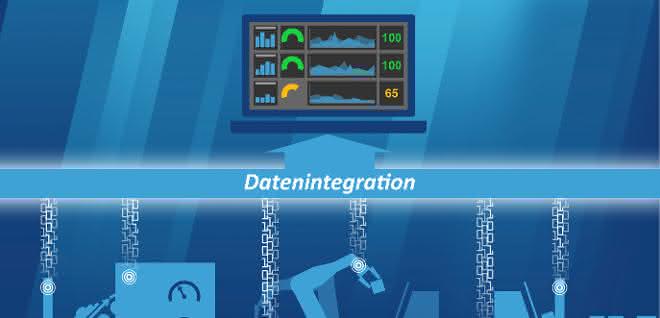
The basic idea behind predictive maintenance is to collect relevant data in real time, evaluate it using suitable models as part of a data analysis and predict when maintenance is due in good time - in other words, to answer the question "What will happen when?" based on the current data situation. The data analysis used for this is known as "predictive analytics". It can be carried out with the help of supervised machine learning, a branch of artificial intelligence. Similar applications have long been widely used in the IT world to predict future developments, such as customer behavior, stock market prices or trend forecasts. Mathematically, the whole thing is a regression task with several predictors - i.e. special variables that describe a machine state, for example. In most cases, this is where the first practical problem becomes clear: data from which suitable predictor or forecast variables can be formed does not exist at all in most machine landscapes.
Create a data integration layer
The machine landscape of a manufacturing company with series production has usually evolved over a long period of time and is therefore extremely diverse. Machines and subsystems from different manufacturers, some of which do not even support a common communication standard, have been combined to form systems. Each individual machine requires extensive expert knowledge. Most system components have their own individual automation technology. In some cases, remote maintenance access is available so that external help can be obtained from a machine manufacturer or service company in the event of problems. In some cases, there are also cloud connections, for example for frequency converter monitoring - all in all, a very heterogeneous technology landscape without open data interfaces.
Before successful predictive maintenance applications can be implemented in such an environment, an open horizontal data integration level is required. This should correspond to the state of the art in the IT world and, if possible, only support three protocols via Ethernet LAN with MQTT, HTTP(S)-based REST API and, if necessary, OPC UA. All subsystems that do not directly support Ethernet and at least one of the three protocols are connected as a data retrofit with the help of a suitable adapter (the market now offers a very large selection here).
Before integrating the data of the individual machines, the application-related question of "What machines do we actually have, what do we want to achieve with a predictive maintenance concept and what data and information are likely to be required for this?" should be clarified as far as possible. An on-site analysis of the current situation and expert discussions between experienced data specialists, machine operators and automation technicians are required for the overall data-related picture. In each case, the goal is a so-called real-time feature vector with context-related cross-sectional data that fits the respective task. The individual data elements of this feature vector can be used to determine which additional sensors are required.
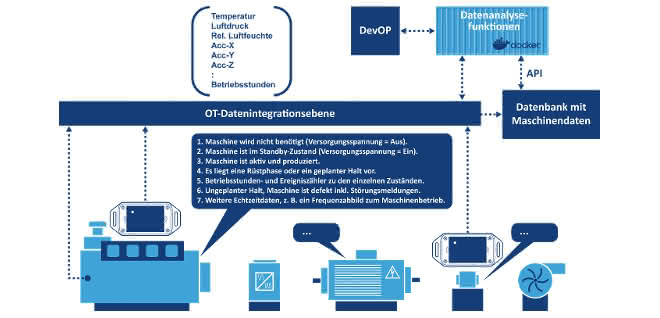
In order to develop a predictive maintenance solution for a machine or assembly step by step, the data integration level should offer a database for machine data plus a runtime environment for Docker containers with data analysis functions. This allows the data expert to initially collect suitable data, evaluate it using descriptive data analysis and discuss the results with the relevant specialists. The first goal would be a data-based differentiation between normal operation and anomaly. In the following steps, the abnormal operating states are linked to possible causes of faults in order to derive the effects and the necessary maintenance work. Over time, this iterative approach creates suitable models for automated predictions of upcoming maintenance tasks and suitable deadlines to prevent machine failures.
Predictive maintenance sensors
With the current state of the art, most machines provide no data at all or insufficient data quality to predict the required maintenance dates with acceptable accuracy using supervised machine learning. In this respect, a sensor data retrofit is almost always necessary in order to provide the data integration layer with suitable raw data. It should be noted that the selection of suitable sensors is very demanding. In terms of measurement technology, there is a big difference between measuring an imbalance on a rotating drive element and measuring the wear on the brushes of a slip ring. In the first case, an acceleration sensor that provides three-dimensional acceleration data with a suitable sampling frequency is helpful. An IR sensor array that provides a thermal image of the entire slip ring unit as output data may be suitable for the slip ring system.
Machine sensors for predictive forecasting consist of several functional units and a very high proportion of software. In addition to the sensor element plus a filter and amplifier stage for the analog measured values, there is an analog-to-digital converter and various special functions. In the case of an acceleration sensor, for example, this includes a Fourier transformation to convert measurement data from the time domain into the frequency domain. Prior to this, this data may pass through further (digital) filters in order to remove disturbance variables from the measured values. Depending on the sensor, this is followed by various mathematical functions such as linear detrending, standardization, normalization, transformation or moving averaging in order to create suitable predictor variables.
Complex but solvable
The large number of subtasks initially sounds very demanding for automation engineers. However, this is primarily due to the fact that data-centric tasks have not been the main focus in this area to date. The challenges of a predictive maintenance solution with sensor data can be solved with the appropriate engineering and specialist knowledge, just like a complex motion control task in robotics, for example.
Klaus-Dieter Walter, CEO, SSV Software Systems / am


You might also be interested in
ESTIA aims to strengthen Europe's cloud
New tech alliance for EU sovereignty
Twelve companies, including Dassault Systèmes, are founding the European Sovereign Tech Industry Alliance (ESTIA). The initiative aims to strengthen Europe's technological independence and define requirements for sovereign cloud services. The start...
 read more...
Deutsche Telekom and Nvidia launch one of Europe's largest AI factories
With the Industrial AI Cloud in Munich, Deutsche Telekom and NVIDIA are creating one of the largest AI factories in Europe. Companies can train AI models, carry out simulations and access 10,000 GPUs.
read more...Leveraging data potential with AI and streaming
Huge data treasures are still lying dormant in many manufacturing companies. And yet it is high time that these treasures were unlocked. There is often a lack of resources and capacity to make data usable in real time. Streaming production data can...
read more...More awareness of noise
Dematic offers solutions that are tailored to different cloud environments and reduce environmental impact through reduced material consumption and improved energy efficiency.
read more...Generative AI in the automation environment
The mechanical engineering and automation industry is undergoing profound change. This transformation is being driven by more volatile global trade, geopolitical crises and increasing market pressure, which demands greater agility, technological...
read more...Rigid data structures have had their day
The traditional data center is no longer the center of data. A hybrid cloud storage approach enables manufacturing companies to both meet the current requirements of data-intensive processes and future-proof their infrastructure.
read more...Software as a service in three stages
CIM Database Cloud is a new out-of-the-box solution from Contact for end-to-end digital product development.
read more...How production can benefit from AI
Together with AI technology, IIoT networking makes it possible to better control machine parameters and optimize quality with predictive quality. Downtimes and set-up times can also be further minimized. Cloud platforms also make these technologies...
read more...More expertise for digital engineering
Altair, a computational science and artificial intelligence (AI) company, has acquired OmniV, a technology from Michigan, USA-based software company XLDyn.
read more...