

Vehicle tracking
Determine position in real time
Vehicle tracking through precise real-time localization: At the Mercedes-Benz Türk bus factory in Hoşdere, time-consuming searches and long search routes on the 36-hectare factory premises are a thing of the past. By implementing the Simatic RTLS real-time location system from Siemens, the Turkish bus manufacturer can locate and track its vehicles with ease.
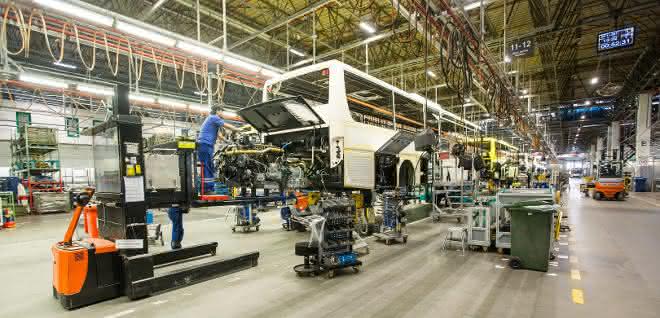
The Mercedes-Benz Türk bus plant in Hoşdere is located on the outskirts of Istanbul, Turkey. It was built in 1994 and is one of the largest plants in Europe. Around 4,500 vehicles are produced here every year by around 3,300 employees. The factory covers an area of 360,000 m², on which four different bus series are manufactured. State-of-the-art technology and the highest quality are the focus at every stage of production: from welding robots and extensive tests to comprehensive inspections after final assembly. The Simatic RTLS tracking system, which is based on scalable hybrid technology and is suitable for both industrial indoor and outdoor use, is now used in the factory to track all finished buses on the factory premises with the utmost precision.
Visualization in real time
As soon as a bus has been driven out of the production hall and parked on the company premises in Hoşdere, it can be located in any of the 200 parking spaces. Without the real-time documentation, employees would have to search for a needle in a haystack every day. "The size of the factory premises combined with the lack of real-time documentation meant that our employees never knew exactly whether the vehicle they were looking for was still in the last documented location or whether it had been moved to another location in the meantime," explains project manager Abdullah Aydin, Senior Solution Architect of IT for Bus Production and Research Development Bus/Truck at Mercedes-Benz Türk. "Until now, it was only possible to document the current location on a desktop computer in external offices, which made it difficult to record and map it accurately and without delay."
This inaccurate location determination led to longer search times with numerous detours, thereby increasing the consumption of resources. "We were faced with the challenge of finding a system that we could use to track our vehicles in real time and document their exact location," says Aydin. Accordingly, Mercedes-Benz Türk's goal was to reduce search times in Hoşdere, optimize existing routes and increase the plant's efficiency. The new system also needed to be flexible and expandable so that it could be adapted to changes and the constantly growing requirements of Mercedes-Benz Türk in the future.
High system flexibility
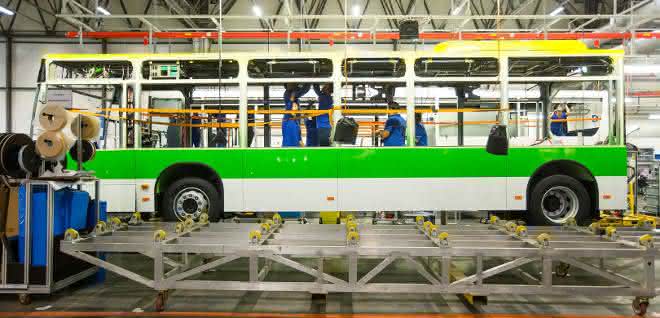
Knowing where the vehicles are at all times is no longer a problem since the implementation of the Simatic RTLS complete solution. The system allows the customer to choose a tracking technology that is suitable for precise tracking in outdoor areas. The minimal configuration effort and modular design make it easy to install and expand the tracking system both indoors and outdoors.
"Ultimately, we opted for the Siemens solution for three reasons," explains Aydin. "The flexibility, expandability and efficiency of the system convinced us right from the start. We also wanted to exploit the untapped potential of comparable applications with the RTLS solution." Simatic RTLS can be used to control material flows, monitor the use of individual components and seamlessly document the assembly of the end product. In addition, it is possible to locate smaller objects, such as tools or workpieces, in indoor areas and larger products in outdoor areas at any time and without any problems. Following the successful implementation and optimization of the pilot project, Mercedes-Benz Türk plans to extend the system to other plants in Turkey.
Real-time location in parking lots
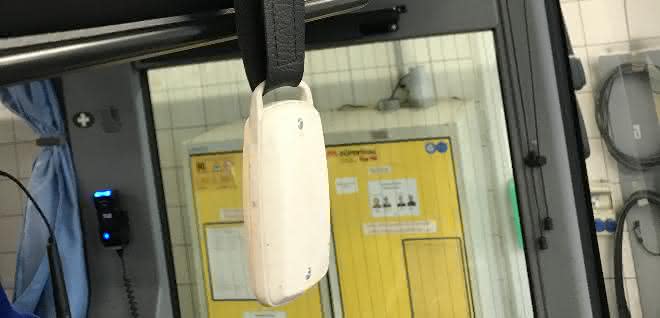
As part of the implementation, Siemens supplied the Simatic RTLS real-time locating system, consisting of around 100 gateways and 300 transponders, as well as the Simatic RLTS Locating Manager locating software. The software calculates the real-time position of the individual transponders and passes this information on to higher-level systems via defined interfaces so that the exact location of the parking lot can be determined. To enable the Locating Manager to determine the positions of the respective buses and update them continuously, Siemens first equipped all relevant vehicles on the factory premises with a transponder. The transponder is temporarily attached to the center of the windshield in a cloth bag so that it can send a signal to the gateways, which act like satellites in the locating system, at predefined intervals.
Next, Siemens set up the positioning infrastructure based on 2D positioning with 100 gateways connected to the network. The gateways perform precise real-time positioning in the local infrastructure by communicating wirelessly with the transponders. They receive the signals from the transponders and transmit them to the Locating Manager via the network. The gateways were attached to buildings or lampposts as fixed reference points so that they are distributed across the entire parking area of the factory premises with a uniform radius of 20 to 30 meters. This allows the transponders attached to the vehicles to continuously measure their distance to the infrastructure devices and transmit a precise signal to the gateways. On the other hand, the transmitted distance can be used to determine the exact position of the vehicle in the Locating Manager software.
The Locating Manager transmits the location in real time to the Mercedes-Benz Türk visualization software, which documents the locations of the vehicles on a map and enables specific vehicles to be tracked thanks to a search function. The use of Siemens' 2.4 gigahertz radio technology, which is ideal for applications in large outdoor areas, ensures maximum accuracy and reliability in data collection. Siemens actively chose 2.4 gigahertz technology for this project because it is the most cost-effective solution for the customer.
Due to the long radio range of several hundred meters and the excellent material penetration, Siemens only had to use a few infrastructure objects and was able to place them further apart. The high flexibility of Siemens technology enables the simultaneous use of different radio technologies with the same infrastructure. For example, Mercedes-Benz Türk can extend the existing real-time positioning system from the outdoor areas to the indoor areas without having to adapt the infrastructure. The flexibility of being able to further adapt the entire solution at a later stage paves the way for the automation of further processes in indoor areas, such as stocking the warehouse or locating smaller products. After an 8-month implementation phase, the tracking system provides reliable support for vehicle tracking.
Real-time data for precise location determination
Simatic RTLS proved itself in practice from day one. The employees at the bus plant were particularly impressed by the high locating accuracy. "With the Siemens positioning system, we can reliably determine the locations of our vehicles down to the parking space," says Aydin. The high accuracy of the Simatic RTLS system and the evaluation of the location data will enable the subsequent conversion of additional plants to real-time location and the optimization of further plant processes.
The basis for this is the installed gateway infrastructure, which could do much more than just locate vehicles on the factory premises. "The next step is to use the data analysis of the Locating Manager in our production halls in a meaningful way," says Aydin about the potential of the Mercedes-Benz Turkey plant. With the web-based Location Intelligence software, which analyses and visualizes dynamic data and processes events, Siemens already has a suitable solution for this in its portfolio. By intelligently linking transponder ID and order data and using geofences, the system can recognize in real time when one of the transponders enters or leaves a certain area. The user gains a comprehensive overview of the material flow and order information in his plant and can systematically optimize his production and logistics processes.
Eliminate errors in manually created vehicle documentation
In addition to its precision, Simatic RTLS also scores points for availability and transparency. In fact, the Locating Manager has far exceeded the customer's expectations with its integrated status monitoring of the RTLS infrastructure. "With the RTLS solution, we have a real-time overview of all vehicles at all times," says Aydin. "Next, we want to give our employees mobile access to the system using tablets - and thus take our vehicle management to an even higher level of effectiveness." The users were also quickly impressed by the new technology. Thanks to the new system, employees can concentrate on their actual work again, as Simatic RTLS has significantly reduced long searches and the need to travel long distances.
By optimizing vehicle management, reducing search and route times and increasing efficiency and resource availability, Simatic RTLS is another building block for Mercedes-Benz Türk in Hoşdere to meet its quality requirements at all process levels. Thanks to the intelligent complete solution, the exact location and route to the finished buses on the factory premises can now be tracked. The planned addition of transponder interfaces opens up further possibilities for the Hoşdere plant. In future, location information will be transmitted directly to the local control system and made available to higher-level systems. This data can then be used to create added value for the factory as a whole.
Mustafa Belhan, Siemens


You might also be interested in
Plagiarius 2024 negative prize
On January 26, 2024, the Plagiarius campaign awarded its dreaded "Plagiarius" negative prize for the 48th time to manufacturers and retailers of particularly brazen counterfeits and fakes.
 read more...
Ivalua honors winners of the Generative AI...
AI-supported "add-ons" for buyers within 48 hours
Ivalua, provider of cloud-based spend management solutions, announced the winners and innovations of the first Generative AI Innovation Cup. The competition took place in December 2023. It was open to all Ivalua partners and employees - more than...
read more...Efaflex celebrates 50 years of high-speed...
The emphasis is on "fast"
Since day one, Efaflex has wanted to use new technologies as early as possible and drive progress in the industry. This year, the family business is celebrating its 50th anniversary under the motto "Fast Forward".
read more...Security of supply even during power outages
In the winter of 2022, Germany was worried about energy shortages. The drugstore retailer dm did not paint any horror scenarios, but nevertheless saw the possibility of controlled, temporary, regional power cuts (brownouts).
read more...Safety technology in mechanical engineering
Modules with new functions
Euchner's product highlights at EMO 2023 include the communication-capable solenoid interlocks.
read more...Transforming the paper industry towards climate neutrality
Together with partners from industry and research, Voith is developing a project for the optimization of energy and material flows in paper production. The aim of the research project is to develop a digital framework that enables effective process...
read more...Up to 95 percent less flue gas thanks to direct extraction
The requirements for occupational safety measures and safety technology are also constantly increasing in welding technology. The Technical Rules for Hazardous Substances (TRGS) stipulate that welding fumes and harmful substances must be extracted...
read more...Competitive advantages with large machines
Whether 3D-printed components for machines and systems, prototypes or aids for design: additive manufacturing is almost indispensable for modern companies in mechanical and plant engineering and automation if they want to play in the premier league.
read more...Transport technology from the modular system
Many transport tasks can be realized with the help of linear technology. Pre-configured solutions are available to simplify the interaction between the linear unit, motor, gearbox and controller. This minimizes the effort required for research and...
read more...