
Storage of hazardous substances
Storing metal powder safely
VDI guidelines help to ensure safety when storing hazardous substances. This also applies to the use of metal powders in additive manufacturing.
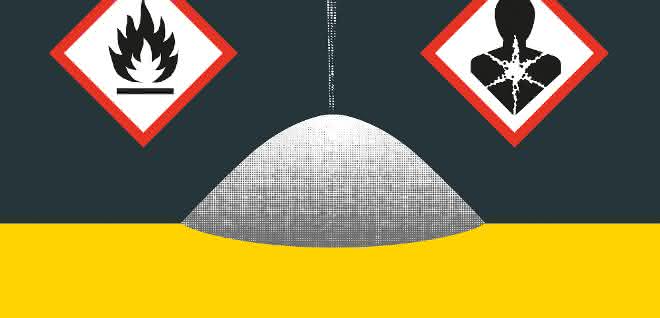
The systems for processing metal powders in additive manufacturing harbor potential hazards. The flammability, explosion risks and health hazards for the employees who fill, operate and clean them should not be underestimated. The new VDI Guideline 3405 Sheet 5.1 provides comprehensive guidance in this regard.
The operator of a technical system is always responsible for the safety of its operation. They must comply with a large number of regulations and obligations in order to ensure safety and protect the health of plant operators and all other persons at risk. The potential hazards associated with the use of metal powders are well known. Nevertheless, there are still few guidelines for the operation of additive manufacturing systems. For this reason, it is difficult for safety managers in companies to assess whether the protective measures taken are sufficient and legally compliant.
Since November 2019, a new VDI guideline has provided more clarity. It deals with the planning, production and assessment of additively manufactured components. The guideline provides guidance and legal certainty for occupational health and safety in laser powder bed fusion. Users and producers of additive manufacturing processes can find out here which rules must be observed. The final version of VDI Guideline 3405 Sheet 6.1 entitled "Safety during the operation of additive manufacturing processes" was published in November 2019. Sheet 6.2, which focuses on safety aspects for users in the additive processing of polymer powders using the laser sintering process, supplements the guideline. The documents are published by the VDI Society for Production and Logistics.
Safety when processing metal powders
Section 8.2 of the new directive deals with the safe storage of powder materials. The following measures are at the forefront of this:
Observe the prohibitions on combined storage: The directive refers to the technical regulations for hazardous substances for the restrictions on storing substances together. In addition to TRGS 509 and TRGS 510, there is a reference to the online tool www.zusammenlagerung.de. This clearly shows, based on substance classes, which substances may be stored together and which must be separated. The directive cites acetone and aluminum powder as an example of a ban on combined storage. However, even without solvents, there may be product-related requirements and restrictions for storing different metal powders together.
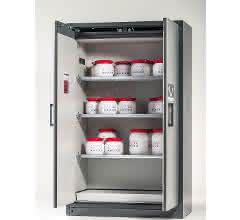
Use safety cabinets: VDI 3405 Sheet 6.1 recommends that even small quantities of metal powder should only be stored in safety storage cabinets. The guideline refers to the requirements for safety cabinets in TRGS 510. F90 type safety cabinets are recommended for storing larger quantities of metal powder, as these cabinets with a fire resistance of at least 90 minutes can be considered a storage section. When storing carcinogenic, germ cell mutagenic or reprotoxic substances - so-called CMR substances - in quantities of more than 200 kg, further specific requirements must be taken into account, for example the specifications in section 5.2 of TRGS 510.
As is customary in hazardous substances legislation, the quantity of metal powder kept in the work area should not exceed the foreseeable daily requirement.
Section 8.8 of the Directive states that the above requirements for the safe storage of metal powders apply not only to the source materials, but also to all waste containing reactive metal powders. Other parts of section 8 of the directive deal with safety during the preparation and reprocessing of powder materials, such as sieving and decanting, as well as the operation of machinery and equipment. Particular attention is paid here to cleaning processes, for example the requirements for dry vacuum cleaners and wet separators. This VDI guideline is not a legally binding document. However, the specifications in VDI 3405 sheets 6.1 and 6.2 can be regarded as the state of the art. Anyone deviating from the recommendations of the guideline must ensure at least a comparable level of safety with individual measures.
Product solution
Asecos offers the Q-Classic-90 safety storage cabinet with 90 minutes fire resistance for the storage of metal powders. In addition to the standard DIN EN 14470-1 marking, a special sticker indicates to the user that flammable and hazardous metal powders may be stored. The interior fittings with heavy-duty gratings made of galvanized sheet steel with a maximum load capacity of 180 kg each are also suitable for larger containers and ensure good ventilation in the cabinet to prevent dangerous powder deposits on the storage levels. The gratings are height-adjustable. A tamper-proof door lock is installed in each cabinet door so that only authorized employees have access. The doors can be opened with little effort and close automatically using oil-damped door closers. This guarantees that they are always securely closed in the event of a fire and that the metal powders are protected.
To prevent an explosive atmosphere inside, the enclosure has an integrated ventilation system that can be connected to a technical ventilation system. The integrated transport base enables the cabinet to be moved easily and safely during operation. With 90 minutes of fire resistance, the metal powder cabinet is also ideally suited for the storage of reactive metal powders in accordance with regulations, taking into account the requirements of the new VDI 3605.
Dr. Friedhelm Kring, freelance copywriter and Sven Sievers, Head of Product Management & Development, Asecos / am


You might also be interested in
Plagiarius 2024 negative prize
On January 26, 2024, the Plagiarius campaign awarded its dreaded "Plagiarius" negative prize for the 48th time to manufacturers and retailers of particularly brazen counterfeits and fakes.
 read more...
Ivalua honors winners of the Generative AI...
AI-supported "add-ons" for buyers within 48 hours
Ivalua, provider of cloud-based spend management solutions, announced the winners and innovations of the first Generative AI Innovation Cup. The competition took place in December 2023. It was open to all Ivalua partners and employees - more than...
read more...Efaflex celebrates 50 years of high-speed...
The emphasis is on "fast"
Since day one, Efaflex has wanted to use new technologies as early as possible and drive progress in the industry. This year, the family business is celebrating its 50th anniversary under the motto "Fast Forward".
read more...Security of supply even during power outages
In the winter of 2022, Germany was worried about energy shortages. The drugstore retailer dm did not paint any horror scenarios, but nevertheless saw the possibility of controlled, temporary, regional power cuts (brownouts).
read more...Safety technology in mechanical engineering
Modules with new functions
Euchner's product highlights at EMO 2023 include the communication-capable solenoid interlocks.
read more...Transforming the paper industry towards climate neutrality
Together with partners from industry and research, Voith is developing a project for the optimization of energy and material flows in paper production. The aim of the research project is to develop a digital framework that enables effective process...
read more...Up to 95 percent less flue gas thanks to direct extraction
The requirements for occupational safety measures and safety technology are also constantly increasing in welding technology. The Technical Rules for Hazardous Substances (TRGS) stipulate that welding fumes and harmful substances must be extracted...
read more...Competitive advantages with large machines
Whether 3D-printed components for machines and systems, prototypes or aids for design: additive manufacturing is almost indispensable for modern companies in mechanical and plant engineering and automation if they want to play in the premier league.
read more...Transport technology from the modular system
Many transport tasks can be realized with the help of linear technology. Pre-configured solutions are available to simplify the interaction between the linear unit, motor, gearbox and controller. This minimizes the effort required for research and...
read more...