
Induction hardening
Saving energy during induction hardening
Inductoheat systems equipped with an energy management system can save up to a fifth of the energy costs in the induction hardening process. This not only enables reduced amortization times. Above all, quality-determining process parameters are documented and optimized. This helps to identify problems at an early stage and avoid follow-up costs.
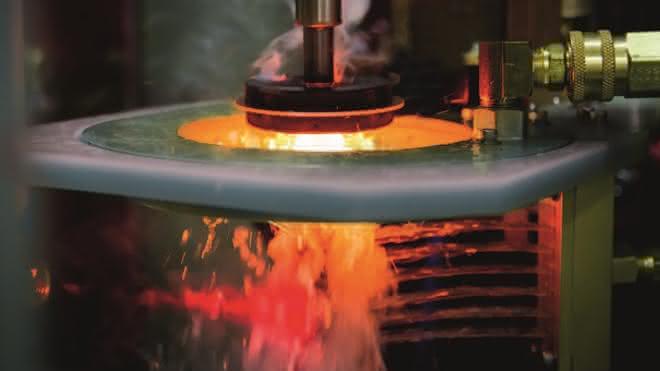
Induction hardening is used for a variety of components such as crankshafts and camshafts, transmission components, rail heads for railroad tracks or large ring bearings for wind turbines. High-frequency alternating current induces a short-circuit current in the electrically conductive component, which heats the material in the surface layer of the workpiece in just a few seconds and thus specifically changes its properties.
The subsequent cooling process with a water-polymer solution fixes the desired material structure. The process can be applied to components from a few grams up to several tons, resulting in a wide range of requirements for the design and dimensioning of the system technology, energy consumption and process times. Compared to conventional hardening processes in ovens, the process saves up to 30 percent energy, as only the functional surfaces and not the material properties of the entire component are changed.
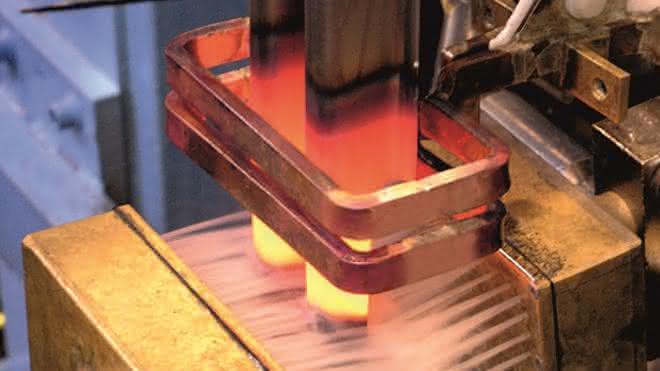
With the Emsyst software solution from Riempp, Inductoheat offers its customers additional energy-saving potential. It records and processes the data and signals already available in the system for the hardening process and the relevant machine parameters. These results can be used to specifically influence parameters and improve energy efficiency and process profitability. This is done, for example, on the feed pumps required for the cooling system. These normally run in continuous operation. Unused quenching emulsion during loading or heating processes is drained via a bypass. Although such a pump often only has a connected load of 4 kW, it consumes up to 50 percent of the total power required in continuous operation. The Emsyst evaluation showed that the use of a regulated pump, which is only connected to the mains for the actual process step of cooling, saves a lot of energy. The efficiency of the inductor, the tool that induces the high-frequency alternating current into the component, also increases if it is matched to the component geometry.
Dialog-capable system
Emsyst came into play in the context of Industry 4.0. "We wanted to make our systems more intelligent and capable of dialog with the environment," says Managing Director Frank Andrä, who was familiar with the Riempp solution from facility management. The focus was on improving the quality of the hardening process, being able to maintain the system remotely or diagnose wear preventively and provide customer-specific maintenance activities via remote maintenance. "Improving the energy balance was a second goal," says Andrä. "Emsyst serves us as a platform-independent interface that collects data via sensors, evaluates it using algorithms and thus provides new data and insights that we can use to optimize the process in a targeted manner and improve quality." The implementation runs parallel to the installation of a system, but can also be retrofitted relatively easily to existing systems. Inductotherm builds around 20 systems a year, with hardening accessories representing its core competence. The company develops and designs the system components itself.


You might also be interested in
Plagiarius 2024 negative prize
On January 26, 2024, the Plagiarius campaign awarded its dreaded "Plagiarius" negative prize for the 48th time to manufacturers and retailers of particularly brazen counterfeits and fakes.
 read more...
Ivalua honors winners of the Generative AI...
AI-supported "add-ons" for buyers within 48 hours
Ivalua, provider of cloud-based spend management solutions, announced the winners and innovations of the first Generative AI Innovation Cup. The competition took place in December 2023. It was open to all Ivalua partners and employees - more than...
read more...Efaflex celebrates 50 years of high-speed...
The emphasis is on "fast"
Since day one, Efaflex has wanted to use new technologies as early as possible and drive progress in the industry. This year, the family business is celebrating its 50th anniversary under the motto "Fast Forward".
read more...Security of supply even during power outages
In the winter of 2022, Germany was worried about energy shortages. The drugstore retailer dm did not paint any horror scenarios, but nevertheless saw the possibility of controlled, temporary, regional power cuts (brownouts).
read more...Safety technology in mechanical engineering
Modules with new functions
Euchner's product highlights at EMO 2023 include the communication-capable solenoid interlocks.
read more...Transforming the paper industry towards climate neutrality
Together with partners from industry and research, Voith is developing a project for the optimization of energy and material flows in paper production. The aim of the research project is to develop a digital framework that enables effective process...
read more...Up to 95 percent less flue gas thanks to direct extraction
The requirements for occupational safety measures and safety technology are also constantly increasing in welding technology. The Technical Rules for Hazardous Substances (TRGS) stipulate that welding fumes and harmful substances must be extracted...
read more...Competitive advantages with large machines
Whether 3D-printed components for machines and systems, prototypes or aids for design: additive manufacturing is almost indispensable for modern companies in mechanical and plant engineering and automation if they want to play in the premier league.
read more...Transport technology from the modular system
Many transport tasks can be realized with the help of linear technology. Pre-configured solutions are available to simplify the interaction between the linear unit, motor, gearbox and controller. This minimizes the effort required for research and...
read more...