
Automated grinding
Robotic grinding system from SHL improves machining processes at EVVA
Anything that takes too long must be optimized. For the Austrian company EVVA Sicherheitstechnologie, this was the processing of profile cylinders and padlocks. A customized robot grinding system from SHL provided a remedy. Since it has been in use, the throughput time has been reduced from one week to one day.
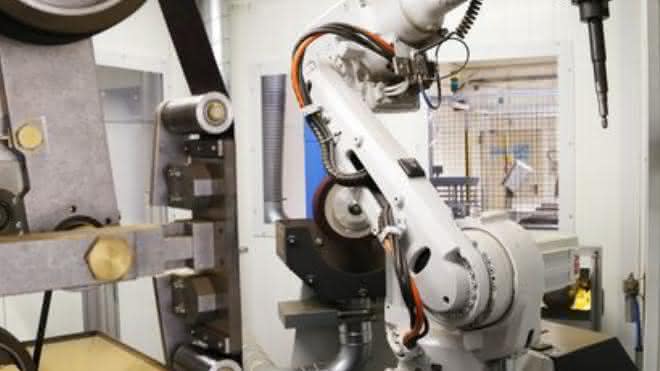
When grinding work is required in series production, not much can be done without automation: manual grinding is too expensive, but also no longer meets today's demands for precision and reproducibility. However, the exact grinding of parts made of different materials is a science in itself. This also requires the manufacturer of automated grinding machines, grinding systems and production lines for automated grinding to have specific knowledge of the grinding process, the appropriate grinding techniques and the appropriate grinding process. "The demands on quality have increased enormously," explains Rudi Reidl, Head of the Surface Technology Department at EVVA Sicherheitstechnologie. "Our locking systems must be absolutely reliable and have a flawless appearance. This means that we need very good surfaces." The grinding of profile cylinders and padlocks gave him a headache. The workpieces were processed by hand in various steps on different machines. "That took too long, and we weren't always satisfied with the surface quality," says Rudi Reidl.
The EVVA company was founded in Vienna in 1919. The first patent for a cylinder padlock followed 18 years later, and the path towards security technology was paved. Internationalization began at the end of the 1970s with the expansion of exports. Today, the company is represented by ten branches in Europe. Research and development plays an important role. It is also pushing for oil- and water-free production of its products in order to conserve resources. The security technology manufacturer employs 460 people at its headquarters in Vienna and 750 across Europe, processing around 700 tons of material every year. Two million security cylinders and 600 million individual parts are manufactured each year. EVVA delivers to over 50 countries worldwide. The strength of the Austrians lies in the combination of mechanical and electronic security know-how. Mechanical systems still account for the majority of sales, while the proportion of electronics is expected to rise to 20 percent in the medium term.
Process reliability is the top priority
As part of their research, the Viennese soon came across the automation specialist SHL in Böttingen. The Austrians had a clear idea of what the specifications should include. "High process reliability, very good workpiece surfaces and improved delivery performance. It was also important for us to keep the added value in-house," explains Reidl. The engineers from Böttingen took a close look at the processes, developed initial concepts and carried out grinding tests in Böttingen. Six months after the initial discussions, a sanding system with a six-axis industrial robot for automatically guiding profiled workpieces, including a safety environment, paternoster, sanding units and protective housing, was created. After a short briefing, the system went into operation in summer 2017.
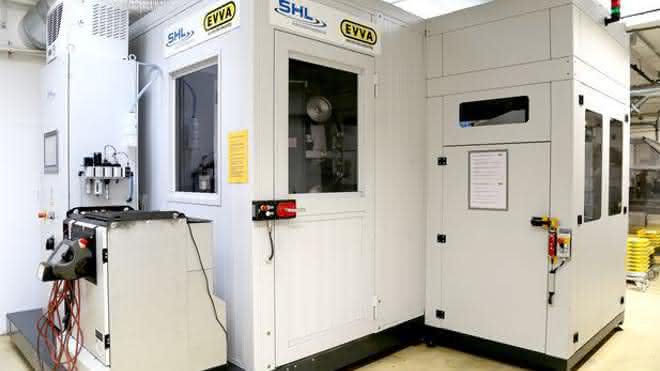
Since then, the Austrians have processed over 175,000 workpieces: First, the operator opens the loading side of the paternoster system and inserts the workpiece carriers with the blanks. He then activates the loading and the paternoster guides the first carrier to the top position. "There it is fixed in a defined position. The robot then picks up the workpiece and starts the process on the processing machines," explains SHL project manager Daniel Welte. An SHL DKS 250/450 ROB double friction belt and contact roller sanding machine first ensures perfect sanding. The brushing process takes place on an SHL P550/100 ROB sanding unit. SHL's intuitive human-machine interface with integrated database for process, machine and set-up data makes operation easy.
Processing without interruption
After processing, the robot places the workpiece on the carrier position from which it previously picked it up. Another component can be ground and brushed. Once the carrier has been processed, the system automatically pushes it to the removal side of the paternoster and feeds another one with raw parts. The operator removes the finished parts from the system and feeds carriers loaded with blanks into free spaces. In this way, loading and unloading takes place without interruption - there is no downtime.
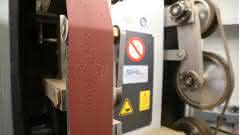
The purchase of the system has paid off for EVVA. Process reliability and delivery performance have improved. The robot grinds and brushes all sides of the padlocks and Scandinavian SKA cylinders fully automatically. "This enhances the surface of our products and refines the edges. This is a visual advantage that is becoming increasingly important and that customers are also demanding when it comes to solutions," explains Reidl.
The cycle times are between 40 and 120 seconds. In one work cycle, the system grinds and brushes 20 pallets with a total of 1,440 workpieces. Previously, this required up to five production steps. "This reduces the throughput time from one week to one day," says Reidl happily. Each part is briefly checked by an employee for final acceptance. With the SHL solution, EVVA has acquired a robot with "manners". Thanks to its robust housing, the system works particularly quietly and cleanly. Every week, around ten kilograms of brass dust are produced during grinding. However, this does not end up in the environment, but is collected by the integrated SHL extraction system and made available for recycling.
According to documents from SHL / ee


You might also be interested in
Plagiarius 2024 negative prize
On January 26, 2024, the Plagiarius campaign awarded its dreaded "Plagiarius" negative prize for the 48th time to manufacturers and retailers of particularly brazen counterfeits and fakes.
 read more...
Ivalua honors winners of the Generative AI...
AI-supported "add-ons" for buyers within 48 hours
Ivalua, provider of cloud-based spend management solutions, announced the winners and innovations of the first Generative AI Innovation Cup. The competition took place in December 2023. It was open to all Ivalua partners and employees - more than...
read more...Efaflex celebrates 50 years of high-speed...
The emphasis is on "fast"
Since day one, Efaflex has wanted to use new technologies as early as possible and drive progress in the industry. This year, the family business is celebrating its 50th anniversary under the motto "Fast Forward".
read more...Security of supply even during power outages
In the winter of 2022, Germany was worried about energy shortages. The drugstore retailer dm did not paint any horror scenarios, but nevertheless saw the possibility of controlled, temporary, regional power cuts (brownouts).
read more...Safety technology in mechanical engineering
Modules with new functions
Euchner's product highlights at EMO 2023 include the communication-capable solenoid interlocks.
read more...Transforming the paper industry towards climate neutrality
Together with partners from industry and research, Voith is developing a project for the optimization of energy and material flows in paper production. The aim of the research project is to develop a digital framework that enables effective process...
read more...Up to 95 percent less flue gas thanks to direct extraction
The requirements for occupational safety measures and safety technology are also constantly increasing in welding technology. The Technical Rules for Hazardous Substances (TRGS) stipulate that welding fumes and harmful substances must be extracted...
read more...Competitive advantages with large machines
Whether 3D-printed components for machines and systems, prototypes or aids for design: additive manufacturing is almost indispensable for modern companies in mechanical and plant engineering and automation if they want to play in the premier league.
read more...Transport technology from the modular system
Many transport tasks can be realized with the help of linear technology. Pre-configured solutions are available to simplify the interaction between the linear unit, motor, gearbox and controller. This minimizes the effort required for research and...
read more...