
Machining centers with rotary table
Three axes and a turntable
For the production of special tools, Jongen uses 3-axis machining centers in combination with a 2-axis rotary table from pL Lehmann. In this way, 5-axis machining is possible and at the same time the company remains flexible in the production of even the most demanding tools.

The precision tool manufacturer Jongen from Willich produces high-quality milling tools. The company's flexibility and short delivery times are aided by three-axis machining centers, which - supplemented by a two-axis CNC rotary table from pL Lehmann - are capable of five-axis simultaneous machining. Günter Hofmann, Head of Design, sees the innovative strength, flexibility and customer proximity of his company as the driving force behind the company's growth in the global competitive environment with milling and drilling tools "Made in Germany": "With around 350 employees, we may not be one of the big players in the tool industry, but we are very close to our customers in Germany and the major European countries. This is because our sales representatives are technically qualified and know what tool solutions need to look like to ensure high productivity in machining. On the one hand, they can draw on our wide-ranging standard program and, on the other, offer special tools that are tailored to the respective application."
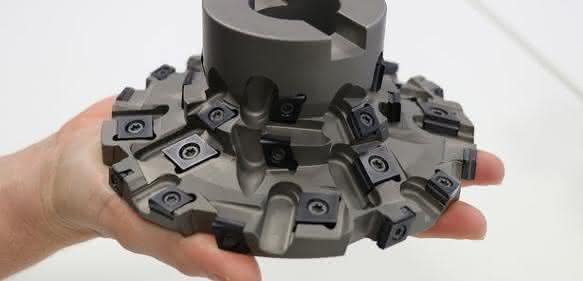
Special tools can be simple tools in special diameters or lengths. The supreme discipline, however, are complex form milling cutters and boring tools as well as multi-stage carrier tools that are fitted with carbide indexable inserts. "With special tools, we can provide the customer with an ideal tool for increasing productivity," says Hofmann, who is also a member of the management team. The company has its own production department. A special machine park is also available for special production. "We pay attention to great flexibility and sufficient free capacity so that we can deliver many tools within two or three weeks," promises the design manager.
3 + 2: flexible five-axis milling
André Gooßens, Head of the Prototypes and Special Tools department, is convinced that indexable insert carrier tools require 5-axis machining: "We mill stepped tools, multi-tooth cutters or solid drills in five axes - almost always simultaneously. Otherwise, the installation positions for the indexable inserts and free milling cannot be created optimally." For years, three-axis drilling and milling centers, supplemented by a two-axis CNC rotary table, have proven to be ideal for prototype and small series production. Jongen obtains these additional fourth and fifth axes from the Swiss manufacturer pL Lehmann. "After we were initially unhappy with another brand, we equipped the next generation of machines with Lehmann models from the 400 series. These were more reliable and clearly superior to competitor products in terms of accuracy and clamping forces," Hofmann concludes.
Rising demand, growing machine park
In recent years, the production volume of special tools has increased significantly and the company has continuously expanded its machine park - in 2015, it added two DMG Mori DMC1150 machining centers, which are equipped with two-axis, single-spindle CNC rotary tables from Lehmann. Gooßens says: "This combination gives us greater flexibility than pure five-axis centers."
Another advantage of this 3+2 solution lies in the masses to be moved. While a 5-axis machine has to accelerate and decelerate the entire machine table including the workpiece, only the rotary axes move with the workpiece in a mounted single-axis or two-axis system. The workpiece is also easier to access. If it is clamped on a mounted rotary table, the interfering edges are lower, which means that short, low-vibration tools can be used.
There was no question for Gooßens and his team that the additional axes would once again come from Lehmann: "The important thing is the quality, and these axes are perfect in terms of precision, stability and repeat accuracy."
After expert advice from pL Lehmann and the German agency representative IVO Oesterle, those responsible opted for the T1-520520.RR varioX edition 2 rotary table. With its high load capacity and center height of 300 mm, it is suitable for tool diameters of up to 350 mm. "We can cover a wide range with these machines, which is important for us. Because we also use them for small tools with a diameter of just 10 mm," adds Gooßens.
Flexible combination
The machining spectrum and the space required for the rotary table made it necessary to choose a relatively large machine as the basis - the DMC 1150V. The vertical machining center with a load capacity of up to 1,500 kg offers a y-travel of up to 700 mm. The maximum travel in the x-axis is 1,150 mm and 550 mm in the z-axis. This leaves enough space on the machine table for an additional clamping device in addition to the rotary axes. Gooßens explains: "Some basic tool bodies require certain preparatory work before they are clamped on the Lehmann axis. This allows us to insert clamping surfaces, grooves or central bores on the same machine."
In terms of quality, the machining center meets all requirements. This is ensured by the stable design with fixed table and overhead x-slide as well as direct path measuring systems and the cooling of the guides and ball screw nuts. "The coordination with DMG Mori regarding the additional equipment also went smoothly. The machine was delivered to us turnkey with the Lehmann axes."
After more than two years, Gooßens' experience with the new rotary tables has been consistently positive: "Compared to previous versions, the rotary tables of the 500 series have considerably higher clamping torques, significantly higher speeds and repeat accuracies. This gives us qualitative and economic advantages in machining." He also finds the integrated black box helpful. During operation, it automatically records and collects important key figures that provide information about the condition of the rotary table. On request, the customer receives a status report and recommendations for preventive maintenance. "If a problem occurs, we can send the relevant data directly to Lehmann. We receive quick and uncomplicated help from there." In general, Jongen is very satisfied with the service. When a minor problem arose with one of the new rotary tables, Lehmann was quickly on the spot and the machine was back in operation as usual within 48 hours. am
GrindTec, Hall P, Stand 9102


You might also be interested in
Further simplify assembly processes
In addition to the proven racks with a length of one meter, Wittenstein alpha now offers optional two-meter racks for linear systems. They are particularly suitable for use in short axes, for example, in order to simplify assembly even further.
 read more...
Hiwin manufactures its own shaft gearboxes
Have you ever waited several months for an urgently needed corrugated gearbox? Hiwin has too. That's why the Offenburg-based drive specialist has decided to produce its own space and weight-saving reduction talent.
read more...Human-robot interaction at the trade fair
Sumitomo Drive Technologies is presenting its drive solutions for automation and robotics at Automatica 2023 together with the Lafert Group. The company will be showcasing two different applications of the Tuaka drive system for robot applications...
read more...Partial automation with robots
At Automatica, Promess will be showcasing its modular individual workstations and how these can be partially automated with robot support. The servo press manufacturer will also be providing information about the latest features of its Revolution X...
read more...A new benchmark for collaborative robots
At this year's Automatica, Denso Robotics will be showcasing its innovations in the field of robotics. The collaborative Cobotta Pro product family will be the focus of the presentations. Visitors to the trade fair can see all variants in various...
read more...Clamping system for a new milling machine
Investments in machinery often lead to further purchases - as is the case at Joma-Maschinenbau, whose modern production facility has recently been supplemented by a 5-axis milling machine.
read more...Schunk wants to simplify processes in automated production
The declared aim of automation specialist Schunk is to make its customers' processes comprehensible, simple and efficient. Data transparency plays an important role in this. It enables reliable processes and provides the basis for resource-saving...
read more...Festo and Hahn Automation develop battery tester for greater safety
The success and reputation of electric vehicle manufacturers depend on the safe and flawless functioning of batteries. Hahn Automation has therefore developed a battery tester that performs a fully automated 100% test of mobile energy storage...
read more...SPN Schwaben Präzision presents gearbox solutions for automation and industrial robotics
Short cycle times, robust technology, wear-free surfaces and compact designs have always been relevant for automation and robotics solutions. This year's Automatica trend topics include "Sustainable production" and "Digitalization and AI". SPN aims...
read more...