

Digitized material data room
Digital twin for materials
Production systems can only be optimized during operation if all process parameters are taken into account. Therefore, the changes in the materials must also be measured, analyzed and mapped.
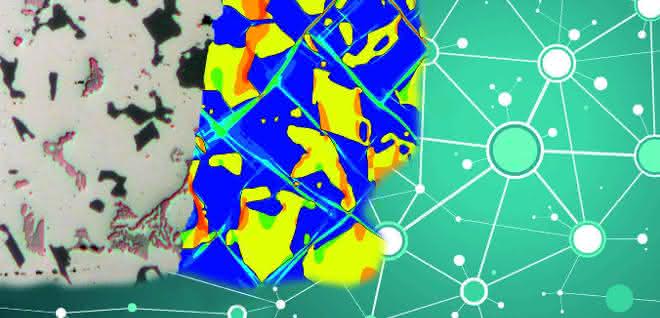
Even the smallest fluctuations in production are enough to change the material properties of workpieces and therefore also the component quality and function. To prevent this, samples are repeatedly taken and examined during production. However, such a sample component has to be disassembled into individual parts and measured for tests, which takes a lot of time.
Researchers at the Fraunhofer Institute for Mechanics of Materials IWM tackled this problem and have now demonstrated the feasibility of digitally mapping many such material histories for the first time: they developed a sample material data space for additively manufactured test specimens and have thus created a basis for the digital material twin. "With the data room concept, we can integrate material information of any kind into digital networks - which is important with regard to Industry 4.0, among other things," explains Dr. Christoph Schweizer, Head of the Materials Evaluation, Lifetime Concepts business unit at Fraunhofer IWM in Freiburg. "From the material data space, we want to automatically generate a digital twin for each material that describes the current state of the material object under consideration."
The material data room offers the advantage that all relevant parameters are available at a glance; previously, the information on various material parameters was usually scattered across numerous data repositories and in different data formats, making a quick comparison impossible. "The material data room could become the production brain of the coming years. Whenever the component quality is not as desired, you could compare it in the material data room with components from the past and find out whether the current one can still be used or has to be discarded," says Schweizer.
Material ontologies as a basis
In order to create the material data space and manage the heterogeneous material data, a suitable information model is required. "This model mirrors the natural world of materials, in which the material states and properties are divided into specific categories," explains Dr. Adham Hashibon, a scientist in the Manufacturing Processes business unit. The researchers rely on ontologies - i.e. a logical, hierarchical structure. The researchers explain the principle using Facebook as an example: In the network, individual people represent nodes that have links to their preferences, for example their taste in music. "We create semantic links between the individual material objects and the associated processing operations," explains Hashibon. The relationships between them, i.e. friendships on Facebook, are information on the chronological sequence of production or work steps in the material data space, such as "comes out of the additive manufacturing process" or "this laser takes part in the 3D printing process".
The aforementioned demonstrator for additively manufactured metal covers sample production, material characterization and the subsequent data analysis and determination of material properties. Due to the logic of the underlying structural model, very complex queries can be made to the data space that would not be possible with this level of flexibility using conventional databases.
With its work on the digitized materials data room, the Fraunhofer IWM is contributing to European materials modeling topics within the framework of the European Materials Modelling Council and to Baden-Württemberg's digitization strategy. In the medium term, it is planned to convert the entire data management at the Fraunhofer IWM to the data room system. Cooperation partners and pilot users who can help shape the developments are welcome for this and other applications.
According to documents from the Fraunhofer IWM / ag


You might also be interested in
Plagiarius 2024 negative prize
On January 26, 2024, the Plagiarius campaign awarded its dreaded "Plagiarius" negative prize for the 48th time to manufacturers and retailers of particularly brazen counterfeits and fakes.
 read more...
Ivalua honors winners of the Generative AI...
AI-supported "add-ons" for buyers within 48 hours
Ivalua, provider of cloud-based spend management solutions, announced the winners and innovations of the first Generative AI Innovation Cup. The competition took place in December 2023. It was open to all Ivalua partners and employees - more than...
read more...Efaflex celebrates 50 years of high-speed...
The emphasis is on "fast"
Since day one, Efaflex has wanted to use new technologies as early as possible and drive progress in the industry. This year, the family business is celebrating its 50th anniversary under the motto "Fast Forward".
read more...Security of supply even during power outages
In the winter of 2022, Germany was worried about energy shortages. The drugstore retailer dm did not paint any horror scenarios, but nevertheless saw the possibility of controlled, temporary, regional power cuts (brownouts).
read more...Safety technology in mechanical engineering
Modules with new functions
Euchner's product highlights at EMO 2023 include the communication-capable solenoid interlocks.
read more...Transforming the paper industry towards climate neutrality
Together with partners from industry and research, Voith is developing a project for the optimization of energy and material flows in paper production. The aim of the research project is to develop a digital framework that enables effective process...
read more...Up to 95 percent less flue gas thanks to direct extraction
The requirements for occupational safety measures and safety technology are also constantly increasing in welding technology. The Technical Rules for Hazardous Substances (TRGS) stipulate that welding fumes and harmful substances must be extracted...
read more...Competitive advantages with large machines
Whether 3D-printed components for machines and systems, prototypes or aids for design: additive manufacturing is almost indispensable for modern companies in mechanical and plant engineering and automation if they want to play in the premier league.
read more...Transport technology from the modular system
Many transport tasks can be realized with the help of linear technology. Pre-configured solutions are available to simplify the interaction between the linear unit, motor, gearbox and controller. This minimizes the effort required for research and...
read more...